


Hey there! I'm a supplier of Schneider PLCs, and I've been in this game for quite a while. One question I get asked a lot is, "How do I select the appropriate CPU module for Schneider PLC?" Well, you've come to the right place! In this blog, I'll walk you through the key factors to consider when picking the right CPU module for your Schneider PLC.
Understanding Your Application Requirements
First things first, you gotta understand what your application needs. Are you working on a small - scale project, like controlling a single machine? Or is it a large - scale industrial automation system that requires handling multiple processes simultaneously?
For small projects, a CPU with lower processing power might be enough. It'll save you some bucks and still get the job done. On the other hand, large - scale applications demand high - performance CPUs that can handle complex algorithms and a large number of I/O points.
Think about the type of tasks your PLC will perform. If it's mainly for simple on - off control, you won't need a super - advanced CPU. But if you're dealing with things like motion control, PID loops, or data logging, you'll need a more powerful one.
Processing Power
The processing power of a CPU module is a crucial factor. It's usually measured in terms of the CPU's clock speed and the number of instructions it can execute per second. A higher clock speed generally means the CPU can process data faster.
For example, if you have a process that requires real - time data processing, like monitoring and adjusting the temperature in a chemical reactor, you'll need a CPU with a high clock speed. This ensures that the PLC can quickly respond to changes in the process variables.
Another aspect of processing power is the memory capacity. The CPU needs enough memory to store the program code, data, and intermediate results. If your application has a large program or generates a lot of data, you'll need a CPU with sufficient memory.
I/O Requirements
The number and type of I/O (Input/Output) points your application needs play a big role in CPU selection. You need to figure out how many digital inputs and outputs (like sensors and relays) and analog inputs and outputs (such as temperature sensors and variable speed drives) your system requires.
Schneider offers a wide range of I/O modules to work with their PLCs. For instance, the Schneider Electric TM3TI4 Analog Input Module is a great option for applications that need to measure analog signals. Make sure the CPU you choose can support the number and type of I/O modules you plan to use.
Also, consider the expansion capabilities. If you think your project might grow in the future and you'll need to add more I/O points, choose a CPU that allows for easy expansion.
Communication Requirements
In today's connected world, communication is key. Your PLC might need to communicate with other devices, such as HMIs (Human - Machine Interfaces), other PLCs, or a central control system.
Schneider PLCs support various communication protocols, like Modbus, Profibus, Ethernet/IP, etc. Think about which protocols your application requires. For example, if you're integrating your PLC with a SCADA (Supervisory Control and Data Acquisition) system that uses Ethernet/IP, you'll need a CPU module that supports this protocol.
The Schneider VW3A3627 Communication Module is a popular choice for enabling communication in Schneider PLC systems. It can help your PLC connect to different devices and networks easily.
Cost - Effectiveness
Let's face it, cost matters. You don't want to over - spend on a CPU module that has more features than you actually need. But at the same time, you don't want to go too cheap and end up with a CPU that can't handle your application properly.
Compare the prices of different CPU models based on their features and performance. Sometimes, a slightly more expensive CPU might offer better long - term value because it can handle future expansions and upgrades more easily.

Compatibility and Support
Make sure the CPU module you choose is compatible with other components of your Schneider PLC system, such as I/O modules, power supplies, and communication modules. Schneider has a vast range of products, and they're generally designed to work well together, but it's still important to double - check.
Also, consider the support available. Schneider is a well - known brand with a good reputation for providing technical support. You want to be able to get help quickly if you run into any issues with your CPU module.
A Real - World Example
Let me give you an example. Suppose you're working on a food processing plant. You need to control the temperature, pressure, and flow rate of different processes. You also need to communicate with a central control room to monitor and adjust the operations.
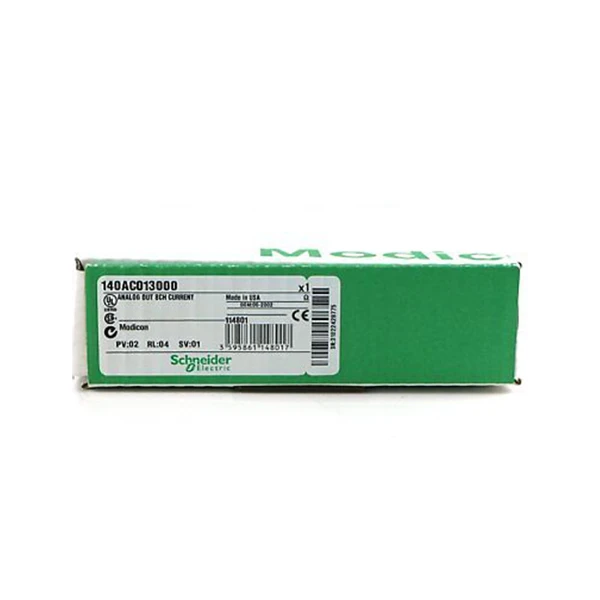
For this kind of application, you might consider the Schneider 140ACO13000. It has a high processing power, which is great for handling the complex control algorithms required for temperature, pressure, and flow control. It also supports multiple communication protocols, so you can easily connect it to the central control room.
Conclusion
Selecting the appropriate CPU module for your Schneider PLC is not a one - size - fits - all process. You need to carefully consider your application requirements, processing power, I/O needs, communication requirements, cost - effectiveness, and compatibility.
If you're still not sure which CPU module is right for your project, don't hesitate to reach out. As a Schneider PLC supplier, I'm here to help you make the best choice. Whether you have a small - scale project or a large - scale industrial automation system, I can provide you with the right advice and products.
So, if you're looking to start a new project or upgrade your existing PLC system, let's have a chat. We can discuss your specific needs and find the perfect CPU module for you.
References
- Schneider Electric official product documentation
- Industrial automation textbooks on PLC systems


