


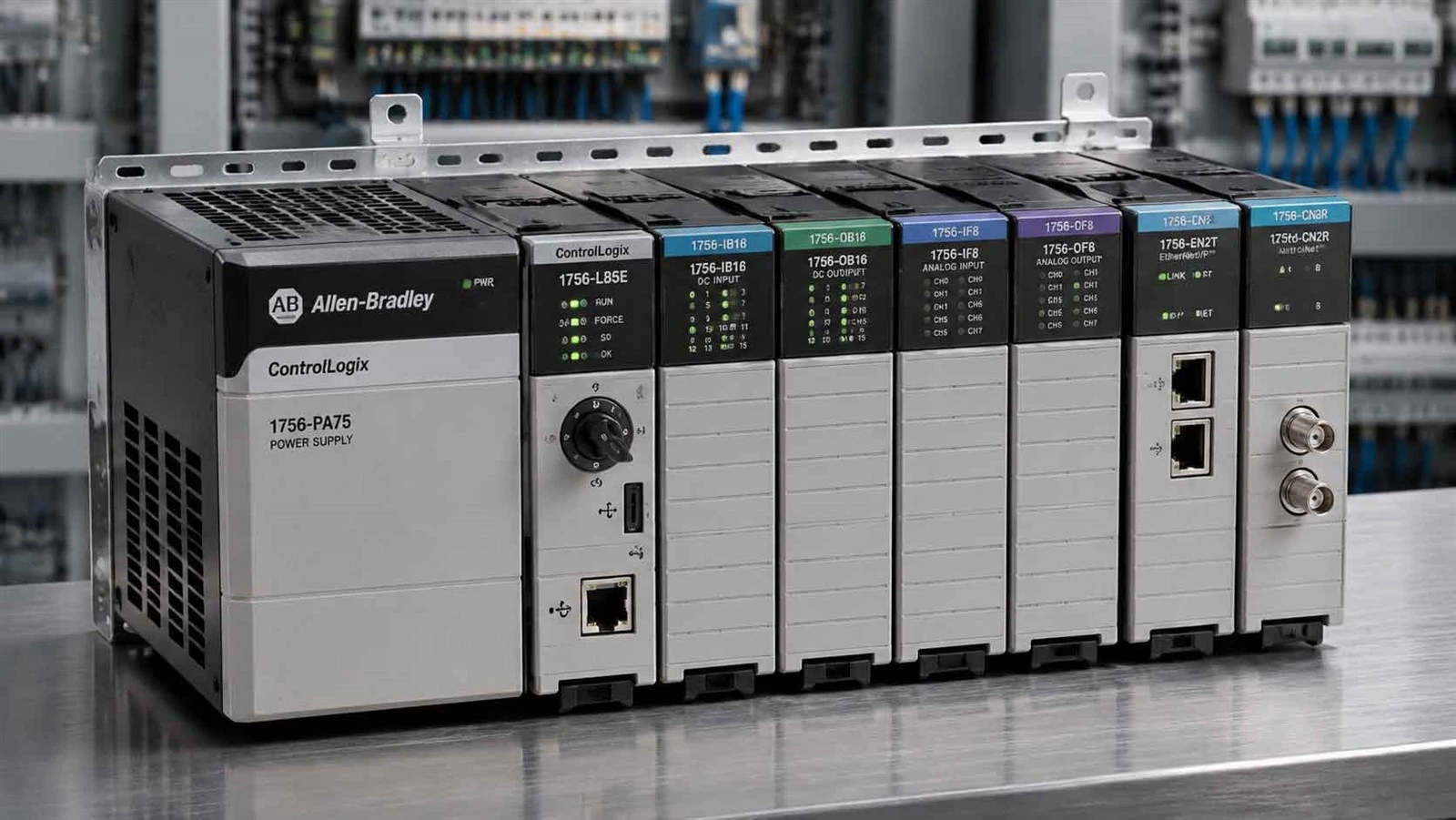
Selecting an Allen-Bradley ControlLogix PLC involves more than comparing processor specifications. The controller must support the application's performance requirements, communicate with existing equipment, and operate within a compatible hardware and software environment. Overlooking these requirements can increase engineering costs, delay commissioning, or extend production downtime.
For engineers designing new automation systems, the challenge is finding a platform with sufficient capacity for current and future requirements. For maintenance teams, the priority is often restoring an existing system without unnecessary hardware changes. This guide explains how to evaluate ControlLogix controller generations, verify system compatibility, configure essential hardware, and make informed decisions when purchasing replacement components.
Start with Your Application: Do You Really Need ControlLogix?
What Is an Allen-Bradley ControlLogix PLC?
ControlLogix is a programmable automation controller (PAC) platform developed by Rockwell Automation under the Allen-Bradley brand. Its modular architecture allows engineers to configure controllers, I/O modules, communication modules, and power supplies around a 1756 chassis.
Unlike more compact PLC platforms, ControlLogix provides extensive configuration options for applications that require complex control, distributed equipment, and substantial system expansion.
When ControlLogix Is the Right Choice
ControlLogix is particularly worth considering when an application involves several interconnected production areas or demanding control requirements.
Typical selection criteria include:
- Multiple production processes requiring coordinated control.
- Extensive local and distributed I/O infrastructure.
- Complex communication with drives, HMIs, and supervisory systems.
- High availability requirements that justify a supported redundancy architecture.
- Future expansion beyond the capacity of smaller controllers.
These conditions are more useful selection indicators than industry classifications alone. A small process facility may have demanding control requirements, while a large factory may operate effectively using several independent controllers.
When CompactLogix May Be a Better Option
Not every automation project requires a ControlLogix system. CompactLogix can be a practical alternative for independent machines, smaller production lines, and applications with limited installation space.
|
Selection Factor |
ControlLogix |
CompactLogix |
|
Application scope |
Complex and distributed systems |
Individual machines and production cells |
|
Hardware architecture |
Modular chassis |
Compact modular configuration |
|
Expansion |
Extensive configuration options |
Model dependent expansion |
|
Controller redundancy |
Supported configurations available |
Generally lacks native controller redundancy |
|
Initial investment |
Typically higher |
Often lower for simpler applications |
If CompactLogix meets the processing, communication, and expansion requirements, selecting ControlLogix may introduce unnecessary hardware costs.
For a broader comparison of available platforms, read our Allen-Bradley PLC families guide.
Which ControlLogix Controller Generation Should You Choose?
The appropriate ControlLogix controller depends on whether the project involves maintaining existing equipment, expanding an installed system, or developing a new control architecture.
ControlLogix 5560: Maintaining Legacy Systems
The ControlLogix 5560 generation includes processors such as the 1756-L61, 1756-L62, and 1756-L63. These controllers remain relevant to maintenance teams responsible for older production equipment.
For facilities operating legacy systems, sourcing a matching processor may require fewer engineering changes than migrating to another generation. However, discontinued products introduce additional sourcing and lifecycle considerations.
The 1756-L62 ControlLogix controller, for example, provides 4 MB of memory and was discontinued by Rockwell Automation in June 2017.
ControlLogix 5570: Installed Systems and Spare Part Planning
The ControlLogix 5570 generation includes the 1756-L71, 1756-L72, 1756-L73, and other L7 processors.
These controllers remain important when maintaining installed automation systems. Selection within this generation depends on memory capacity, application requirements, existing communication modules, and software compatibility.
When planning spare parts, maintenance teams should document the exact controller catalog number and current firmware requirements rather than purchasing another L7 model solely because it belongs to the same generation.
ControlLogix 5580: Performance and System Modernization
The ControlLogix 5580 generation offers embedded Ethernet connectivity and controller options suitable for demanding industrial applications.
Representative models include the 1756-L81E with 3 MB of user memory and the 1756-L83E with 10 MB. These processors can be considered when expanding control applications, increasing network capacity, or modernizing earlier ControlLogix installations.
However, upgrading to a 5580 controller requires more than comparing memory specifications. Engineers must also evaluate project conversion, network configuration, and compatibility with installed modules.
ControlLogix 5590: Evaluating the Newer Generation
ControlLogix 5590 introduces additional processing and memory options for modern industrial control architectures.
According to Rockwell Automation's technical specifications, standard controller models range from the 1756-L902TS with 2 MB of standard memory to the 1756-L980TS with 80 MB.
This generation deserves consideration when planning new systems or substantial modernization projects. Nevertheless, its expanded capabilities do not automatically make it a direct replacement for every existing ControlLogix processor.
ControlLogix Controller Generation Comparison
|
Generation |
Example Model |
Example Memory |
Communication Considerations |
Typical Selection Direction |
|
5560 |
1756-L62 |
4 MB |
Serial interface and separate network modules |
Legacy maintenance |
|
5570 |
1756-L71 |
2 MB |
Separate industrial network modules |
Installed systems and spares |
|
5580 |
1756-L81E |
3 MB |
Embedded Gigabit Ethernet |
Modernization and new applications |
|
5590 |
1756-L915TS |
15 MB standard |
Embedded Ethernet with configuration requirements |
New projects and modernization |
The memory values above apply to the specific example models rather than their entire controller generations. Software requirements and product lifecycle status should be checked individually before ordering.
For additional information on processor specifications, catalog numbers, and sourcing considerations, see our Allen-Bradley ControlLogix processor selection and buying guide.
Five Technical Factors That Determine the Right ControlLogix PLC
Processing Performance and User Memory
Controller memory determines how much application logic and data can be accommodated, while processing performance affects how efficiently control tasks are executed.
Evaluate program size, task execution requirements, motion control demands, and anticipated expansion. A controller with greater memory is not necessarily the best choice if its other characteristics do not satisfy the application.
Local and Remote I/O Requirements
Calculate the number and types of field signals before selecting hardware. Distinguish between I/O points, physical modules, remote stations, and network connections.
Applications with numerous distributed devices also require consideration of communication capacity and Requested Packet Interval (RPI) settings. Faster data updates can increase communication demands, even when the physical I/O count remains unchanged.
Industrial Network and Communication Requirements
Determine which networks the controller must communicate with. EtherNet/IP is widely used in Logix systems, while existing installations may still depend on ControlNet, DeviceNet, Data Highway Plus, or traditional Remote I/O.
Some connections require dedicated communication modules. Verify whether the proposed controller supports the required network architecture before replacing existing hardware.
Redundancy and System Availability
Controller redundancy may be appropriate for continuous processes where an unexpected controller failure would cause significant operational disruption.
However, controller redundancy, redundant power supplies, network redundancy, and functional safety serve different purposes. Each requires a suitable system architecture.
Verify the supported controller models, redundancy modules, communication components, and firmware combinations before specifying a redundant system.
Expansion, Installation Space and Long-Term Cost
Evaluate the available chassis slots, power supply capacity, cabinet space, and future module requirements.
The controller price represents only part of the system investment. Additional costs may include communication hardware, software, engineering, spare parts, and maintenance. Comparing complete system configurations provides a more meaningful purchasing decision than comparing CPU prices alone.
How to Check ControlLogix Hardware and Firmware Compatibility
Compatibility verification is particularly important when purchasing replacement components for an installed automation system. A processor may belong to the correct product family while still requiring changes to firmware, software, or associated hardware.
Verify the Catalog Number and Hardware Series
Begin with the complete catalog number shown on the product label. A partial reference such as 1756-L7 does not identify a specific controller.
Record the full model number, including any suffix, together with the hardware Series and other relevant identification details.
Hardware Series, firmware revision, and serial number represent different information. Providing a clear photograph of the original module label helps reduce identification errors during procurement.
Match the Firmware and Programming Software Versions
ControlLogix firmware compatibility must be evaluated against the engineering software and existing project requirements.
Older installations may use RSLogix 5000, while newer systems generally use Studio 5000 Logix Designer. The appropriate software version depends on the controller and firmware involved.
Module Electronic Keying requirements may also affect whether configured devices are accepted by the system. Do not assume that newer firmware will automatically operate with an existing project.
Check Chassis, Power Supply and I/O Module Compatibility
Review the existing chassis catalog number and Series, available power supply capacity, communication modules, and installed I/O hardware.
The 1756 prefix identifies a product family, but it does not guarantee that every component can be used with every ControlLogix generation or configuration.
Create a record of the installed hardware and compare it with the requirements of the proposed replacement controller.
Use Rockwell Automation Compatibility Tools Before Ordering
The Rockwell Automation Product Compatibility and Download Center (PCDC) provides access to product compatibility information, firmware downloads, and release notes.
A practical verification sequence is:
- Identify the exact controller catalog number and hardware Series.
- Confirm the installed firmware and engineering software versions.
- Review the chassis, power supply, I/O, and communication configuration.
- Compare the products using official compatibility information and technical documentation.
- Resolve any identified differences before approving the purchase.
PCDC supports compatibility research, but complete system suitability must still be confirmed through engineering review.
Build the Right ControlLogix Hardware Configuration
Controller, Chassis and Power Supply
The controller executes the application logic, while the chassis provides the physical mounting and backplane connections for system modules.
A suitable power supply must support the installed configuration. Products such as the Allen-Bradley 1756-PA72 power supply represent one option within the 1756 product range, subject to the system's electrical and compatibility requirements.
Digital, Analog and Remote I/O Modules
Digital modules handle discrete signals such as switch states and equipment commands. Analog modules process continuously varying measurements, including pressure, temperature, and flow.
Both signal types may be accommodated through local or distributed I/O architectures. Check signal ranges, channel counts, input and output requirements, and connection accessories when selecting Allen-Bradley PLC modules.
Communication Modules and Wiring Accessories
Communication modules connect controllers to industrial networks and existing equipment. For legacy applications, products such as the 1756-DHRIO communication module may be relevant when maintaining Data Highway Plus or traditional Remote I/O connections.
Wiring accessories, including the 1756-TBCH removable terminal block, should also be checked against the selected I/O module requirements.
These products illustrate different hardware categories rather than a universally compatible system configuration.
A Basic ControlLogix Bill of Materials Checklist
Use the following BOM checklist when preparing hardware requirements for a new installation or expansion.
|
Component |
Purchasing Consideration |
|
Controller |
Catalog number and application capacity |
|
Chassis |
Number of slots and supported Series |
|
Power supply |
Input voltage and power budget |
|
Digital I/O modules |
Signal direction and voltage |
|
Analog I/O modules |
Signal ranges and channel count |
|
Communication modules |
Network and device requirements |
|
Terminal blocks |
Module specific connection requirements |
|
Remote I/O adapters |
Distributed I/O configuration |
|
Redundancy components |
Required only for supported architectures |
|
Software and firmware |
Version and licensing requirements |
Record the required quantity and verified compatibility status for each applicable item. A complete BOM helps prevent overlooked accessories and unexpected purchasing requirements during installation.
Replacing or Upgrading an Existing ControlLogix PLC
Same-Model Replacement vs. Controller Upgrade
Replacing a failed processor and modernizing an automation system are different engineering decisions.
|
Replacement Strategy |
Suitable Situation |
Main Verification Requirement |
|
Same model replacement |
Restoring an existing system |
Exact model, Series, firmware, and project |
|
Compatible replacement |
Original model is difficult to source |
Documented compatibility and replacement approval |
|
Controller upgrade |
System modernization or expansion |
Software migration, hardware review, and testing |
A newer controller may offer greater capacity, but migration can introduce additional engineering work. For urgent maintenance, a verified matching spare may be more practical when the existing architecture must remain unchanged.
What to Do When a ControlLogix Model Is Discontinued
A discontinued PLC is not necessarily unavailable through every supply channel. Unused older inventory, used components, and refurbished products may still be available.
Maintenance teams should distinguish between immediate equipment recovery and long-term system planning. Purchasing a discontinued controller may support short-term operational requirements, while a planned migration can reduce future dependence on aging hardware.
Check the product's official lifecycle status and evaluate the condition and availability of any proposed replacement.
How to Avoid Ordering the Wrong Replacement Module
Before purchasing replacement hardware, obtain the complete catalog number, hardware Series, applicable firmware requirements, and a clear photograph of the original product label.
Any alternative model should have documented technical justification and approval from the responsible engineering team.
Actual replacement should include appropriate project backups, engineering validation, and a controlled maintenance procedure.
If you are sourcing a replacement ControlLogix processor or module, contact CHENTUO to check part availability using your existing product identification details.
Practical ControlLogix Selection Examples
The following illustrative examples demonstrate how different application requirements influence controller selection and replacement decisions.
Example 1: Multi-Area Water Treatment System
Consider a water treatment facility with several pumping stations, flow measurements, level monitoring, and distributed I/O equipment.
ControlLogix may be appropriate when multiple treatment areas require coordinated operation and extensive data exchange. Engineers should evaluate network capacity, process control tasks, and availability requirements before choosing a controller.
The decision should reflect the complexity of the control architecture rather than the water treatment application alone.
Example 2: Packaging Line Expansion
A packaging line plans to add conveyors, drives, inspection equipment, and an additional operator interface.
If the existing controller has sufficient processing and communication capacity, retaining it may be the most economical option. CompactLogix could suit a separate production cell, while ControlLogix may deserve consideration when extensive coordination and expansion are required.
Review the anticipated application workload before committing to a platform upgrade.
Example 3: Replacing a Legacy 1756-L62 Controller
Suppose an older production line experiences a 1756-L62 controller failure.
The maintenance team should identify the original hardware Series, confirm firmware requirements, and locate the existing project backup before ordering a replacement.
A matching controller may help restore the original system with fewer configuration changes. If suitable hardware cannot be sourced, an engineered migration should be evaluated rather than installing an unverified newer processor.
What to Check Before Buying an Allen-Bradley ControlLogix PLC
Product Condition and Traceability
Distinguish between new products, unused older inventory, used hardware, and refurbished components when comparing quotations.
Request actual product photographs, identification details, available test documentation, and information about the product's condition. Packaging and appearance alone are not sufficient evidence of authenticity or operational performance.
Availability, Lead Time and Warranty
Confirm the available quantity, expected delivery schedule, warranty coverage, and return conditions before placing an order.
Availability may vary significantly for older ControlLogix processors and communication modules. For additional purchasing considerations, see our Allen-Bradley PLC buying guide.
Information to Include in Your RFQ
Providing clear purchasing requirements allows a supplier to identify the requested products and prepare a more relevant quotation.
|
RFQ Information |
Details to Provide |
|
Manufacturer |
Allen-Bradley |
|
Catalog number |
Complete part number |
|
Hardware Series |
Where required |
|
Firmware revision |
Existing system requirements |
|
Quantity |
Number of units |
|
Product condition |
Acceptable condition |
|
Delivery requirements |
Destination and required date |
|
Additional information |
Product label and relevant configuration details |
For projects without finalized catalog numbers, provide the application requirements and available system specifications for further discussion.
FAQ

What is the difference between ControlLogix 5570, 5580 and 5590 controllers?
Is ControlLogix better than CompactLogix for process control?
Can I replace a 1756-L62 controller with a newer ControlLogix processor?
How do I check ControlLogix firmware compatibility?
Are all Allen-Bradley 1756 modules interchangeable?
Which ControlLogix controllers support redundancy?
Conclusion: Choose the Right Controller Before You Order
The right Allen-Bradley ControlLogix PLC is the controller that satisfies your application requirements, integrates with the intended hardware configuration, and supports your maintenance strategy.
For new installations, begin with system specifications and a complete BOM. For existing equipment, prioritize accurate product identification and compatibility verification before considering alternative models.
CHENTUO supplies industrial automation components, including PLC controllers, power supplies, I/O modules, and communication modules.
Browse our Allen-Bradley PLC product range or request a quotation with your required part numbers, quantities, and delivery requirements.


