

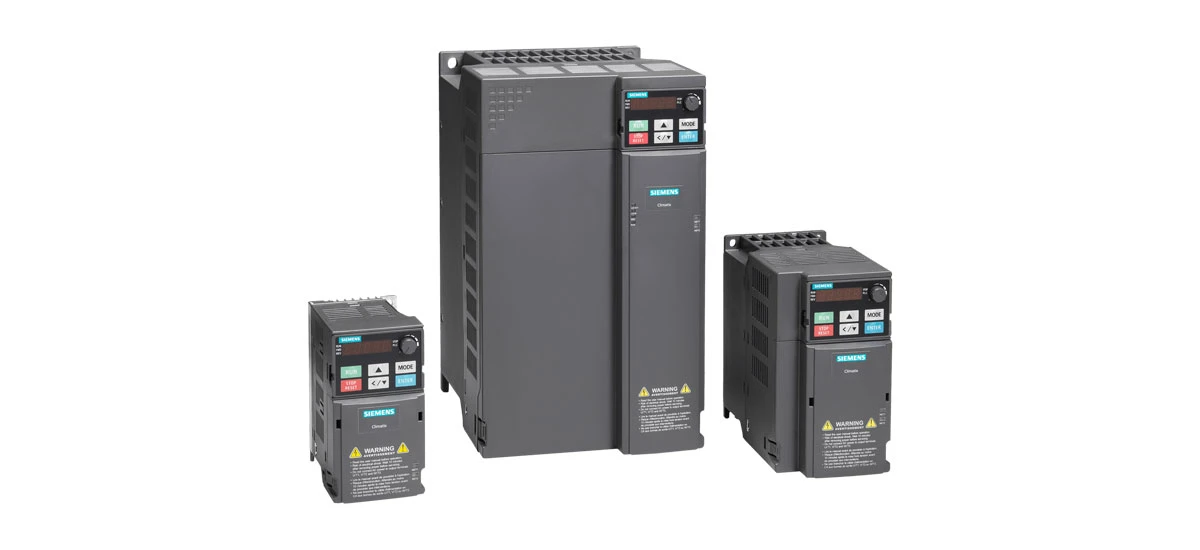
One of the most trusted solutions for this is Siemens VFD Closed-Loop Control. A Siemens VFD (Variable Frequency Drive) is a device that controls the speed and torque of electric motors by adjusting the frequency and voltage of the power supplied to them. Closed-loop control, when paired with encoder feedback, takes this control to the next level, ensuring accuracy even in the most demanding applications. Whether you're running a factory, a conveyor system, or a pump, understanding how Siemens VFD Closed-Loop Control works with encoder feedback can help you improve performance, save energy, and reduce downtime.
What Is Siemens VFD Closed-Loop Control?
First, let's start with the basics: what is a closed-loop control system for a Siemens VFD? A closed-loop system is a type of control that uses feedback to adjust the motor's speed and performance. Unlike an open-loop system (which doesn't use feedback and can't correct errors), a closed-loop system continuously checks the motor's actual speed and compares it to the desired speed. If there's a difference (called an "error"), the Siemens VFD adjusts the frequency and voltage to fix it. This makes Siemens VFD Closed-Loop Control much more accurate and reliable than open-loop control, especially for applications that need consistent speed, like packaging machines or CNC tools. Siemens VFD Closed-Loop Control is used in many industries because it combines the flexibility of a VFD with the precision of feedback-based control.
Siemens VFD Closed-Loop vs. Open-Loop Control
To understand why Siemens VFD Closed-Loop Control is so useful, let's compare it to open-loop control. In an open-loop system, the Siemens VFD sends a signal to the motor to run at a certain speed, but it doesn't check if the motor is actually running at that speed. If the motor's load changes (for example, a conveyor carrying a heavier load), the speed might drop, and the VFD won't correct it. This can lead to product defects, inefficiency, or even machine damage. On the other hand, Siemens VFD Closed-Loop Control uses feedback (from an encoder) to monitor the motor's actual speed. If the speed drops because of a heavier load, the VFD automatically increases the frequency to bring the speed back to the desired level. This is why Siemens VFD Closed-Loop Control is better for applications that require precision, like printing, bottling, or robotics. A common question is: "When should I use Siemens VFD closed-loop vs open-loop control?" The answer is simple: use closed-loop if you need consistent speed, even when the load changes.
Encoder Feedback: The Key to Siemens VFD Closed-Loop Control
Encoder feedback is what makes Siemens VFD Closed-Loop Control possible. An encoder is a small device that attaches to the motor's shaft. It measures the motor's speed and position and sends this information back to the Siemens VFD. The VFD then uses this feedback to adjust the motor's speed and torque, ensuring it matches the desired settings. Without encoder feedback, Siemens VFD Closed-Loop Control wouldn't be able to correct errors or maintain precision. Encoders are essential for applications where even small speed variations can cause problems, like in medical equipment or precision manufacturing. Siemens VFD closed-loop control with encoder feedback is the gold standard for accurate motor control in industrial settings.
How Encoder Feedback Works with Siemens VFD
Let's break down how encoder feedback works with a Siemens VFD step by step. First, the encoder is mounted on the motor's shaft. As the shaft spins, the encoder generates electrical signals that represent the motor's speed and position. These signals are sent to the Siemens VFD's control unit. The VFD then compares the encoder's feedback (actual speed) to the set speed (the speed you want the motor to run at). If the actual speed is lower than the set speed, the VFD increases the frequency of the power supplied to the motor, which makes the motor spin faster. If the actual speed is higher than the set speed, the VFD decreases the frequency, slowing the motor down. This process happens hundreds of times per second, so the motor's speed stays consistent even if the load changes. Siemens VFDs are designed to work seamlessly with encoders, making setup and operation simple. For example, Siemens MM440 and SINAMICS G120C VFDs support encoder feedback with easy parameter settings (like P1300=20 for vector control with encoder feedback) to get the system up and running quickly.
Types of Encoders Used in Siemens VFD Closed-Loop Control
There are two main types of encoders used with Siemens VFD Closed-Loop Control: incremental encoders and absolute encoders. Incremental encoders are the most common-they measure the motor's speed by counting the number of pulses generated as the shaft spins. They are simple, affordable, and work well for most industrial applications. Absolute encoders, on the other hand, measure the motor's exact position (not just speed) and can provide feedback even if the power is turned off. They are used in applications that require precise position control, like robotics or CNC machines. Both types of encoders work well with Siemens VFDs, and the choice depends on your application's needs. For example, a conveyor system might use an incremental encoder, while a robotic arm would use an absolute encoder. When setting up Siemens VFD closed-loop control with encoder feedback, choosing the right encoder is key to getting the best precision.
Precision Speed Regulation with Siemens VFD
Precision speed regulation is the main benefit of Siemens VFD Closed-Loop Control. It means that the motor runs at the exact speed you set, even when the load changes, the voltage fluctuates, or other conditions change. This is critical for many industries-for example, in a printing press, inconsistent speed can cause blurry text or misaligned pages; in a pump system, inconsistent speed can lead to uneven water flow or pressure. Siemens VFD Closed-Loop Control ensures that the motor's speed stays within a very small range (often +/- 0.1% of the set speed), making it ideal for high-precision applications. How to set up Siemens VFD precision speed regulation? It starts with proper encoder installation and VFD parameter configuration, which we'll cover later in this blog.
Why Precision Speed Regulation Matters
Precision speed regulation isn't just a "nice-to-have"-it's essential for many businesses. Here are three key reasons why it matters:
- Improved Product Quality: Consistent speed ensures that products are made the same way every time. For example, in a packaging machine, precise speed means all packages are sealed correctly and have the same weight.
- Energy Savings: Siemens VFD Closed-Loop Control adjusts the motor's speed to match the load, which uses less energy than running the motor at full speed all the time. This can reduce energy costs by 10-30% or more, depending on the application.
- Longer Machine Life: When a motor runs at a consistent speed, it experiences less wear and tear.
This reduces maintenance costs and extends the life of the motor and other machine parts. Siemens VFD Closed-Loop Control's precision speed regulation helps businesses save money and improve reliability.
How Siemens VFD Achieves Precision Speed Regulation
Siemens VFDs use advanced technology to achieve precision speed regulation. The VFD's control unit processes the encoder feedback in real time and adjusts the frequency and voltage using a PI (Proportional-Integral) controller. The PI controller ensures that the motor's speed quickly returns to the set speed if there's an error. Siemens VFDs also have features like acceleration pre-control and resonance damping to improve stability and reduce oscillations. For example, acceleration pre-control calculates the torque needed based on the motor's acceleration and inertia, adding it to the speed controller's output to make the motor respond faster. Resonance damping helps reduce mechanical vibrations, which can affect speed precision. These features work together to make Siemens VFD Closed-Loop Control one of the most precise motor control solutions available.
How to Set Up Siemens VFD Closed-Loop Control
Setting up Siemens VFD Closed-Loop Control is easier than you might think, especially with Siemens' user-friendly VFD models like the SINAMICS V20, G120C, or MM440. Here's a step-by-step guide to help you get started. Remember, if you're not familiar with electrical work, it's always best to ask a trained technician for help to ensure safety and proper setup.
Step 1: Install the Encoder
First, mount the encoder to the motor's shaft. Make sure it's securely attached and aligned correctly-misalignment can cause inaccurate feedback. Follow the encoder manufacturer's instructions for installation. For Siemens VFDs, it's important to use an encoder that is compatible with the VFD model. Most Siemens VFDs support incremental encoders with open-collector or differential outputs, and some support absolute encoders via PROFINET or IO-Link.
Step 2: Wire the Encoder to the Siemens VFD
Next, connect the encoder's wires to the Siemens VFD. The VFD has dedicated terminals for encoder feedback-check the VFD's user manual to find the correct terminals. Typically, you'll connect the encoder's power supply, ground, and signal wires. Use shielded cables to reduce electrical interference, which can cause inaccurate feedback. It's also important to keep encoder wires separate from power wires to avoid interference.
Step 3: Configure the Siemens VFD Parameters
Once the encoder is wired, you need to configure the Siemens VFD's parameters to enable closed-loop control. Here are the key parameters to set (the exact parameter numbers may vary by VFD model, so check your manual):
- Set the control mode to closed-loop (vector control with encoder feedback). For example, on the MM440, set P1300=20; on SINAMICS G120C, set the control mode to vector control with speed feedback.
- Enter the encoder's resolution (number of pulses per revolution) so the VFD can calculate the motor's speed correctly.
- Set the desired speed range and acceleration/deceleration times.
- Enable the PI controller and adjust the proportional (P) and integral (I) gains if needed. Siemens VFDs often have auto-tuning features (like P1400 for PI gain adaptive or P1960 for parameter tuning) to make this easier.
- Test the system to ensure the encoder feedback is working and the motor runs at the set speed.
Step 4: Test and Adjust
After configuring the parameters, test the system. Run the motor at different speeds and check if the actual speed (from the encoder feedback) matches the set speed. If there's a small error, adjust the PI gains or encoder resolution. If the motor is oscillating (speeding up and slowing down), adjust the resonance damping parameter (like P1740 on MM440) to stabilize it. It's also a good idea to test the system under different load conditions to ensure it maintains precision speed regulation.
Benefits of Siemens VFD Closed-Loop Control
Siemens VFD Closed-Loop Control offers many benefits for industrial applications, from improved precision to energy savings. Let's take a closer look at the top benefits, which make it a popular choice for businesses around the world. These benefits align with the needs of most industrial users, making Siemens VFD Closed-Loop Control a reliable and cost-effective solution. The benefits of Siemens VFD closed-loop control include:
1. Higher Precision and Consistency
As we've discussed, Siemens VFD Closed-Loop Control uses encoder feedback to maintain precise speed, even when the load changes. This consistency ensures that products are made to the same standard every time, reducing defects and waste. For example, in a CNC machine, precise speed control ensures that cuts are accurate, leading to better-quality parts. Siemens VFDs can maintain speed accuracy within +/- 0.1% of the set speed, which is far better than open-loop systems.
2. Energy Savings
Siemens VFDs are designed to be energy-efficient, and closed-loop control enhances this. By adjusting the motor's speed to match the load, the VFD uses only the energy needed, rather than running the motor at full speed all the time. This can lead to significant energy savings-many businesses report saving 10-30% on their energy bills after installing Siemens VFD Closed-Loop Control. For variable torque loads like pumps and fans, savings can be even higher, up to 70%.
3. Longer Equipment Life
Consistent speed and reduced stress on the motor mean less wear and tear. Siemens VFD Closed-Loop Control reduces sudden speed changes and overloads, which can damage the motor and other machine parts. This extends the life of the motor, encoder, and other components, reducing maintenance costs and downtime. Routine maintenance of the Siemens VFD and encoder can further extend equipment life and prevent unexpected failures.
4. Better Load Handling
Siemens VFD Closed-Loop Control handles changing loads better than open-loop systems. If the load increases (e.g., a conveyor carrying a heavier box), the VFD automatically adjusts to maintain speed. This is especially useful for applications with variable loads, like mixers, pumps, or conveyors. Vector control (used in Siemens VFD Closed-Loop Control) also provides full torque at zero speed, which is useful for applications like hoists or extruders that need to hold a load without moving.
5. Easy Integration with Industrial Systems
Siemens VFDs are designed to integrate seamlessly with other industrial systems, like PLCs (Programmable Logic Controllers) and SCADA (Supervisory Control and Data Acquisition) systems. This makes it easy to monitor and control the VFD from a central location. Siemens VFDs also support communication protocols like PROFINET and Modbus, making integration with third-party equipment simple. For example, you can use Siemens TIA Portal to configure and monitor the VFD and encoder feedback, making setup and troubleshooting easier.
Conclusion: Why Siemens VFD Closed-Loop Control Is the Best Choice for Precision
Siemens VFD Closed-Loop Control, paired with encoder feedback, is the best solution for industrial applications that require precise speed regulation. It offers higher accuracy, energy savings, longer equipment life, and better load handling than open-loop systems. Whether you're in manufacturing, packaging, or any other industry that relies on motor control, Siemens VFD Closed-Loop Control can help you improve efficiency, reduce costs, and ensure consistent product quality. Setting up Siemens VFD Closed-Loop Control is simple with Siemens' user-friendly VFD models and clear parameter settings. And with common troubleshooting steps, you can quickly resolve any issues that arise. By choosing Siemens VFD Closed-Loop Control, you're investing in a reliable, efficient, and precise motor control solution that will help your business succeed.
If you're ready to upgrade your motor control system, consider Siemens VFD Closed-Loop Control with encoder feedback. It's a smart choice that will pay off in better performance, lower costs, and greater reliability. Remember, Siemens VFD Closed-Loop Control is designed to be easy to use and integrate, so you can start seeing benefits right away.


