

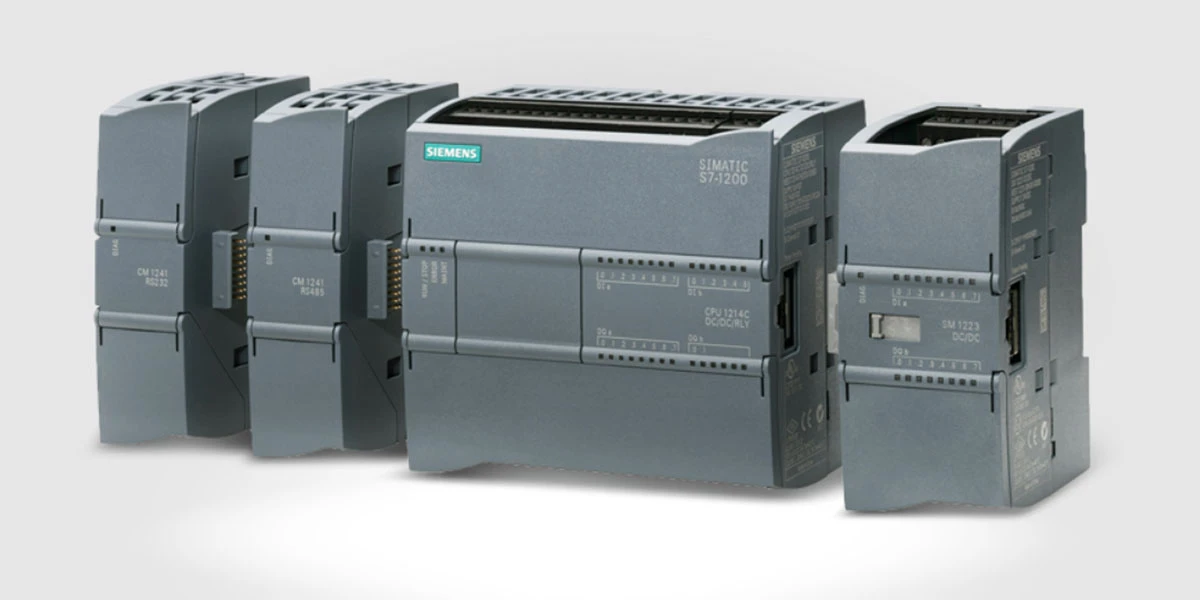
In the world of industrial automation, choosing the right Programmable Logic Controller (PLC) can make a big difference in how efficiently your project runs. Two popular options from Siemens are the SIMATIC S7-1200 and S7-1500. Both are powerful, but they're designed for different needs. This blog will break down their key differences, compare their performance, and show you when to use each one, with a special focus on the SIMATIC S7-1200.
1. Introduction to SIMATIC S7-1200 and S7-1500
What is the SIMATIC S7-1200?
The SIMATIC S7-1200 is a compact, user-friendly PLC designed for small to medium-sized industrial projects. It's perfect for beginners and engineers who need a balance of performance and simplicity. With its modular design, you can easily add input/output (I/O) modules, communication modules, and memory as your project grows. It's widely used in applications like small production lines, conveyor systems, packaging machines, and simple process control.
What is the SIMATIC S7-1500?
The SIMATIC S7-1500, on the other hand, is a high-performance PLC built for large, complex industrial systems. It's designed to handle advanced automation tasks, high-speed data processing, and integration with Industry 4.0 technologies. With faster processors, more memory, and advanced diagnostic features, it's ideal for industries like automotive manufacturing, chemical processing, and large-scale power plants.
2. Key Differences Between S7-1200 and S7-1500
Performance and Processing Power
S7-1200:
The S7-1200 has a capable processor for its size, with cycle times ranging from 0.2 to 2 milliseconds for basic tasks. It can handle up to 1,024 digital I/O points and 128 analog I/O points, which is enough for most mid-sized projects. While it's not the fastest, it's reliable for standard automation tasks like controlling motors, reading sensors, and managing simple logic.
S7-1500:
The S7-1500 is much faster, with cycle times as low as 0.01 milliseconds for complex programs. It supports up to 65,536 digital I/O points and 4,096 analog I/O points, making it suitable for huge systems with thousands of sensors and actuators. Its advanced processor can handle complex algorithms, real-time data analysis, and high-speed communication, which is crucial for tasks like robotics control or high-speed packaging.
Memory and Storage
S7-1200:
The S7-1200 offers 100 KB to 2 MB of program memory and 256 KB to 4 MB of data memory, depending on the model. This is sufficient for storing standard control programs, basic data logging, and simple HMI (human-machine interface) interfaces. It's perfect for projects where you don't need to store large amounts of historical data or run multiple complex programs at once.
S7-1500:
The S7-1500 has much larger memory: 1 MB to 20 MB of program memory and 4 MB to 64 MB of data memory. This allows it to run multiple complex programs simultaneously, store detailed diagnostic data, and support advanced features like edge computing and predictive maintenance. For example, it can collect data from hundreds of sensors, analyze it in real-time, and send insights to the cloud for better decision-making.
Connectivity and Communication
S7-1200:
The S7-1200 supports common industrial protocols like PROFINET, Modbus RTU, and Ethernet/IP, making it easy to connect to sensors, HMIs, and other devices. It has built-in Ethernet ports for simple network setups and can use optional modules for wireless communication or serial connections. While it's not designed for the most advanced industrial networks, it works well for basic to mid-level connectivity needs.
S7-1500:
The S7-1500 takes connectivity to the next level with support for PROFINET IRT (Isochronous Real-Time) for ultra-fast data transfer, as well as advanced protocols like OPC UA for secure data exchange with enterprise systems. It can connect to multiple networks at once, including IT networks, and supports features like network redundancy to ensure no downtime. This makes it ideal for factories moving towards Industry 4.0, where machines need to communicate seamlessly with each other and with cloud-based software.
Programming and Ease of Use
S7-1200:
The S7-1200 is programmed using TIA Portal, Siemens' unified engineering software. The interface is intuitive, with drag-and-drop functionality and built-in wizards that help beginners set up projects quickly. It supports ladder logic, function block diagrams, and structured text, making it flexible for different programming styles. The learning curve is gentle, especially for those new to Siemens PLCs.
S7-1500:
The S7-1500 also uses TIA Portal, but it offers more advanced programming features for complex systems. It supports object-oriented programming, which lets engineers reuse code modules for faster development. The diagnostic tools are more detailed, showing real-time statuses of all modules and pinpointing errors quickly. While it's powerful, it requires more advanced knowledge to use all its features, making it better suited for experienced engineers working on large projects.
Size and Modularity
S7-1200:
The S7-1200 is compact, with a small footprint that's perfect for tight spaces, like control panels in small machines or mobile equipment. It offers a range of modular options, including signal modules for different I/O types and communication modules for specific protocols. However, its expandability is limited compared to the S7-1500, with a maximum of 8 signal modules per CPU.
S7-1500:
The S7-1500 is larger and more modular, supporting up to 30 signal modules per CPU. This means you can build very large systems with hundreds of I/O points. It also has a rugged design for harsh environments, with options for extended temperature ranges and resistance to vibrations and dust, making it suitable for heavy industry settings.
3. Performance Comparison Table
|
Feature |
SIMATIC S7-1200 |
SIMATIC S7-1500 |
|---|---|---|
|
Target Application |
Small to medium projects, simple logic |
Large, complex systems, Industry 4.0 |
|
Processor Speed |
Up to 1.0 GHz (depending on model) |
Up to 1.6 GHz, multi-core options |
|
Max I/O Points |
1,024 digital, 128 analog |
65,536 digital, 4,096 analog |
|
Program Memory |
100 KB – 2 MB |
1 MB – 20 MB |
|
Communication |
PROFINET, Modbus RTU, Ethernet/IP |
PROFINET IRT, OPC UA, network redundancy |
|
Ease of Use |
Beginner-friendly, simple setup |
Advanced features, steeper learning curve |
|
Price Range |
Lower cost, ideal for budget projects |
Higher cost, invest in advanced needs |
4. Use Cases: When to Choose S7-1200 vs. S7-1500
When to Use SIMATIC S7-1200
Small Production Lines:
The SIMATIC S7-1200 PLC excels in automating compact assembly lines for consumer goods, electronics, or food production. Its modular design supports seamless integration with sensors, conveyors, and basic robotic arms, making it ideal for cost-effective small to medium industrial automation.
Packaging Machinery:
For tasks like labeling, sealing, or sorting, the S7-1200's Modbus RTU compatibility and straightforward STEP 7 TIA Portal programming ensure quick setup. Operators can adjust parameters via HMI panels like KTP1000, enhancing flexibility without complex configurations.
Educational & Training Projects:
As a budget-friendly PLC for beginners, the S7-1200 is widely adopted in technical schools. Its intuitive interface and support for ladder logic simplify teaching core automation concepts, such as motion control with PTO/PWM outputs.
Mid-Scale Process Control:
In water treatment or HVAC systems, the S7-1200's analog I/O modules and PID control capabilities manage pumps, valves, and temperature sensors efficiently. Its diagnostic tools help troubleshoot issues like overloads or communication errors, ensuring reliable operation.
SIMATIC S7-1500 Applications
Large-Scale Automation:
The S7-1500 dominates in automotive plants or chemical facilities requiring PROFINET IRT communication and multi-core processing. Its ability to handle 65,000+ I/O points supports Industry 4.0 integration with cloud platforms like MindSphere.
High-Speed Manufacturing:
For precision tasks like CNC machining or pharmaceutical packaging at 1,000+ units/minute, the S7-1500's ultra-fast cycle times and redundant systems minimize downtime.
When to Use SIMATIC S7-1500
Large Industrial Plants:
In automotive factories with hundreds of robots, conveyor belts, and quality control systems, the S7-1500 can manage all processes in real-time, ensuring smooth coordination and minimal downtime.
High-Speed Manufacturing:
For tasks like producing bottles at 1,000 units per minute or cutting materials with precise timing, the S7-1500's fast processor and PROFINET IRT connectivity are essential for maintaining accuracy.
Industry 4.0 and IoT Integration:
If your factory needs to connect to the cloud for predictive maintenance, remote monitoring, or data analytics, the S7-1500's OPC UA support and large memory allow seamless integration with digital platforms like MindSphere.
Mission-Critical Systems:
In industries like pharmaceuticals or oil and gas, where any downtime could cause huge losses, the S7-1500's redundancy features (optional dual CPUs and power supplies) ensure continuous operation even if a component fails.
5. Cost Considerations
SIMATIC S7-1200 Cost Advantages:
The S7-1200 offers a low-cost entry point for industrial automation, with CPUs starting under $500. Its modular architecture allows incremental expansion-add signal modules or communication modules as needed, avoiding upfront overinvestment. Maintenance is affordable, with Siemens providing long-term support for spare parts and firmware updates. For projects like small conveyor systems or educational labs, the S7-1200 delivers high ROI without sacrificing reliability.
SIMATIC S7-1500 Investment Value:
While the S7-1500's initial cost is higher (starting around $2,000), it justifies the price in large-scale deployments. Features like OPC UA integration and predictive maintenance tools reduce long-term operational costs by preventing unplanned downtime. Industries like energy or automotive benefit from its scalable memory and multi-network redundancy, critical for mission-critical systems.
Conclusion: Key Considerations for Choosing Between SIMATIC S7-1200 and S7-1500
Selecting between the SIMATIC S7-1200 and S7-1500 depends on the scale and complexity of your industrial automation project. The S7-1200, with its low-cost entry, modular design, and ease of use, is ideal for small to medium-sized applications such as packaging machinery or educational labs. It supports Modbus RTU communication and STEP 7 TIA Portal programming, ensuring rapid deployment and reliable performance.
In contrast, the S7-1500 targets large-scale, complex systems requiring PROFINET IRT high-speed communication, multi-core processing, and OPC UA cloud integration, making it indispensable for automotive manufacturing or Industry 4.0 scenarios. While the S7-1500 demands a higher upfront investment, its long-term scalability and robustness in mission-critical systems justify the cost. By aligning your choice with budget, technical requirements, and future growth, you can maximize automation efficiency and ROI.


