


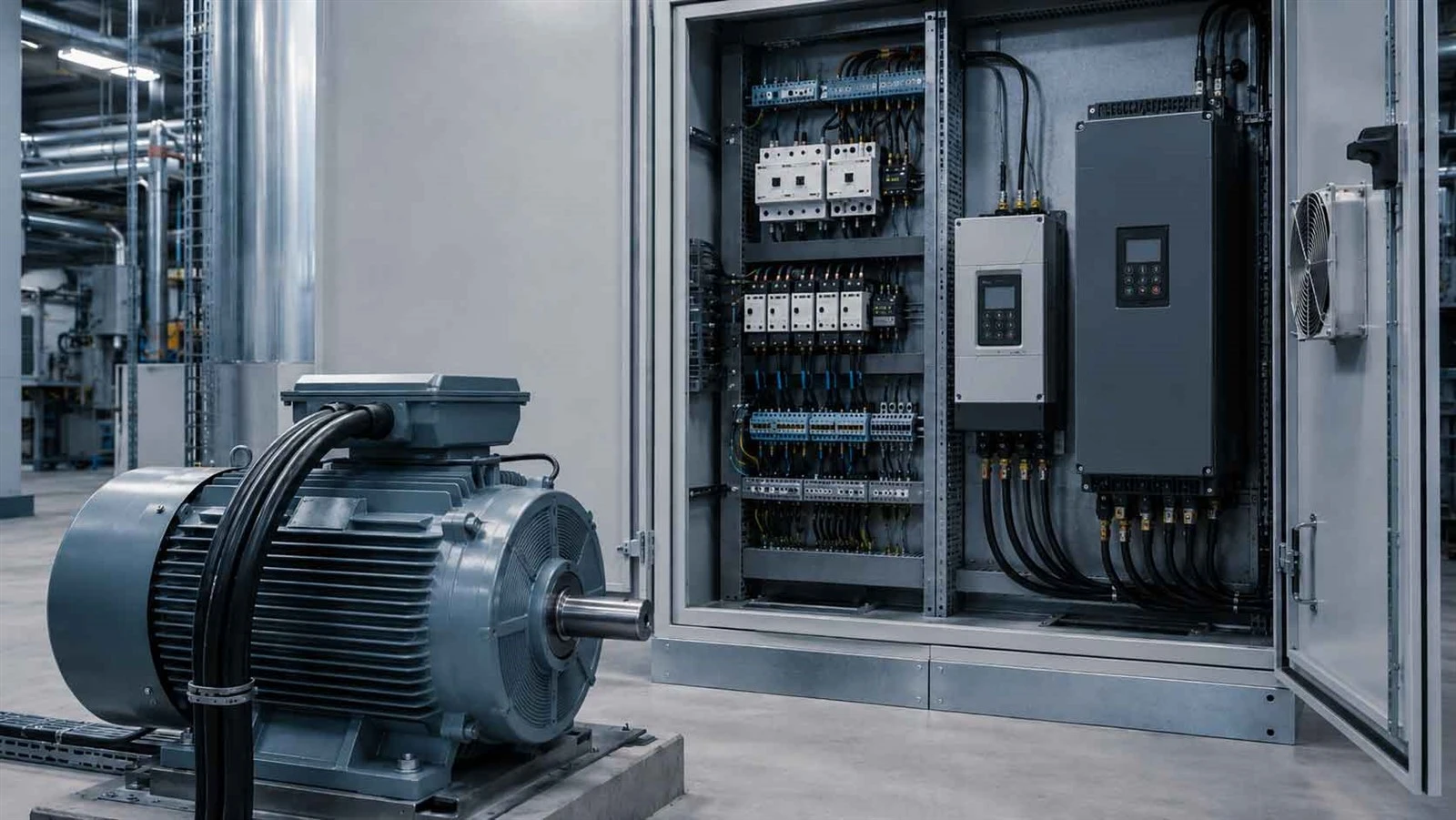
A soft starter and a variable frequency drive can both provide controlled motor starting, but they solve different operating problems. The first question is not which device is more advanced. It is whether your motor only needs a controlled start or whether your process needs the motor speed to change after startup.
If the motor normally runs at one fixed speed and the main problem is high starting current, mechanical shock, or an abrupt stop, a soft starter is usually the first technology to evaluate. If the process requires continuous speed adjustment, pressure or flow regulation, changing conveyor speed, or closed-loop control, a VFD is normally the better starting point.
That first rule solves many applications, but not all of them. Starting torque, load inertia, starts per hour, power supply capacity, motor compatibility, panel conditions, and total installed cost can change the final decision.
Soft Starter vs VFD at a Glance
|
Requirement |
Soft Starter |
VFD |
|
Smooth motor startup |
Yes |
Yes |
|
Reduced starting current |
Yes |
Yes |
|
Continuous speed control |
No |
Yes |
|
Controlled stopping |
Yes, application dependent |
Yes |
|
Variable-flow energy saving |
No continuous speed control |
Yes, when the load profile supports it |
|
Lower initial equipment cost |
Usually |
Usually higher |
|
Starting torque control |
Application dependent |
More flexible with suitable drive and control method |
|
Installation complexity |
Usually lower |
Usually higher |
|
PID or process control |
Limited, model dependent |
Common on industrial VFDs |
|
Best fit |
Fixed-speed motors needing controlled start |
Variable-speed or process-controlled motors |
The One Difference That Usually Decides the Answer
The most important difference between a soft starter and VFD is what happens after the motor reaches operating speed.
A soft starter primarily manages acceleration and, on suitable models, deceleration. Once the motor reaches normal speed, it usually operates at line frequency.
A VFD controls both voltage and output frequency, allowing the motor speed to change continuously during normal operation.
Consider two identical centrifugal pumps. The first pump always operates at full speed but produces an unacceptable pressure shock when starting or stopping. A soft starter may solve the actual problem without adding unnecessary speed-control capability.
The second pump must maintain a changing pressure setpoint throughout the day. Smooth starting alone cannot do that. Motor speed must become part of the process control strategy, which points toward a VFD.
Quick Selection Rules
Start with these practical rules:
- If the motor runs at one speed and only the starting event is causing problems, evaluate a soft starter first.
- If motor speed must change during normal production, evaluate a VFD.
- If the process requires PID control for pressure, flow, or another process variable, a VFD is normally the relevant device class.
- If the load has high breakaway torque or high inertia, do not select only on the basis of reduced starting current.
- If the application is simple and fixed-speed, additional VFD capability may increase cost and commissioning work without creating process value.
How a Soft Starter and VFD Control the Motor Differently
Understanding the basic power path makes the selection rules easier to apply.
How a Soft Starter Works
A typical soft starter uses SCRs, also called thyristors, to control the voltage supplied to the motor during acceleration.
The simplified sequence is:
AC supply → SCR control → voltage ramp or current limit → motor acceleration → full operating voltage
Many designs also use a bypass arrangement once acceleration is complete.
By gradually increasing applied voltage instead of connecting full line voltage immediately, the soft starter can reduce electrical inrush and mechanical shock. However, reducing voltage also affects the torque available to accelerate the load.
That is why a soft starter should not be selected only because someone wants the lowest possible starting current.
How a VFD Works
A typical VFD takes a different approach:
AC input → rectifier → DC bus → inverter → controlled voltage and frequency output
Because the inverter controls output frequency, the VFD can continue changing motor speed after startup.
This makes the drive useful when speed itself is a process variable. A pump can follow pressure demand, a fan can follow airflow demand, and a conveyor can change speed according to production requirements.
For a more detailed explanation of drive architecture, terminology, sizing, and selection, see our Variable Frequency Drive guide.
If you are still comparing contactors, traditional motor starters, soft starters, and drives as separate device categories, our motor control device comparison guide covers that broader decision.
The Differences That Matter in a Real Installation
A specification sheet may make the comparison look simple. A real installation has more variables.
|
Selection Factor |
Soft Starter |
VFD |
Why It Matters |
|
Starting current |
Reduced |
Controlled |
Can affect voltage dip and upstream supply |
|
Starting torque |
Reduced with applied voltage |
Depends on drive and control method |
Load must still accelerate |
|
Operating speed |
Normally fixed |
Adjustable |
Often the main decision factor |
|
Soft stop |
Available on suitable designs |
Available |
Important for some pumps and processes |
|
Energy saving |
Limited to start/stop effects |
Possible during variable-speed operation |
Depends on actual load profile |
|
Harmonics |
Generally less complex |
Requires system evaluation |
Can affect power-quality design |
|
Panel heat |
Usually lower |
Usually higher |
Important in retrofit cabinets |
|
Communication |
Model dependent |
Common |
May affect PLC or SCADA integration |
|
Initial cost |
Usually lower |
Usually higher |
Only one part of total cost |
|
Duty |
Must be checked |
Must be checked |
Frequent starts or overload can affect sizing |
The three rows that deserve the most attention are operating speed, starting torque, and duty. These are also where simple online comparison tables are most likely to lead to the wrong decision.
Starting Current Is Only Half the Story: Check Starting Torque Too
Reducing motor inrush is often the reason a plant considers a soft starter. The mistake is treating starting current as an isolated specification.
When a soft starter reduces the voltage applied to an induction motor during acceleration, available motor torque also changes. The load still requires enough accelerating torque to overcome breakaway resistance and reach normal speed within an acceptable time.
If the current limit is set too aggressively, a difficult load may accelerate slowly or fail to accelerate properly.
This matters especially for applications such as:
- Conveyors that start with material already on the belt
- Crushers with high breakaway resistance
- High-inertia fans
- Heavily loaded machinery
- Processes with strict acceleration-time limits
Before sizing the starter, ask four questions:
- Does the machine start loaded or unloaded?
- What breakaway torque does the load require?
- What acceleration time is acceptable?
- How frequently will the motor start?
Supply conditions matter as well. On a generator, small transformer, or electrically weak bus, reducing starting current can help control voltage dip. However, current reduction cannot be considered separately from the torque required to accelerate the machine.
For difficult loads, motor nameplate data alone may not be enough. Load characteristics and, in some cases, motor and load torque curves should be reviewed before ordering.
When a Soft Starter Is the Better Choice
A soft starter is a strong candidate when the motor operates at full speed during normal production and the main problem exists only during starting or stopping.
Fixed-Speed Motors That Need a Controlled Start
Consider a conveyor that always operates at rated speed. If the process does not require production speed adjustment but starting creates belt shock or gearbox stress, continuous variable-frequency control may offer little additional value.
The same principle can apply to fixed-speed pumps, compressors, and large fans.
The machine type does not determine the answer by itself. A fixed-speed pump and a variable-flow pump can require completely different motor-control strategies.
When Soft Stop Matters
Pumping systems are a common example. An abrupt change in flow can contribute to pressure transients and water hammer.
Controlled deceleration from a suitable soft starter can help reduce abrupt hydraulic changes in appropriate applications. This should not be treated as a universal water-hammer solution because the result also depends on piping, valves, pump characteristics, and the overall hydraulic system.
When a Soft Starter May Be the Wrong Choice
Reconsider a soft starter when:
- The process needs continuous variable speed
- Starting torque is difficult to achieve under the required current limit
- Start frequency or duty is demanding
- The machine needs advanced closed-loop process control
- The application requires operating conditions that should be verified against the manufacturer's starter ratings
If your requirement is better diagnostics and motor data but not variable speed, it can also be useful to compare advanced starters with conventional starter designs. See our Smart Motor Controller vs Traditional Starter guide.
When a VFD Is the Better Choice
A VFD becomes valuable when its additional control capability is actually used by the process.
When Motor Speed Must Change During Operation
Typical examples include:
- A pump that regulates pressure or flow
- A fan that adjusts airflow according to demand
- A conveyor whose production rate changes
- Mixing or processing equipment that requires multiple operating speeds
In these cases, the requirement is no longer simply to start the motor smoothly. The operating speed itself becomes a controlled variable.
When the Process Needs Closed-Loop Control
Many industrial drives can work with process feedback through a PLC, external controller, or supported internal PID functions.
A pressure-control application, for example, may follow this basic sequence:
Pressure sensor → controller or PID → VFD speed command → pump → updated pressure feedback
This is fundamentally different from simply ramping a motor to full speed.
When Better Low-Speed Control Is Required
Some applications require controlled operation at reduced speed or more sophisticated torque behavior.
The correct conclusion is not that every VFD automatically provides high starting torque. Performance depends on the drive, control mode, motor, sizing, and application.
An appropriately selected VFD with the correct motor-control method can provide much more flexible speed and torque control than a soft starter.
When a VFD Is Overkill
A VFD can technically start a motor even when continuous speed control is unnecessary. That does not make it the best commercial decision.
If the motor always runs at rated speed and the only problem is starting current or mechanical shock, VFD functionality may add:
- Higher equipment cost
- More commissioning
- Additional panel heat
- More power-quality considerations
- More complex troubleshooting
The right goal is not to buy the device with the most functions. It is to buy the device whose functions solve the actual process requirement.
Soft Starter vs VFD by Application
|
Application |
Typical Starting Point |
Main Question |
|
Fixed-flow pump |
Soft Starter |
Is smooth start or stop the main requirement? |
|
Variable-flow pump |
VFD |
Must speed change with flow or pressure demand? |
|
Fixed-speed fan |
Soft Starter or simpler starter |
Is startup the only problem? |
|
Variable-airflow fan |
VFD |
Can speed follow process demand? |
|
Conveyor |
Application dependent |
Fixed or variable speed, loaded or unloaded start? |
|
Compressor |
Application dependent |
Fixed-speed operation or capacity control? |
|
Crusher |
Engineering review |
How much breakaway torque is required? |
|
High-inertia load |
Engineering review |
What acceleration time and thermal duty are acceptable? |
Pumps
For pumps, avoid the simple rule that "pumps use VFDs."
A variable-flow or variable-pressure system often points toward a VFD because adjusting motor speed can directly regulate the process.
A pump that always operates at one speed but requires gentler acceleration or deceleration may be better suited to a soft starter.
Fans
A fan with variable airflow demand is a common VFD application. If the process regularly requires less than full airflow, reducing motor speed may provide both process control and energy benefits.
If the fan always runs at full speed and the only issue is startup stress, evaluate whether a soft starter can satisfy the requirement with less complexity.
Conveyors
For conveyors, check the application rather than the equipment name.
Ask:
- Is production speed fixed or adjustable?
- Does the conveyor start loaded?
- Is breakaway torque high?
- Is mechanical shock damaging the belt or drivetrain?
A fixed-speed conveyor needing only smoother acceleration may point toward a soft starter. A conveyor that changes production rate during operation points toward a VFD.
Cost Comparison: Purchase Price Is Not Total Cost
Soft starters usually have a lower initial equipment cost than comparable VFD solutions because their primary job is more limited.
But equipment price is only the first cost.
Installed cost can include panel modifications, wiring, cooling, bypass arrangements, commissioning, and, where required, reactors or other power-quality measures.
Operating cost also needs careful treatment.
A soft starter mainly changes the starting and stopping event. It should not be justified as if it continuously reduces motor operating energy.
A VFD can reduce operating energy when the application allows the motor to run below full speed for meaningful periods. The actual benefit depends on the load, operating profile, electricity price, and number of annual operating hours.
For a simple investment comparison:
Payback Period = Incremental Installed Cost ÷ Annual Verified Savings
Use measured or realistic plant data. Avoid basing a purchase on generic energy-saving percentages.
VFD Installation Checks That Are Easy to Miss
A VFD provides more control, but its power electronics also introduce additional engineering checks.
Harmonics and Power Quality
Do not assume that every drive requires the same harmonic filter or input accessory.
Power-quality requirements depend on the electrical system, project standards, system impedance, drive configuration, and other connected equipment. Line reactors, chokes, or other mitigation may be appropriate in some installations, but they are not universal requirements.
Motor Cable and dV/dt
Long motor cables can increase output-side concerns associated with PWM switching and voltage rise.
Do not apply a universal maximum cable length. Check the selected drive manufacturer's cable guidance and determine whether output-side mitigation is needed for the actual installation.
Existing Motor Compatibility
A retrofit also requires checking the motor itself.
Two questions are especially important:
- Is the motor insulation suitable for the intended VFD application?
- Will the motor have adequate cooling if it operates for long periods at reduced speed?
A motor-driven shaft fan also slows as motor speed falls, which can reduce self-cooling. Low-speed, high-torque operation therefore deserves additional thermal review.
Panel Heat and Ventilation
Replacing an existing starter with a drive is not always a simple component swap.
Check available cabinet space, ambient temperature, ventilation, required clearances, enclosure conditions, and any manufacturer derating requirements before finalizing the model.
How to Size a Soft Starter or VFD Before You Buy
Correct device selection begins with data, not horsepower alone.
1. Start With the Motor Nameplate
Record:
- Rated voltage
- Full-load current, or FLA
- kW or horsepower
- Frequency
- Rated RPM
A clear motor nameplate photo is often more useful than a message that only says "30 kW motor."
2. Define the Load
Tell the supplier what the motor actually drives:
- Pump
- Fan
- Conveyor
- Compressor
- Crusher
- Mixer
- Other machinery
Also identify whether the load starts loaded, has high breakaway torque, or has significant inertia.
3. Define the Duty
Important operating information includes:
- Starts per hour
- Required acceleration time
- Deceleration requirement
- Normal operating speed range
- Overload requirement
- Continuous or intermittent operation
4. Check Installation Conditions
Confirm:
- Supply voltage and frequency
- Ambient temperature
- Altitude
- Available panel space
- Enclosure requirements
- Existing protection and wiring
5. Define Control and Communication Requirements
Do not wait until after purchasing the drive to discover that the control system requires a particular interface.
Check required I/O, Modbus, PROFINET, EtherNet/IP, PID, braking, safety, PLC integration, and other control requirements before choosing the final series.
If you already know that a VFD is required, you can review our Variable Frequency Drive range. If you have an existing manufacturer or exact catalog number, the CHENTUO Model Library is a faster starting point.
Three Quick Selection Examples
Example 1: Variable-Flow Centrifugal Pump
Operating condition: Flow demand changes during the day.
Engineering requirement: Motor output must follow process demand.
Implication: The system needs operating speed control, not only controlled acceleration.
Starting point: VFD.
The final drive still needs to be checked against motor FLA, voltage, control method, installation conditions, and process requirements.
Example 2: Fixed-Speed Conveyor With Mechanical Shock
Operating condition: The conveyor always runs at full speed, but startup creates belt and drivetrain shock.
Engineering requirement: Controlled acceleration without continuous speed adjustment.
Starting point: Soft starter candidate.
Before ordering, verify whether the conveyor starts loaded and whether enough starting torque remains under the proposed current limit.
Example 3: High-Breakaway-Torque Load
Operating condition: The plant wants to reduce starting current, but the machine requires high torque to begin moving.
Engineering conflict: Lower current is desirable, but excessive current limiting may prevent satisfactory acceleration.
Starting point: Engineering review.
This is not a good application for selecting equipment from motor kW alone. Motor current, load torque, starting condition, acceleration time, and supply limits should be reviewed first.
6 Questions That Decide Soft Starter or VFD
Use this sequence before choosing a device:
Does motor speed need to change during normal operation?
If yes, start by evaluating a VFD.
Is the problem limited to startup or stopping?
If yes and the motor normally runs at full speed, evaluate a soft starter.
How much starting torque does the load require?
High breakaway torque requires more detailed checking.
Would reducing operating speed create process or energy value?
If yes, a VFD may justify its additional cost.
How demanding is the starting duty?
Check starts per hour, acceleration time, overload, and thermal conditions.
What system constraints exist?
Consider power supply strength, panel space, harmonics, motor compatibility, communication, and retrofit requirements.
If you cannot answer several of these questions, collect the application data before choosing a part number.
Common Selection Mistakes
|
Mistake |
Why It Causes Problems |
Better Approach |
|
Choosing only by motor kW or HP |
Current and duty may differ |
Check nameplate FLA and application data |
|
Treating a soft starter as a speed controller |
It does not provide normal continuous speed control |
Define operating speed requirements first |
|
Buying a VFD because it is "more advanced" |
Added capability may create no process value |
Match capability to the actual requirement |
|
Assuming every VFD saves energy |
Savings depend on operating profile |
Compare real speed and load demand |
|
Ignoring starting torque |
Motor may not accelerate correctly |
Check load and breakaway torque |
|
Ignoring starts per hour |
Duty can affect thermal sizing |
Verify product duty ratings |
|
Assuming every VFD needs the same accessories |
Installation requirements vary |
Evaluate the actual electrical system |
|
Ignoring retrofit cabinet conditions |
Space and heat can become limiting |
Check enclosure, ventilation, and clearances |
Final Decision: Which One Should You Choose?
Choose a soft starter when the motor normally operates at one fixed speed and the main goal is to reduce starting current, mechanical shock, or abrupt stopping without adding unnecessary continuous speed control.
Choose a VFD when motor speed must change during normal operation, the process requires pressure or flow control, production speed is adjustable, or the application benefits from more flexible motor control.
Request an application review when starting torque is uncertain, the load has high inertia, the supply is generator-fed or electrically weak, starting duty is demanding, an existing motor is being retrofitted, or required VFD accessories are unclear.
If you already have a catalog number, use our Model Library to continue your search. If you are still selecting, send the motor nameplate, voltage, FLA, load type, starts per hour, required speed range, existing controller model, communication requirements, and quantity.
For stock, model selection, or quotation support, you can send CHENTUO your application details.
FAQ

Can a VFD replace a soft starter?
Does a soft starter control motor speed?
Which is cheaper, a soft starter or VFD?
Does a VFD save more energy than a soft starter?
Is a soft starter or VFD better for a pump?
What information is needed to size a soft starter or VFD?


