


Timers are essential components in ABB PLC programming, playing a crucial role in controlling the sequence and duration of operations in industrial automation systems. As an ABB PLC supplier, I have extensive experience in utilizing timers effectively in various applications. In this blog post, I will share some insights on how to use timers in ABB PLC programming.
Understanding the Basics of Timers in ABB PLCs
Before diving into the programming details, it's important to understand the basic concepts of timers in ABB PLCs. Timers are used to measure time intervals and generate outputs based on the elapsed time. ABB PLCs offer different types of timers, including on-delay timers, off-delay timers, and retentive timers, each serving a specific purpose.
On-Delay Timers
On-delay timers are the most commonly used type of timers. They start timing when the input signal goes high, and the output signal goes high after a preset time has elapsed. For example, if you set an on-delay timer with a preset time of 5 seconds, the output will turn on 5 seconds after the input signal is activated.
Off-Delay Timers
Off-delay timers work in the opposite way. The output signal goes high immediately when the input signal goes high, and it remains high for a preset time after the input signal goes low. This type of timer is useful for applications where you need to keep an output active for a certain period after an input signal is removed.
Retentive Timers
Retentive timers are similar to on-delay timers, but they can retain the accumulated time even if the power is interrupted or the input signal goes low. When the input signal goes high again, the timer resumes timing from the previously accumulated value.
Programming Timers in ABB PLCs
Now that we have a basic understanding of the different types of timers, let's look at how to program them in ABB PLCs. The programming process may vary depending on the specific ABB PLC model and the programming software you are using. In this example, I will use ABB's Automation Builder software, which is a popular programming tool for ABB PLCs.
Step 1: Create a New Project
Open the Automation Builder software and create a new project. Select the appropriate ABB PLC model for your application.
Step 2: Define the Timer
In the programming environment, navigate to the ladder logic editor. To define a timer, you need to specify the timer type (on-delay, off-delay, or retentive), the timer address, and the preset time. For example, to create an on-delay timer with a preset time of 10 seconds, you can use the following ladder logic:
|-----[TON T1, 10000]-----|
In this code, TON stands for on-delay timer, T1 is the timer address, and 10000 represents the preset time in milliseconds (10 seconds = 10,000 milliseconds).
Step 3: Connect the Input and Output Signals
Next, you need to connect the input and output signals to the timer. The input signal is used to start the timer, and the output signal is the result of the timer operation. For example, if you want to start the timer when a sensor signal goes high, you can use the following ladder logic:
|-----[I0.0]-----[TON T1, 10000]-----[Q0.0]-----|
In this code, I0.0 is the input signal from the sensor, and Q0.0 is the output signal that will turn on after 10 seconds when the input signal is high.
Step 4: Test and Debug the Program
Once you have programmed the timer, it's important to test and debug the program to ensure it works as expected. You can use the simulation mode in the Automation Builder software to test the program without connecting to the actual PLC hardware. Check the timer's operation and make any necessary adjustments to the preset time or the input/output signals.
Practical Applications of Timers in ABB PLC Programming
Timers are widely used in various industrial applications. Here are some common examples:
Conveyor Belt Control
In a conveyor belt system, timers can be used to control the start and stop of the conveyor. For example, you can use an on-delay timer to start the conveyor a few seconds after a sensor detects a product on the belt. This allows time for the product to be properly positioned before the conveyor starts moving.
Pump Control
Timers are also useful for pump control. An off-delay timer can be used to keep the pump running for a certain period after the water level in a tank reaches a certain level. This ensures that all the water is pumped out of the tank before the pump stops.
Machine Cycle Control
In a manufacturing machine, timers can be used to control the different stages of the machine cycle. For example, you can use a series of on-delay timers to control the duration of each step in a machining process, such as the cutting, drilling, and finishing operations.
Choosing the Right ABB PLC for Timer Applications
When selecting an ABB PLC for timer applications, it's important to consider the specific requirements of your project. Different ABB PLC models offer different timer capabilities, such as the number of timers available, the maximum preset time, and the timer resolution.
For example, the 1SAP130300R0271 ABB - PM573-ETH is a powerful PLC that offers a large number of timers and high-performance processing capabilities. It is suitable for complex industrial applications that require precise timer control.

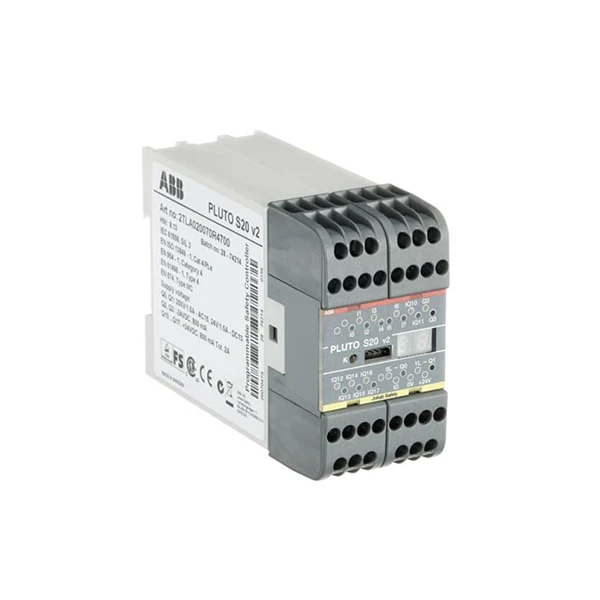
The 2TLA020070R4700 ABB PLC is another option that provides a good balance between performance and cost. It has a sufficient number of timers for most medium-sized applications.
If you need to interface with analog sensors in your timer application, the 1TNE968902R1101 ABB - AI561 can be used in combination with the PLC. It offers high-resolution analog input channels, which can be used to measure variables such as temperature, pressure, and flow rate.
Conclusion
Timers are an essential part of ABB PLC programming, enabling precise control of time-dependent operations in industrial automation systems. By understanding the different types of timers, how to program them, and their practical applications, you can effectively use timers to improve the efficiency and reliability of your industrial processes.
If you are interested in purchasing ABB PLCs or need further assistance with timer programming in ABB PLCs, please feel free to contact us for a detailed discussion. We are committed to providing high-quality ABB PLC products and professional technical support to meet your industrial automation needs.
References
- ABB Automation Builder User Manual
- ABB PLC Programming Guide


