


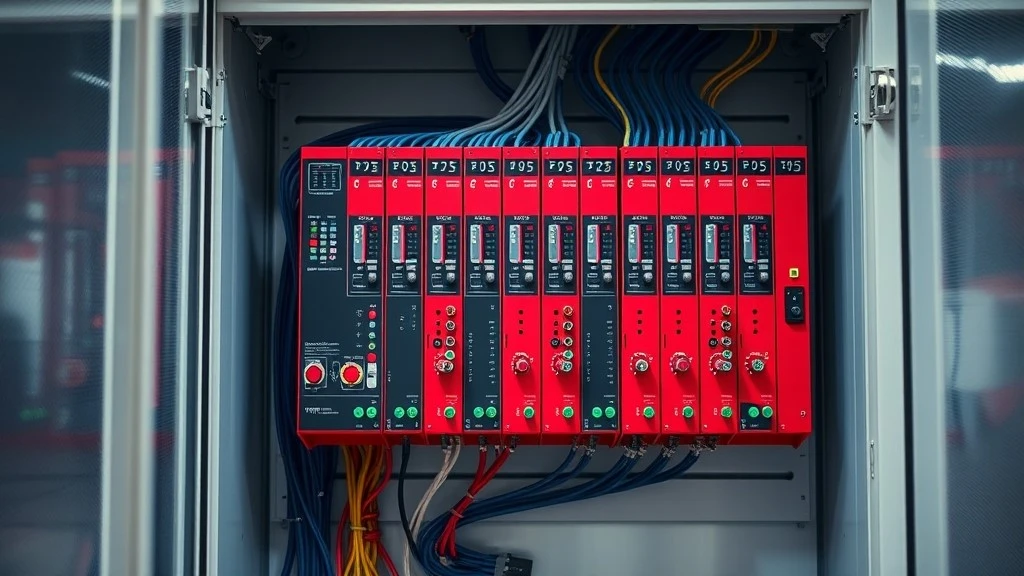
A failed controller on a running line costs money every minute it stays down. A wrong catalog number on a purchase order costs a week. A long lead time on the wrong platform can stall an entire build. If you are holding a bill of materials and deciding which Allen-Bradley PLC to specify, verify, and buy, this guide is written for you, not for someone studying automation theory.
Quick answer: Allen-Bradley is Rockwell Automation's PLC brand. The four families you choose between are ControlLogix (large, 1756), CompactLogix (mid-range, 1769/5069), MicroLogix (legacy small, now being retired), and Micro800 (entry and OEM), with GuardLogix as the safety-rated option. This guide covers how to select the right platform, confirm a unit is genuine, and source it worldwide, including discontinued parts.
This guide is for procurement buyers, maintenance engineers, OEM and panel builders, and plant managers handling spares and replacements, especially outside North America. Start with the platform map, then work through selection, price, obsolescence, authenticity, cross-brand options, and global sourcing.
Allen-Bradley PLC platforms at a glance
Allen-Bradley PLCs sit on one continuum. ControlLogix, CompactLogix, and GuardLogix share the Studio 5000 environment and a common instruction set, so logic moves between them with limited rework. MicroLogix and Micro800 use older or separate software. Use the table as your reference. The short notes below only tell you when each family is the right call.
|
Family |
Series |
I/O scale |
Redundancy |
Motion |
Safety |
Software |
Typical use |
Lifecycle status |
|
ControlLogix |
1756 |
High to very high |
Yes |
Multi-axis |
Via GuardLogix |
Studio 5000 |
Plant-wide, large lines, process |
Active |
|
CompactLogix |
1769 / 5069 |
Low to medium-high |
No |
Yes (scalable) |
Some variants |
Studio 5000 |
Single machines and cells |
Active |
|
MicroLogix |
1100 / 1400 |
Low |
No |
Limited |
No |
RSLogix 500 |
Maintaining existing systems |
Legacy / being retired |
|
Micro800 |
820 / 830 / 850 / 870 |
Low |
No |
Basic |
Some models |
CCW (free) |
Standalone machines, OEM |
Active (entry line) |
|
GuardLogix |
1756/5069 |
Medium to high |
Yes |
Yes |
SIL 2 / SIL 3 |
Studio 5000 |
Safety plus standard control |
Active |
ControlLogix (1756)
Pick ControlLogix for high I/O counts, controller redundancy, several disciplines in one program, or coordinated multi-axis motion. It uses a modular 1756 chassis and suits plant-wide control, large production lines, and process or power applications.
CompactLogix (1769/5069)
Pick CompactLogix for a single machine or cell with a bounded I/O count, where the full ControlLogix chassis would be over-specified. Its buyer advantage is portability: it shares Studio 5000 and the instruction set with ControlLogix, so code and skills carry across.
MicroLogix (1100/1400)
Pick MicroLogix only to maintain an existing installation. It is a legacy platform on RSLogix 500, succeeded by Micro800, and its programs do not port to Studio 5000. Buying it today almost always means sourcing a spare, which leads straight to lifecycle and availability.
Micro800 (820/830/850/870)
Pick Micro800 for simple standalone machines and OEM builds with a tight cost target. It is programmed with Connected Components Workbench (CCW), which is free. It is the current entry line, not a legacy product, which is the key difference from MicroLogix.
GuardLogix
Pick GuardLogix when you need rated functional safety to SIL 2 or SIL 3 and want safety and standard control in one controller rather than separate safety relays or a second PLC. It is the safety-rated member of the ControlLogix family (see Step 4).
The map tells you the options. The next section turns it into a decision.
How to choose the right Allen-Bradley PLC

Selection is not about the "best" PLC. It is about your application narrowing the field to one platform. Work through these seven steps in order, and let each one eliminate options.
Carry one example through them: a packaging cell with three conveyors, one safety zone, roughly 120 I/O points, and EtherNet/IP devices.
Step 1: Count your I/O and types
List your digital and analog points (DI, DO, AI, AO) and add 20 to 30 percent headroom. Consequence: a small fixed count points to Micro800 or MicroLogix, a few hundred points to CompactLogix, and thousands to ControlLogix. Sizing to today's exact count with no room to expand is the most common mistake. Our 120-point example fits CompactLogix.
Step 2: Performance, scan time, and motion axes
Match performance to your fastest loop and your axis count. Consequence: high axis counts, tight scan times, or coordinated motion push you from CompactLogix up to ControlLogix, while basic speed and on/off control stay lower in the range.
Step 3: Communication and protocols
EtherNet/IP is the default for current Allen-Bradley hardware. Check what your existing devices, drives, and remote I/O actually speak. Consequence: legacy DeviceNet, ControlNet, DH+, or serial DF1 may force an older platform or a gateway, which feeds into the obsolescence question below.
Step 4: Safety requirements
Decide whether you need rated functional safety and to which SIL level. Consequence: if you do, weigh integrated safety (GuardLogix) against separate safety relays. Our example has one safety zone, so both options stay on the table.
Step 5: Operating environment
Check ambient temperature, the risk of condensation or corrosive air, and the panel's IP rating. Consequence: extreme temperatures or harsh atmospheres point you to conformal-coated or extended-temperature variants. Specify the actual numbers your site sees.
Step 6: Software and code portability
Studio 5000 covers ControlLogix, CompactLogix, and GuardLogix; RSLogix 500 covers MicroLogix and SLC; CCW covers Micro800. Consequence: your existing code base can lock your platform. A plant standardized on Studio 5000 has a real reason to stay inside the Logix family, because MicroLogix and Micro800 code does not carry over.
Step 7: Budget and total cost of ownership
Look past the controller price to software licensing, modules, spares, and any future migration. Consequence: the cheapest controller is not the cheapest system, which the next section breaks down.
Decision shortcut
- Small standalone machine, tight budget: Micro800
- Mid-size single machine or cell on EtherNet/IP: CompactLogix
- Large or plant-wide, high I/O, redundancy, or heavy motion: ControlLogix
- Any of the above with rated safety: add or step up to GuardLogix
- Maintaining an older system: match the installed platform (often MicroLogix or SLC) and read the lifecycle section first
Complex or mixed applications are worth a second opinion. If you want a sanity check, send your specification to our team and we will confirm the platform before you order.
Allen-Bradley PLC pricing and total cost of ownership
There is no single price for an Allen-Bradley PLC, but there is a clear set of factors that move it. Knowing them lets you budget and read a quote without surprises.
What drives the price
Four things mostly set the number: the platform tier (Micro800 at the low end, ControlLogix processors plus chassis, power, and I/O at the high end), the I/O and module count, the condition of the unit, and how urgent your lead time is. Emergency, same-week sourcing of a discontinued part carries a premium that planned buying avoids.
New vs refurbished vs NOS vs surplus
Four conditions, four trade-offs. Define them once and you will recognize them across the whole market:
- New (authorized): current production, full manufacturer warranty, highest price, and standard lead times that can be long on constrained parts.
- New-old-stock (NOS): never used, original packaging, often from a discontinued line, with price driven by scarcity.
- Refurbished: professionally tested and reconditioned, typically well below new, usually with a supplier warranty.
- Surplus or used: the broadest secondary-market pool, lowest cost and widest availability, and the category where testing, warranty, and authenticity matter most.
The costs that hide in the system
Budget for Studio 5000 licensing where it applies, the modules around the controller (power supply, chassis, I/O, communication cards), critical spares, and any future migration off a legacy platform. Common mistake: comparing two controllers on bare price while ignoring a license or a chassis that only one of them needs.
|
Platform |
Relative cost tier |
Common condition options |
Note |
|
Micro800 |
$ |
New, refurbished |
Lowest entry cost |
|
MicroLogix |
$ to $$ |
NOS, refurbished, surplus |
Legacy, secondary market |
|
CompactLogix |
$$ |
New, refurbished, surplus |
Mid-range |
|
ControlLogix / GuardLogix |
$$$ |
New, refurbished, surplus |
System cost, not just the CPU |
These tiers are for planning only. For a real figure, send your part numbers or BOM and we will return current pricing, condition options, and lead time.
One factor sits above all others for both price and availability: whether your model is still in production.
Lifecycle, obsolescence, and sourcing legacy Allen-Bradley PLCs
Allen-Bradley hardware has a long service life, which means a large installed base is running parts that are no longer in full production. If you are sourcing a spare, lifecycle status decides both the price and how hard the part is to find.
Rockwell lifecycle stages, in buyer's terms
Rockwell moves products through predictable stages. What each one means for you:
- Active: ordered normally, standard lead time.
- Active Mature: still available, but plan ahead. This is the signal to start stocking spares.
- End of Life and Last Time Buy: a final ordering window before production stops, and the moment to secure critical spares.
- Discontinued: no longer produced, so the secondary market becomes your main route.
Which lines are affected
SLC 500 has been retired after decades in service. MicroLogix is a legacy line being succeeded by Micro800. PLC-5 has been discontinued for years. If your panel runs any of these, treat replacement parts as a sourcing project, not a catalog order, and have a plan before a failure forces your hand.
Maintain or migrate
Two questions decide it: how critical is the line, and how available are the spares. Maintain and stock spares when the system is stable and parts are still findable. Migrate when spares are drying up, downtime risk is high, or you are already modernizing. A common path is moving SLC 500 or MicroLogix systems to CompactLogix 5380, which keeps you inside the current Logix and Studio 5000 world. Note that this is an Allen-Bradley to Allen-Bradley upgrade. Switching brands is a separate decision, covered further down.
How to source discontinued parts reliably
For legacy and end-of-life hardware, your options are last-time-buy from authorized channels while the window is open, factory-remanufactured units where available, and vetted independent or surplus suppliers with global reach for parts that are otherwise gone. A supplier network that spans regions matters here, because a part that is unavailable in one market is often in stock in another.
Not sure your model is still obtainable? Send the catalog number and we will tell you what is available, in what condition, and how fast.
Once you are buying legacy or secondary-market hardware, authenticity becomes the main risk.
How to verify genuine Allen-Bradley hardware and avoid counterfeits

As legacy parts get scarcer and more valuable, relabeled and counterfeit units appear. This is a real risk on the secondary market, and the way to manage it is the same whoever you buy from: know what to check and what to demand.
Red flags on the unit itself
Inspect before you install. Warning signs include misaligned or low-quality labels, wrong fonts or logos, poor plastic molding or casing finish, missing or mismatched serial numbers, and no clear record of where the part came from. Any one of these justifies pausing the purchase.
Read and confirm the markings
Three identifiers control both compatibility and authenticity: the catalog number (the model and configuration), the series letter (the hardware revision, which affects compatibility), and the firmware revision (which your application may depend on). Reading them correctly prevents wrong orders as much as it catches fakes: two units with the same catalog number but different series letters are not always interchangeable, so the full marking matters.
Confirm the part is authentic
Verify serial numbers with Rockwell support where possible, ask for test reports, and confirm the firmware identity in software before the unit goes into a live system. A genuine part that has not been verified is still a risk on a running line.
What to require from any supplier
Hold every supplier to the same bar. Ask for functional testing, a clear warranty and its length, traceability for the part's origin, and a straightforward return policy. Use this short checklist on any quote, including ours:
- Unit functionally tested before shipment
- Stated warranty term, in writing
- Catalog number, series letter, and firmware confirmed
- Traceable source and condition disclosed
- Clear return or replacement policy
If genuine, in-production Allen-Bradley hardware is too costly or too slow for your project, a cross-brand equivalent may serve better.
Allen-Bradley PLC cross-brand equivalents and alternatives
Sometimes the right answer is not Allen-Bradley. Long lead times, budget limits, or regional availability can make an equivalent from another brand the better choice. As a multi-brand supplier, we can map these honestly, because we are not tied to one platform.
When an equivalent makes sense
Consider an alternative when Allen-Bradley lead times do not fit your schedule, when the budget rules out a Logix system, when another brand is simply easier to source in your region, or when you are standardizing a site on a different platform. It is a trade-off, not a downgrade.
Rough equivalents by class
The table maps platforms by functional class, not by exact feature. Treat each row as a starting point to verify against your own requirements, never as a drop-in swap.
|
Allen-Bradley class |
Siemens |
Mitsubishi |
Omron |
Schneider |
ABB |
|
Entry / micro (Micro800, MicroLogix) |
S7-1200 |
FX5U (iQ-F) |
CP1 / CP2 |
Modicon M221 / M241 |
AC500-eCo |
|
Compact / mid (CompactLogix) |
S7-1500 |
iQ-R / Q |
NX1P / NJ |
Modicon M251 / M262 / M340 |
AC500 |
|
Large / process (ControlLogix, GuardLogix) |
S7-1500 high-end |
iQ-R |
NJ / NX7 |
Modicon M580 |
AC500 (PM5xx) |
What switching actually costs
Changing brands is not free. Budget for a different programming environment and instruction set, re-wired I/O, retraining, and a new spare-parts ecosystem. "Equivalent" means a comparable functional class, not identical behavior, so validate the choice for your application. This brand switch differs from an Allen-Bradley to Allen-Bradley migration, so weigh the code rewrite carefully.
Not sure what matches your Allen-Bradley part? Send the part number and we will find the equivalent.
Sourcing Allen-Bradley PLCs globally (for international buyers)
Most Allen-Bradley buying guides assume a North American buyer. If you are sourcing from anywhere else, the practical questions are channel, lead time, warranty, and how to actually place the order.
Authorized distributor vs independent supplier
Both have a place. Authorized channels give you current-production parts with the full manufacturer warranty, the right call for new builds where lead time allows. Independent and multi-brand suppliers add value when you need discontinued parts, faster availability, mixed-brand orders on one purchase order, or support in your own time zone. The honest rule: authorized channels for in-production hardware, a vetted independent supplier for legacy parts, speed, and cross-brand sourcing.
Lead time and shipping, realistically
Constrained and discontinued parts can carry long lead times, and shipping distance adds to them. Reduce the risk by sourcing across more than one region, holding buffer stock of critical spares, and buying before a part fails rather than during an outage.
Warranty, testing, and after-sales across borders
Confirm how warranty works when you and the supplier are in different countries: the warranty term, who handles testing, and how a replacement is managed if a part fails on arrival. Get these answers before you order, not after.
How to place an order
When you are ready, the fastest path is a clear request for quote. Include:
- Catalog numbers and quantities
- Acceptable condition (new, NOS, refurbished, or surplus)
- Target lead time and destination country
- Any required certifications or test reports
Send that list and you will get pricing, condition options, and lead time in return. We supply customers in 30+ countries and reply quickly by email at jerry@szct-automation.com or through the contact page.
FAQ

New, refurbished, or surplus: which should I buy?
Do you ship Allen-Bradley PLCs internationally?
What software do I need to program Allen-Bradley PLCs?
What is the lead time to buy an Allen-Bradley PLC?
Can I replace an Allen-Bradley PLC with a Siemens, Mitsubishi, or Omron equivalent?
How can I tell if an Allen-Bradley PLC is genuine?
Your next step
You now have the decision path: map the platform, run the seven-step selection, plan the full cost, check lifecycle before you buy a spare, verify the part is genuine, and weigh a cross-brand equivalent if Allen-Bradley does not fit your schedule or budget. The last step is the order.
Send us your Allen-Bradley part list or BOM and we will return current pricing, condition options, and lead time, including for discontinued parts and cross-brand equivalents.


