


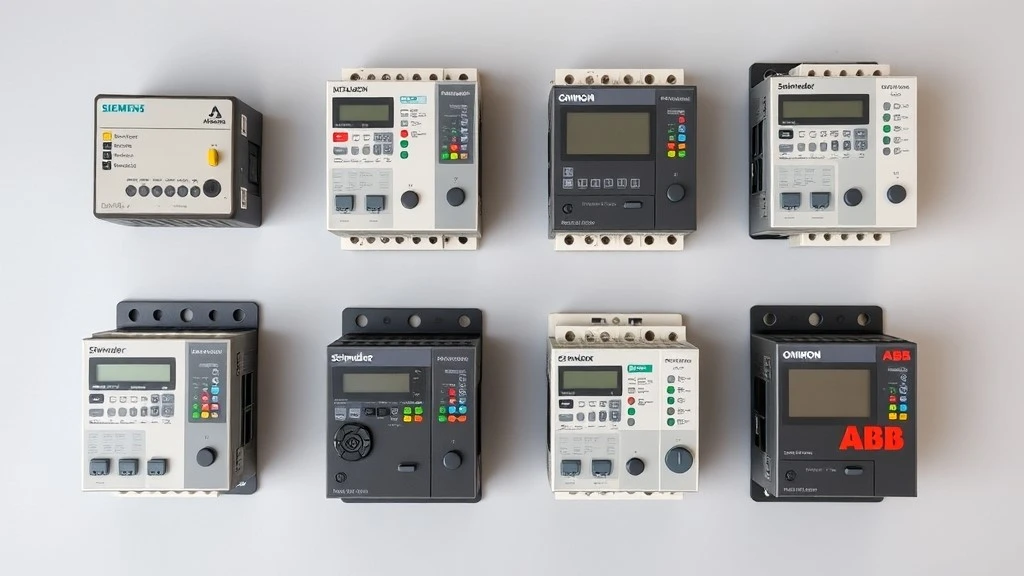
Choosing a PLC brand is only half the job. The other half, getting a genuine unit at a workable price and lead time, is where most projects actually stall. This PLC brand comparison covers both sides. First, it helps you match a brand to your project size, budget, and industry. Then it shows you how to source the right part, avoid counterfeits, handle obsolete modules, and pair the controller with the right HMI and drive. If you are an engineer, buyer, OEM, or system integrator deciding right now, start with the quick answer, then read deeper where it matters.
Quick Answer: Best PLC Brand by Project Size, Industry, and Budget
Before comparing features, apply three filters in order. If a brand is already installed across your plant, default to it. Then match your budget. Then check which brand has real support and stock in your region.
|
Your situation |
Strong picks |
Series to look at |
|
Small machine, tight budget |
Mitsubishi, Delta |
FX5, DVP / AS |
|
Small machine, premium or existing brand |
Siemens, Allen-Bradley |
S7-1200, CompactLogix |
|
Mid-size discrete or process |
Siemens, Allen-Bradley, Omron |
S7-1500, ControlLogix, NX |
|
Large, complex, high availability |
Siemens, Allen-Bradley, Mitsubishi |
S7-1500, ControlLogix, MELSEC iQ-R |
|
Energy, water, infrastructure |
Schneider, ABB, Siemens |
Modicon, AC500, S7-1500 |
|
Cost-driven OEM or export market |
Mitsubishi, Omron, Delta |
FX5, CP, AS |
If you already run one brand plant-wide, staying with it usually beats switching, unless cost or regional support forces a change. The rest of this guide explains the reasoning and, just as important, how to buy the part once you have chosen.
What Matters When Choosing a PLC: 7 Decision Factors
These seven factors are the lens for the brand comparison below. For each one, the question is not the textbook definition but what to check when you weigh one brand against another.
Processing power and scalability
Map your I/O count, scan time needs, and application type before you shop. A small discrete line may need 16 to 64 I/O points, while a mid-size cell runs into the hundreds. Pick modular over fixed I/O if the project will grow, and leave at least 20 percent spare I/O headroom so the next change order does not force a controller swap.
Programming software and ease of use
The hidden cost of a PLC is its software and the learning curve behind it. Each brand ties you to an environment: Siemens TIA Portal, Rockwell Studio 5000, Mitsubishi GX Works, Schneider EcoStruxure Control Expert, Omron Sysmac Studio, and ABB Automation Builder. All support IEC 61131-3 languages, but licensing models differ. The software your team already knows often matters more than any feature sheet.
Communication and Industry 4.0 readiness
Check how the controller joins your existing network and your IT layer. Each brand has a native protocol it does best: PROFINET with Siemens, EtherNet/IP with Allen-Bradley, CC-Link with Mitsubishi, and EtherCAT with Omron. Modbus is broadly supported, and OPC UA handles the path up to MES or the cloud. If your plant already runs PROFINET, a PROFINET-native brand saves gateways and grief.
Reliability, redundancy, and safety
Match the platform to your real availability and safety target, not the highest one available. Continuous process lines may justify redundant CPUs, but most discrete machines do not. If you need functional safety, look at integrated safety controllers such as GuardLogix or the Siemens S7-1500F and confirm the certifications you need (IEC 61508, IEC 61511, and the right SIL level). Ask whether you truly need redundancy before paying for it.
Total cost of ownership, not just price
Look past the sticker. Five-year cost spans five buckets: hardware, software licenses or subscriptions, spare parts, support and training, and downtime risk. A cheap controller is not always cheap over five years, and a premium one is not always worth the premium. Price the whole life, not the purchase order.
Availability, lead time, and lifecycle
Availability is a selection criterion, not an afterthought. Factory lead times for some controllers stretch for months, and every product moves through active, mature, and obsolete stages. A controller you cannot get on time, or that loses support mid-project, is the wrong controller. We cover how to handle this in the sourcing section below.
Local support and sourcing
Finally, ask who supports and supplies you in your region. Authorized channels are strong in their home markets but thin in many emerging ones, where spare-parts logistics and response time often decide a project. How to judge a supplier is covered later in this guide.
The Leading PLC Brands Compared, Plus Budget Alternatives
Below, each brand gets the same treatment: where it leads, where to be careful, the series to look at, and when to choose or avoid it. Price positioning is qualitative here. Indicative numbers sit in the comparison table that follows.
Siemens (SIMATIC S7-1200 / S7-1500)
The global market-share leader, common across Europe and large plants worldwide, built around the unified TIA Portal environment with PROFINET. The S7-1200 suits compact applications, while the S7-1500 covers mid-size to large systems. Watch-outs: premium pricing and licensing complexity. Choose it for scalable, multi-site, or process-heavy systems. Avoid over-specifying it on a tiny single-machine job. Browse Siemens PLC modules in stock.
Allen-Bradley / Rockwell (CompactLogix / ControlLogix)
The default across North America, with a deep Studio 5000 ecosystem and EtherNet/IP. ControlLogix handles large and motion-heavy systems, and CompactLogix fits mid-range work. Watch-outs: the highest price tier and a more closed, region-weighted channel. Choose it if you already run Allen-Bradley or build for North America. Outside that, you often pay more and wait longer for support. MicroLogix remains common as a legacy. Browse Allen-Bradley PLC modules.
Mitsubishi Electric (MELSEC iQ-R / FX5)
Valued for price-to-performance, compact size, and fast scan times, with the CC-Link ecosystem and a strong base in Asia, OEM machinery, and electronics. The FX5 covers compact builds, and MELSEC iQ-R scales up. Watch-outs: support depth outside Asia and a somewhat closed ecosystem. Avoid it where heavy redundancy or process-critical control is the core need. Browse Mitsubishi PLC modules.
Omron (Sysmac NX/NJ/CP series)
Omron's Sysmac platform brings control, motion, vision, and safety into one software environment over EtherCAT, which suits packaging, light automation, and fast commissioning. The CP series covers compact jobs. Watch-outs: a smaller installed base in heavy industry. Avoid it as the backbone of a very large redundant process plant. Browse Omron PLC modules.
Schneider Electric (Modicon / EcoStruxure)
A natural fit for energy, water, and infrastructure, with a Modbus heritage, OPC UA support, and the EcoStruxure platform. The Modicon range runs from the M221 and M241 up to the M340 and M580. Watch out: in pure discrete machine building, it is often seen as the strong runner-up to Siemens and Allen-Bradley. Browse Schneider PLC modules.
ABB (AC500)
Often missed in brand roundups, ABB is strong in process industries, power, utilities, oil and gas, and robotics integration, programmed in Automation Builder. Watch-outs: less common in light discrete machinery and a smaller third-party ecosystem. Choose it for process and energy work, especially where an ABB DCS is already in place. Browse ABB PLC modules.
Budget alternatives: Delta and Inovance
For cost-driven and price-sensitive markets, Delta (DVP, AS) and Inovance (H3U, AM, Easy series) deliver strong value, and their ecosystems keep improving. Watch-outs: thinner global support and documentation and fewer certified integrators. Choose them for cost-driven OEM work and simple to mid-complexity discrete control in regions where they already have an installed base. Avoid them for safety-critical systems or where a global standard is mandated. These are serious options, not afterthoughts, especially when budget drives the decision.
PLC Brand Comparison Table
Use this as a scan layer. Read it alongside the brand notes above, not instead of them.
|
Brand |
Key series |
Software |
Indicative price band* |
Best-fit industries |
Regional strength |
|
Siemens |
S7-1200 / S7-1500 |
TIA Portal |
Mid to premium |
Manufacturing, process, energy |
Europe, global |
|
Allen-Bradley |
CompactLogix / ControlLogix |
Studio 5000 |
Premium |
Automotive, F&B, packaging |
North America |
|
Mitsubishi |
FX5 / MELSEC iQ-R |
GX Works |
Value to mid |
Electronics, OEM, high-speed |
Asia, global |
|
Omron |
CP / NX / NJ |
Sysmac Studio |
Value to mid |
Packaging, light automation |
Asia, global |
|
Schneider |
Modicon M221 to M580 |
EcoStruxure |
Mid |
Energy, water, infrastructure |
Europe, global |
|
ABB |
AC500 |
Automation Builder |
Mid to premium |
Process, power, oil and gas |
Global |
|
Delta / Inovance |
DVP, AS / H3U, AM |
ISPSoft / InoProShop |
Value |
Cost-driven OEM, simple, discrete |
Asia, emerging markets |
*Indicative only. The actual price varies widely by model, I/O count, and configuration. Confirm current pricing, stock, and lead time with your supplier.
Matching the Right PLC to Your Industry
Pick by what the application demands, and then let the brand follow. (Link each industry below to its solution page.)
Energy and utilities. Priorities are reliability, redundancy, remote sites, and long-distance communication. Strong fits: Siemens, ABB, and Schneider.
Food and beverage. Priorities are washdown and hygiene, fast changeover, and batch traceability. Strong fits: Allen-Bradley in North American plants, Mitsubishi for compact lines, and Siemens.
Water treatment and infrastructure. Priorities are distributed sites, SCADA integration, long life cycles, and remote I/O telemetry. Strong fits: Schneider and Siemens.
Packaging and material handling. Priorities are speed, motion synchronization, and quick commissioning. Strong fits: Omron, Mitsubishi, and Allen-Bradley.
OEM machine builders and high-speed automation. Priorities are unit cost, footprint, repeat accuracy, and support in export markets. Strong fits: Mitsubishi, Omron, and Delta, where budget leads.
Do Not Buy a PLC Alone: PLC, HMI, and VFD as One Control Package
Most brand guides stop at the controller. In practice you are buying a control system: a PLC for logic, an HMI for the operator, and a VFD to drive motors. How you combine them affects integration time, compatibility, and who you call when something fails.
Why brand consistency reduces integration risk
Staying inside one ecosystem aligns protocols and data. With Allen-Bradley, tag-based integration links a PanelView HMI and a PowerFlex drive over EtherNet/IP. With Siemens, a Comfort Panel and a SINAMICS drive sit on PROFINET inside TIA Portal. The payoff is shorter commissioning, one software environment, and unified diagnostics. The honest counterpoint: mixing brands can still be the right call when cost, legacy equipment, or a best-in-class component justifies it. A gateway and clear protocol planning make mixed systems work, so go in knowing the trade-off.
Common pairings
A practical starting point, with the reason each set holds together (shared protocol and software):
|
PLC |
HMI |
VFD / drive |
|
Siemens S7 |
Comfort / Basic Panel |
SINAMICS G / V |
|
Allen-Bradley CompactLogix / ControlLogix |
PanelView Plus |
PowerFlex |
|
Mitsubishi MELSEC |
GOT |
FR series |
|
Omron NX / NJ |
NA HMI |
1S / G5 servo |
|
Schneider Modicon |
Magelis / HMIGTO |
Altivar |
|
Delta AS / DVP |
DOP HMI |
MS300 |
Sourcing the full package from one supplier
Buying the PLC, HMI, and VFD from one stocking source has practical upside. Compatibility is checked once; lead times are consolidated; the shipment arrives as one landed cost; warranty and after-sales run through one contact; and you touch fewer points where counterfeits can enter.

Need a matched PLC, HMI, and VFD package?
Get a compatibility-checked quote. See our HMI panels and VFDs.
Sourcing PLCs in 2026: Lead Times, Authenticity, and Obsolete Parts
This is where most buyers get hurt and where most brand guides go silent. The goal here is simple: get the genuine part, on time, without overpaying.
Original vs counterfeit or refurbished: how to tell
You can check authenticity yourself before you trust any seller. Work through a short list: inspect packaging, labels, and anti-counterfeit marks; confirm the batch code and firmware revision make sense for the model; verify the serial number with the original manufacturer; treat a price far below market as a warning; and ask for traceability documents. Insist that the seller clearly states whether a unit is new, genuine, refurbished, or aftermarket. "Refurbished" is not automatically wrong if it is disclosed honestly, but it must be disclosed.
Handling long factory lead times
When the factory quotes twenty weeks or more, you have options. Stocking distributors hold inventory that ships now, often at a premium over the factory price. You can split shipments to start work early, qualify an equivalent replacement, or build buffer into the schedule. The judgment call: wait for the factory when time allows and the saving is real, and go to stock when downtime cost outweighs the premium. Browse PLC modules in stock.
Sourcing discontinued or obsolete modules
If your module is discontinued, first confirm its lifecycle status, then decide between a drop-in replacement and a migration. Surplus and stocking channels often still hold obsolete parts; a last-time buy can bridge a planned phase-out, and sometimes a retrofit is the better long-term move. A line down on an aging S7-300 needs a part this week, not a redesign this quarter, so knowing where stock sits matters.
MOQ, landed cost, and cross-border warranty
For cross-border buyers, the real number is landed cost, not unit price. Check minimum order quantities, factor in duties, freight, and Incoterms, and confirm that any warranty is actually enforceable across borders with the right documentation. A low unit price with a warranty you cannot claim is not a saving.
Looking for a discontinued module or fast delivery? Check live stock availability.
How to Vet a PLC Supplier, Especially for Cross-Border Buyers
Even the right model can fail you if the seller does. Use the standards below to judge any supplier, including us.
Red flags to avoid
Be cautious with a seller that has no verifiable address or history; prices far below the market; offers no written warranty terms; is vague about authenticity or traceability; cannot show real stock; or pressures you to order fast.
Questions to ask before you order
Put these in writing. What are the warranty terms and duration? Is the unit new, refurbished, or aftermarket? Can you prove current stock and confirm lead time? What is the return or RMA process? What payment protection is offered? What documentation ships with the order?
What a reliable multi-brand stocking distributor looks like:
A dependable supplier carries genuine multi-brand stock, has years of trading history, provides traceability and warranty, supports buyers in several languages and regions, and responds fast. Shenzhen Chentuo Technology has operated this way since 2016, stocking Siemens, Allen-Bradley, Mitsubishi, ABB, Omron, Schneider, and more across PLC, HMI, and VFD, with international support. Judge any supplier, us included, against these standards. About Chentuo.
PLC Selection and Sourcing Checklist
Run this before you request a quote:
- Define I/O count, scan needs, and application type, with 20 percent spare I/O
- Decide standard vs safety, and whether redundancy is truly required
- Match the brand to your existing plant standard, budget, and region
- Confirm the programming software fits your team's skills
- Check native communication protocols against your existing network
- Select the matching HMI and VFD for the controller
- Estimate five-year total cost of ownership, not just unit price
- Verify authenticity: serial, batch, firmware, traceability
- Confirm current stock and a realistic lead time
- Check MOQ, landed cost, and cross-border warranty
- Vet the supplier against the red flags and questions above
FAQ

Which PLC brand is best for a small, mid, or large project?
Siemens vs Allen-Bradley vs Mitsubishi: which should I choose?
What is the price range of an industrial PLC?
How can I tell if a PLC is genuine and not a clone?
Where can I buy a discontinued or hard-to-find PLC module?
Can I mix different brands for PLC, HMI, and VFD in one system?
Conclusion: Match the Brand to Your Project, Then Source It Right
Selecting a PLC is two decisions, not one. First, match the brand to your project: default to the brand already in your plant; for a greenfield build, lean on Siemens for scale, Mitsubishi or Delta for cost, and Allen-Bradley for North America. Pair the HMI and VFD from the same ecosystem unless cost says otherwise. Second, source it right: always verify authenticity and confirm lead time before you order, and judge the supplier against clear standards.
Get those two right, and the project runs on time and on budget.


