

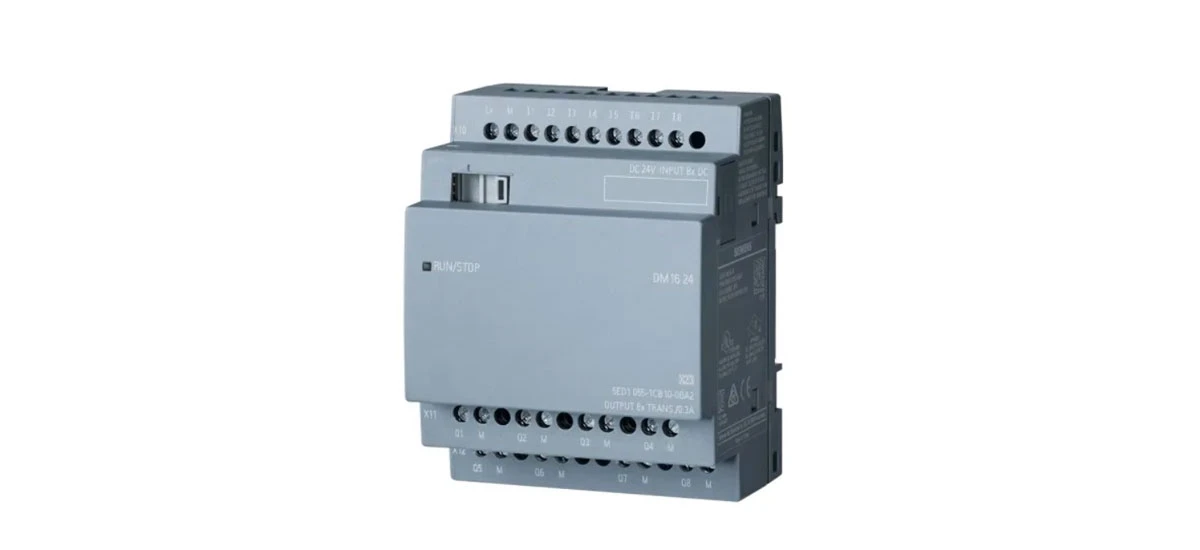
In the world of automation, finding a reliable and cost-effective solution is crucial. Siemens, a well-known name in the industry, offers the LOGO! PLC (Programmable Logic Controller), which has become popular among small and medium-sized businesses. This blog post will be your complete beginner's guide to Siemens LOGO! PLC, especially focusing on the 6ED1055-1CB10-0BA2 model and how it can bring affordable automation to your projects.
What is Siemens LOGO! PLC?
Siemens LOGO! PLC is a compact programmable logic controller. It is designed to manage and automate various processes across different industries such as manufacturing, construction, energy, and even home automation. Its main job is to execute logical functions and monitor and control different devices and systems.
One of the great things about the LOGO! PLC is its small size. It's highly compact, which makes it easy to install in different environments, even when space is limited. This compact design doesn't mean it lacks functionality, though. It comes with a range of features that make it a powerful tool for automation.
Programming Made Easy
Programming the Siemens LOGO! PLC is not as difficult as you might think, especially for beginners. It uses a simple and intuitive programming language. There's a graphical interface that allows programmers to easily create logical functions, set up monitoring, and automate processes.
To program the LOGO! PLC, you typically use the LOGO! Soft Comfort software that comes with it. This software has a user-friendly interface. You can drag and drop different elements to create your program. For example, if you want to create a simple ON/OFF control for a motor, you can find the relevant function block in the software, place it in your program, and connect it to the appropriate input and output. This graphical programming method makes it accessible even to those without a strong programming background.
Inputs and Outputs
The LOGO! PLC has various digital and analog inputs and outputs. These are important as they allow the PLC to connect with sensors, switches, motors, and other devices. For instance, digital inputs can be used to detect if a switch is open or closed. If you have a limit switch on a conveyor belt, you can connect it to a digital input of the LOGO! PLC. When the switch is triggered (the belt reaches a certain point), the PLC can detect this change in the input state.
Analog inputs, on the other hand, are useful for measuring continuous values such as temperature or pressure. If you have a temperature sensor that outputs an analog signal, you can connect it to the analog input of the LOGO! PLC. The PLC can then read this signal and use it for control purposes, like adjusting the speed of a fan to regulate temperature.
The outputs of the LOGO! PLC are used to control devices. Digital outputs can turn on or off a relay, which in turn can control a motor or a light. Analog outputs can be used to control devices that require a variable signal, such as a variable-speed drive for a pump.
The 6ED1055-1CB10-0BA2 Model
The 6ED1055-1CB10-0BA2 is a specific model within the Siemens LOGO! PLC product line. It is a digital expansion module. This means that if the base LOGO! PLC unit doesn't have enough input or output points for your project, you can add the 6ED1055-1CB10-0BA2 module to expand its capabilities.
This module has 8 digital inputs and 8 digital outputs. It operates at a voltage of 24V. With these additional input and output points, you can connect more sensors and control more devices. For example, in a small factory where you need to monitor the status of multiple sensors (like door sensors and light sensors) and control various actuators (such as solenoid valves and small motors), the 6ED1055-1CB10-0BA2 can be a great addition to your LOGO! PLC setup.
Communication Capabilities
Siemens LOGO! PLC, including models that can be paired with the 6ED1055-1CB10-0BA2, supports various communication protocols. This is essential as it enables integration with other systems, data transmission, and remote monitoring.
Some of the common communication protocols it supports are Ethernet, serial connections, Modbus, and Profibus. With Ethernet connectivity, you can connect the LOGO! PLC to a local network or even the internet. This allows you to monitor and control the PLC from a remote location. For example, if you have an automation system in a building and you're at home, you can use a web browser to access the PLC's interface (if properly configured) and check the status of the system or make changes to the program.
Modbus is another widely used protocol. It allows the LOGO! PLC to communicate with other Modbus-compatible devices. This could be other PLCs, sensors, or actuators. If you have a Modbus-enabled temperature sensor, the LOGO! PLC can communicate with it, receive temperature data, and use that information for control operations.
Applications of Siemens LOGO! PLC
The applications of Siemens LOGO! PLC are vast. In industrial settings, it can be used for conveyor belt automation. The LOGO! PLC can control the speed of the conveyor belt and start and stop it based on certain conditions (such as the presence of a product at a specific point). It can also be used for exhaust and filtering systems. For example, it can monitor the air quality in a factory and control the fans in the exhaust system to maintain proper ventilation.
In building automation, the LOGO! PLC is useful for light control. You can program it to turn lights on and off at specific times or based on the amount of natural light in a room. It can also be used for gate and barrier control. For instance, in a parking lot, the LOGO! PLC can control the opening and closing of the gates based on signals from sensors (like vehicle detection sensors).
Even in home automation, the LOGO! PLC can play a role. You can use it to automate simple tasks like turning on the coffee maker in the morning at a set time or controlling the temperature in a room by adjusting the heating or cooling system.
Why Choose Siemens LOGO! PLC for Affordable Automation?
Siemens LOGO! PLC offers several advantages that make it a great choice for affordable automation. Firstly, its cost-effectiveness is a major plus. Compared to some other PLC systems, especially those from competitors, the LOGO! PLC is priced reasonably, making it accessible to small and medium-sized enterprises with limited budgets.
Secondly, its ease of use and programming make it suitable for beginners. You don't need to have years of programming experience or a large team of engineers to get started with the LOGO! PLC. This reduces the training costs and time required to implement an automation system.
The modular design of the LOGO! PLC, which includes the ability to add expansion modules like the 6ED1055-1CB10-0BA2, gives it flexibility. You can start with a basic setup and then expand it as your project requirements grow. This means you don't have to invest a large amount of money upfront in a complex system that you may not fully need at the moment.
In summary, the Siemens LOGO! PLC delivers industrial-grade automation at an accessible price point. With its intuitive programming (LOGO! Soft Comfort), modular expandability (including the 6ED1055-1CB10-0BA2 digital I/O module), and versatile applications from manufacturing to building control, this PLC empowers small businesses and automation beginners to implement efficient systems without complex investments. Start your cost-effective automation journey today-the LOGO! PLC is your reliable partner for scalable control solutions.


