

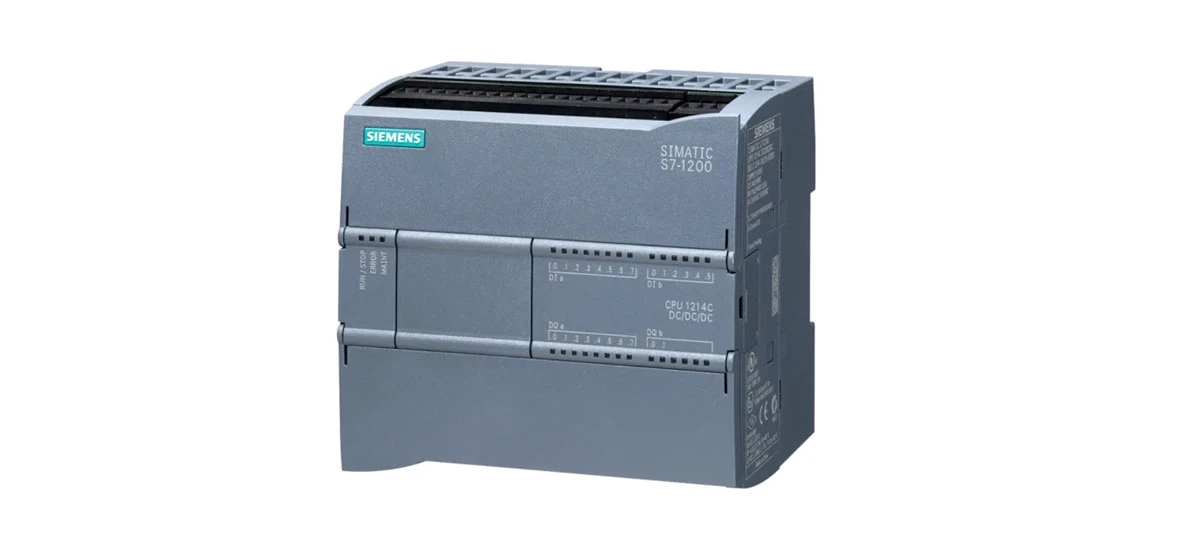
From packaging lines to smart water plants, the Siemens SIMATIC S7-1200 CPU (6ES7214-1AG40-0XB0) solves critical challenges: limited I/O points, legacy system incompatibility, and space constraints. This guide analyzes its hardware design, signal module flexibility, and high-speed processing – empowering you to optimize PLC selection for reliability in harsh environments.
An Overview of the Siemens S7-1200 Series
The Siemens S7-1200 belongs to the SIMATIC family of industrial products, which are noted for their endurance and inventiveness. This series is intended for mid-range applications and bridges the gap between simple controllers and high-end systems, making it appropriate for industries such as manufacturing, energy, and food processing. The SIMATIC S7-1200 CPU serves as the system's brain, processing commands, communicating with other devices, and controlling machinery.
The SIMATIC 1214C (6ES7214-1AG40-0XB0) is one of the most popular CPUs in this series. This model is recognized for its combination of performance, compact size, and low cost. It's designed to handle a variety of easy and moderate automation jobs, making it a popular choice among engineers looking for a dependable solution without excessive complexity.
Key Specifications of the SIMATIC S7-1200 CPU
Processing and Memory for Smooth Operation
The heart of any CPU is its processing power, and the S7-1200 doesn't disappoint. Equipped with a fast processor, it can quickly execute programming languages like ladder logic, which is essential for real-time control in industrial settings. For example, when managing a conveyor belt that needs to start, stop, or adjust speed based on sensor inputs, the CPU processes these commands instantly to keep the system running smoothly.
Memory is another critical specification. The SIMATIC 1214C comes with enough program memory to store detailed automation routines-think of it as the CPU's "brain storage" for all the instructions it needs to follow. This means engineers can write complex programs without worrying about running out of space, whether they're controlling a series of pumps in a water treatment plant or managing a robotic arm in a car factory.
Inputs and Outputs: Connecting to the Physical World
A CPU needs to talk to the outside world through inputs (which receive signals from sensors) and outputs (which send commands to devices like motors or valves). The SIMATIC 1214C has built-in digital and analog inputs/outputs:
- Digital inputs detect on/off signals, such as when a door is open or a switch is pressed.
- Digital outputs control devices that have two states, like turning a light or a motor on or off.
- Analog inputs measure continuous values, such as temperature or pressure (for example, reading a sensor that sends a voltage signal based on how hot an engine is).
While these built-in I/O points are sufficient for many tasks, the S7-1200 is designed to be expanded. If a project needs more inputs or outputs, additional modules can be added, which we'll explore later.
Communication: Connecting to the Industrial Network
Communication is critical in today's networked manufacturing. The S7-1200 CPU supports various protocols, including PROFINET, a high-speed industrial Ethernet standard that connects to HMIs, drives, and PLCs. This means that the CPU may share data in real time, enabling operators to monitor and adjust processes from a central control room.
Optional modules handle older protocols like Modbus and PROFIBUS, ensuring compatibility with both new and existing systems. This adaptability is critical in factories with a mix of old and modern equipment, allowing the S7-1200 to fit into practically any configuration.
The Modular Design: Building a Customized System
The S7-1200's modular architecture allows users to customize the system to meet their individual needs. Instead of purchasing a one-size-fits-all controller, begin with a simple CPU and add modules as your project evolves. Let's look at the basic types of modules:
Signal Modules: Expanding I/O Capabilities
If the built-in inputs and outputs of the CPU aren't enough, signal modules come to the rescue. These modules can be plugged into the CPU to add more digital or analog points. For example:
- A digital input module can connect more sensors, like proximity sensors that detect when a part is in position.
- An analog output module can control devices that require variable signals, such as adjusting the speed of a fan based on temperature readings.
This modularity is perfect for projects that start small but might need to grow later. Imagine a food packaging line that starts with a few machines but expands to include more sensors and motors over time-adding signal modules is a simple way to scale without replacing the entire system.
Communication Modules: Enhancing Connectivity
While the CPU has built-in Ethernet for PROFINET, some applications require connections to various networks and devices.Communication modules address this issue by enabling support for other protocols. For example:
- A RS485 module allows the CPU to communicate with devices that use the Modbus RTU protocol, common in older industrial equipment.
- A PROFIBUS module connects the system to a PROFIBUS network, which is still widely used in many factories.
These modules ensure the S7-1200 can work with almost any device in a plant, making it a versatile choice for complex setups.
Signal Boards: Small Additions for Tight Spaces
Signal boards are ideal for tasks with limited area. These tiny boards attach directly to the CPU and provide a few more inputs or outputs without taking up much space. A signal board with digital outputs can operate multiple valves in a compact machine that cannot accommodate a full-sized module.
Power Supply Modules: Keeping the System Running
A reliable power source is critical for every industrial system. The S7-1200 power supply modules ensure stable 24V DC power for the CPU and related modules. They are designed to withstand electrical supply variations, ensuring that the system remains operational even in locations with unpredictable power, such as isolated factories or places with regular voltage surges.
Hardware Architecture: How It All Fits Together
The physical design of the S7-1200 is both robust and user-friendly, built to withstand the harsh conditions of industrial environments while being easy to install and maintain.
The CPU Module: The Central Hub
The CPU module houses the processor, memory, and built-in I/O interfaces. It's the core of the system, responsible for executing programs and managing communication between modules. The SIMATIC 1214C (6ES7214-1AG40-0XB0) is a prime example, with a compact size that fits easily into control cabinets or small machines, yet powerful enough to handle demanding tasks.
Backplane Bus: The System's Nervous System
All modules-CPU, signal modules, communication modules-are connected via a backplane bus, which acts like a highway for data. This bus allows fast and reliable communication between components, ensuring that data from a sensor in one module reaches the CPU and triggers a response in another module almost instantly.
PROFINET and Ethernet Ports: Built for the Future
The CPU's built-in Ethernet ports support PROFINET, a protocol designed for industrial automation that offers high-speed data transfer and reliability. This is crucial for applications that require real-time coordination, such as a series of robots working together on an assembly line. The ports also support standard Ethernet, making it easy to connect to computers or network devices for programming and monitoring.
Compact and Durable Design
Industrial environments can be tough-there might be dust, vibrations, or wide temperature changes. The S7-1200 is built to handle this, with a rugged casing and a design that fits on a standard DIN rail, making installation quick and secure. Its compact size is a bonus, allowing it to fit into tight spaces where larger controllers can't.
Real-World Applications of the S7-1200
Precision Control in Food Processing
In commercial bakeries, the Siemens S7-1200 CPU (6ES7214-1AG40-0XB0) orchestrates thermal management systems via analog input modules like the SM1231. By continuously monitoring oven temperatures through PT100 sensors (±0.5°C accuracy), the PLC dynamically adjusts heating elements via PWM outputs. Simultaneously, its high-speed counters track conveyor belt positions, synchronizing with digital outputs to regulate motor speeds – ensuring uniform baking while reducing energy waste by 15-20%.
Intelligent Water Treatment Plants
Municipal water facilities leverage the S7-1200's PROFINET integration to create networked purification systems. The SIMATIC 1214C CPU processes signals from ultrasonic level sensors (4-20mA analog inputs), triggering digital outputs to activate pump cascades when reservoirs hit threshold levels. Critical operational data – including pH readings and flow rates – is logged through TIA Portal HMI integration and transmitted to SCADA via Modbus RTU communication modules (e.g., CM 1241 RS485).
Choosing the Right S7-1200 Components
When building a system, start by assessing your needs:
- How many sensors and devices do you need to connect? This will determine if you need extra signal modules.
- What type of communication does your factory use? Choose communication modules that match your network protocols.
- What power conditions do you have? Select a power supply module that can handle your environment's electrical requirements.
The SIMATIC 1214C (6ES7214-1AG40-0XB0) is an excellent starting point for many projects, offering a balanced set of features that can be expanded as needed.
Conclusion
The Siemens S7-1200 CPU, especially the versatile SIMATIC 1214C, is a top choice for industrial automation due to its powerful specifications, modular design, and robust hardware architecture. Whether you're setting up a new system or upgrading an existing one, its ability to handle a range of tasks-from simple on/off control to complex networked processes-makes it a reliable partner.
By understanding its specifications, leveraging its expandable modules, and appreciating its durable hardware, you can create efficient, scalable automation solutions that meet the needs of today's industries. The S7-1200 isn't just a CPU; it's a foundation for building smarter, more connected industrial systems.
For more information on programming the S7-1200 or exploring advanced applications, stay tuned to our blog for future deep dives into industrial automation technology.


