

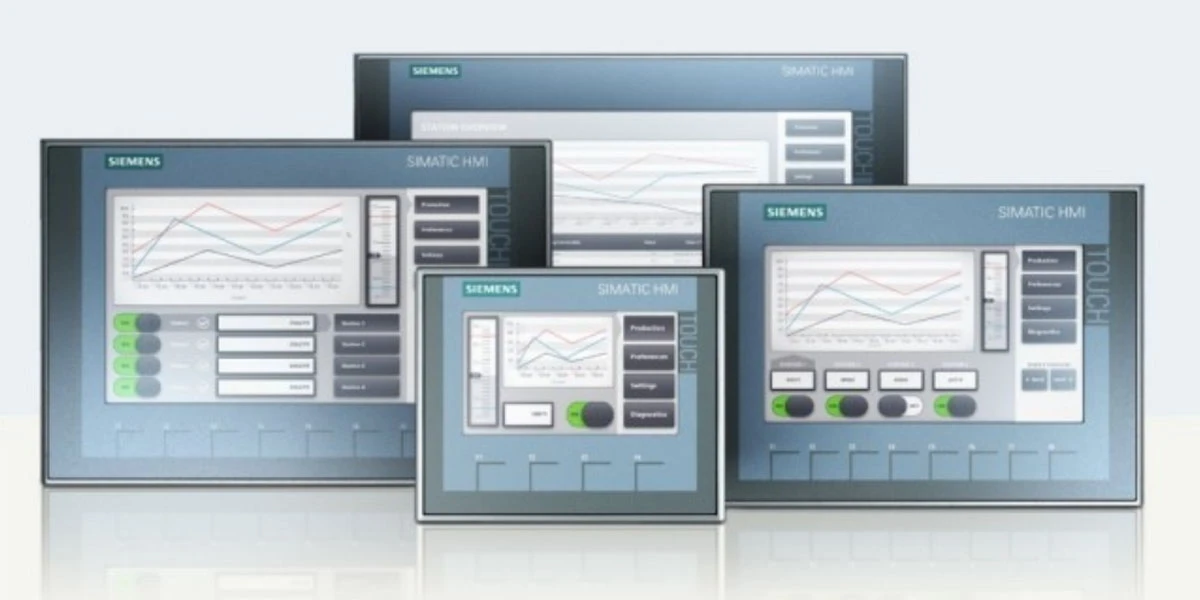
In industrial automation, Human-Machine Interfaces (HMI) bridge operators and machinery, directly impact production efficiency and operational experience. How does the SIMATIC HMI KP700 enhance manufacturing workflows? As a top-tier HMI with PROFINET support, Siemens' KP700 combines advanced technical specifications and flexible application capabilities for diverse industrial fields-from smart factories to energy management. This article explores its core advantages, IoT integration, and real-world applications in automotive, pharmaceuticals, and logistics.
1. Understanding SIMATIC HMI KP700: A Reliable Industrial HMI Solution
The SIMATIC HMI KP700 is a high-performance HMI device designed by Siemens specifically for industrial environments. It aims to provide operators with an intuitive and stable interactive experience. Combining a robust hardware design with powerful software functions, it can adapt to complex industrial settings-maintaining stable operation even in high-temperature, dusty, or vibrating environments. For production lines and control systems that require efficient human-machine interaction, the KP700 is an essential tool to boost operational efficiency.
Core Technical Specifications Analysis
Clear and Intuitive Display & Operation
The KP700 features a 7-inch high-resolution color touchscreen with sharp visuals and vibrant colors, ensuring operators can easily read screen information even in dim or brightly lit environments. The touchscreen supports multi-touch functionality with sensitive response, enabling smooth gestures like pinch-to-zoom and swipe for convenient parameter setting and program monitoring. Paired with physical buttons for quick function switching, it caters to different operation habits and enhances efficiency in scenarios requiring fast task transitions.
Powerful Processing & Memory Configuration
Equipped with a high-performance processor, the device efficiently handles complex industrial data and graphic interface rendering, ensuring smooth screen transitions and real-time data updates. Sufficient memory space allows for running multiple applications and storing large project files, maintaining stable performance even in complex automation systems and preventing lag caused by slow processing or insufficient memory.
Rich Connectivity Options
The KP700 supports multiple industrial communication protocols, including PROFINET, PROFIBUS, and Ethernet/IP, enabling seamless integration with PLCs, sensors, drives, and other devices for real-time data interaction and centralized equipment control. It comes with Ethernet and USB interfaces for easy data transfer-for example, quickly importing/exporting project programs and recipe data via USB to improve engineering debugging and maintenance efficiency.
Durable Industrial Design
Built for harsh industrial environments, the KP700 features a robust casing and compact structure with an IP65 protection rating, effectively resisting dust and water ingress. Its wide operating temperature range (-20°C to +50°C) makes it suitable for various regional and industrial temperature conditions. Resistance to vibration and shock ensures long-term stable operation, reducing failure risks caused by environmental factors.
2. Diverse Applications of SIMATIC HMI KP700 in Industrial Automation
1. Enhancing Production Line Intelligence
In manufacturing production lines, the KP700 plays a key role as an operation terminal. Operators can use the touchscreen to monitor the real-time status of each workstation, including critical parameters like equipment speed, temperature, and output. When a fault occurs, the KP700 immediately displays alarm messages with causes and solutions, helping operators quickly locate and resolve issues to minimize downtime.
For example, in automotive assembly lines, the KP700 connects with PLCs and robot systems at each workstation to enable precise control over the assembly process. Operators can easily switch production modes and set product parameters/formulas via the interface, ensuring smooth assembly of different vehicle models. The device also collects real-time production data to generate reports, providing managers with insights for efficiency analysis and quality tracing.
2. Optimizing Energy Management & Monitoring
In energy production and distribution, the KP700 monitors power generation equipment, substations, and transmission systems. It displays real-time grid parameters like voltage, current, and power, helping operators grasp system status. Connected to energy management systems, it enables real-time consumption monitoring and optimization-automatically adjusting equipment parameters based on load changes to improve energy efficiency.
In power plants, as an operation interface for key equipment like steam turbines and generators, the KP700 allows operators to start/stop and adjust speeds while monitoring real-time parameters and faults. With remote monitoring support, managers can view system status via networks from offices or remote terminals, making timely decisions to ensure a stable and efficient energy supply.
3. Achieving Smart Warehouse Management
In logistics and warehousing, automated storage systems and conveyor lines require efficient HMIs for goods storage, retrieval, and transport control. The KP700 connects with Warehouse Management Systems (WMS) and logistics equipment controls, allowing operators to input storage locations and quantities via the interface. The device then auto-plans storage paths and controls stackers/conveyors for accurate goods handling.
Additionally, it displays real-time inventory status, equipment operation, and goods trajectories, assisting managers with inventory and logistics scheduling. When anomalies like goods jams or equipment faults occur, the interface triggers alarms to prompt timely interventions, ensuring smooth logistics processes.
4. Precise Monitoring of Complex Production Flows
In process control industries like chemicals, pharmaceuticals, and food & beverage, where production flows are complex and parameter control is critical, the KP700 acts as an operation interface for process control systems. It displays key parameters such as temperature, pressure, and flow rate, supporting precise control of valves, pumps, and other actuators.
Operators can set process parameters, start/stop production, and view historical trend curves and alarm records to adjust processes in time, ensuring stable product quality. The device also supports data archiving and report generation for quality analysis and traceability, meeting industry compliance requirements.
3. Three Key Advantages of Choosing SIMATIC HMI KP700
1. Lowering Operational Barriers
The KP700 features a simple, intuitive interface designed for ergonomic use, allowing operators to get started quickly without extensive training. Siemens provides flexible configuration software like WinCC, enabling users to design personalized interfaces with graphics, animations, and reports for enhanced usability. It also supports multi-language switching, which is ideal for international industrial environments.
2. Ensuring Long-Term Stable Operation
As an industrial-grade device, the KP700 undergoes strict testing and validation for exceptional reliability. Its rugged hardware and wide temperature tolerance adapt to harsh environments, reducing malfunctions. Backed by Siemens' strong technical support and service network, it ensures timely fault resolution and maintenance, minimizing production interruptions.
3. Adapting to Diverse Needs
The KP700 supports multiple communication protocols and connection methods and is compatible with different brands and types of industrial equipment for easy integration into existing automation systems. Whether for small single-machine control or large distributed systems, it offers flexible adaptation. Users can choose configurations like a built-in power supply or extended interfaces based on specific needs, fitting diverse industrial scenarios.
4. Maximizing SIMATIC HMI KP700 Performance
1. Designing User-Friendly Interfaces
When developing interfaces with configuration tools such as WinCC flexible, it is critical to adhere to the ideals of simplicity and clarity. Place frequently used features in prominent locations, and avoid unduly complex interfaces. Use appropriate colors and icons to differentiate distinct statuses and functions-for example, red for alarms and green for normal operation-to improve the operator's recognizing efficiency. To reduce operational errors, ensure that the interface's response time and interactive logic are in line with user habits.
2. Regular Equipment Maintenance
While the KP700 is highly reliable, regular upkeep is essential. Clean the screen and casing, check cable connections, and ensure proper heat dissipation. Update firmware and configuration software timely to access new features and optimizations, enhancing stability and security.
3. Integrating with Industrial Internet for Remote Monitoring
Leverage the KP700's network capabilities to connect with industrial internet platforms, enabling remote device monitoring. Managers can view real-time status, receive alarms, and adjust parameters/programs via mobile devices, improving production management efficiency and flexibility.
Conclusion
The SIMATIC HMI KP700 stands out as an ideal HMI solution in industrial automation, thanks to its advanced specs, reliable performance, and flexible applications. From manufacturing to energy and logistics, it delivers efficient, intuitive interaction to boost productivity and optimize processes. As industrial automation evolves, the KP700 will continue to empower enterprises in their smart transformation journey.
If you're seeking a high-performance HMI for industrial environments, the SIMATIC HMI KP700 deserves your attention. For more technical details and application cases, visit the Siemens official website or contact your local dealer for professional support and customized solutions.


