


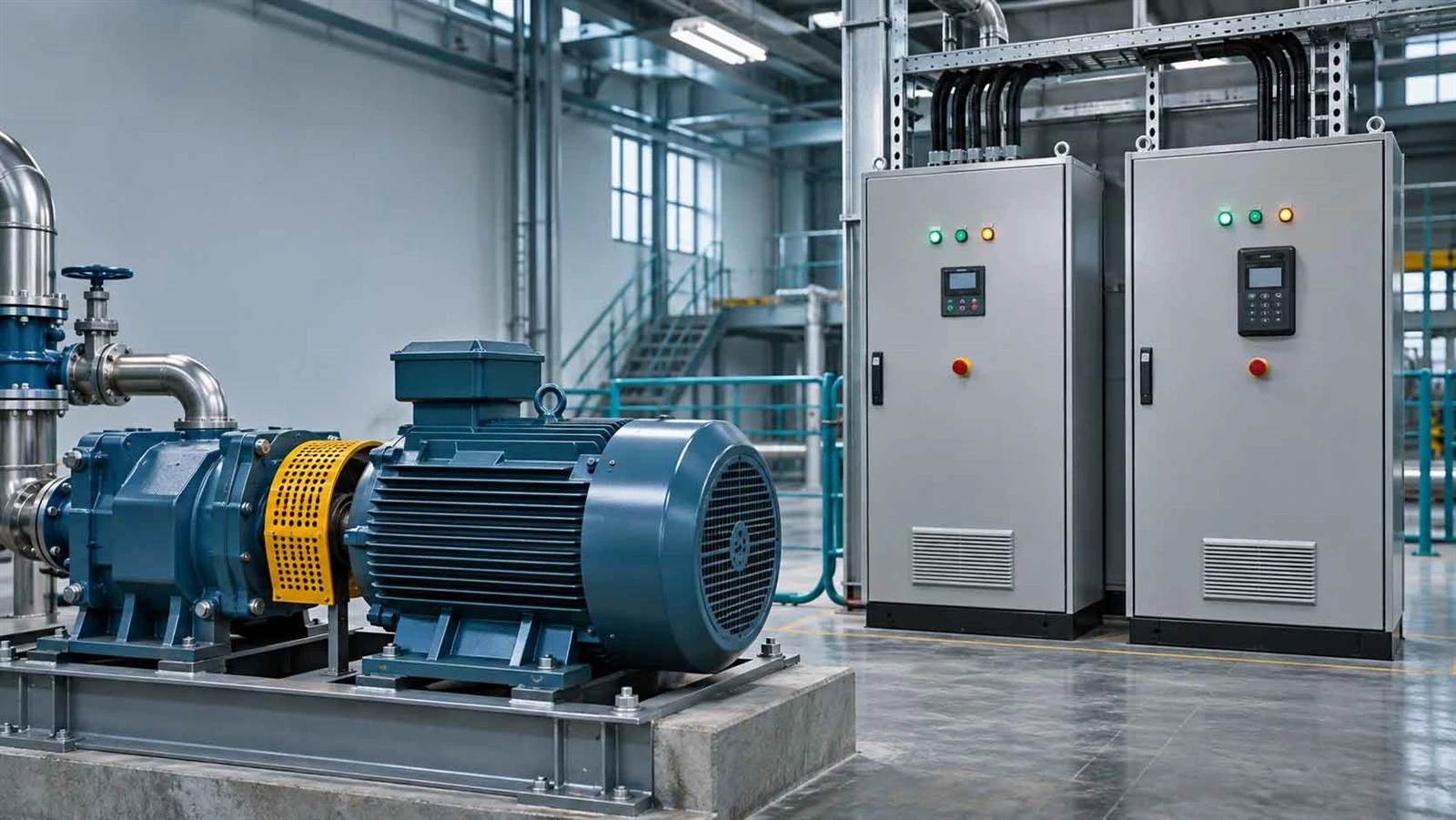
A conveyor repeatedly damages couplings during startup. A pump operates reliably at full speed but creates pressure surges when it stops. Another pump needs to vary flow throughout the day. All three problems involve motor control, but they do not call for the same equipment.
When planning a motor retrofit, the soft starter vs. VFD decision should begin with the problem you can measure, not a product preference. A soft starter may be sufficient for a fixed-speed motor that needs controlled acceleration. A variable frequency drive (VFD) is worth evaluating when the process requires adjustable speed or more flexible motor control. Neither device automatically repairs mechanical defects or replaces every required protection function.
This guide focuses on what to inspect before changing equipment, how to compare suitable solutions, and how to verify whether the retrofit worked. For a broader introduction, see CHENTUO's Soft Starter vs. VFD comparison.
1. Soft Starter or VFD: Which Retrofit Problem Are You Solving?
When a soft starter may be enough
If a motor runs at one fixed speed and the complaint occurs mainly during starting or stopping, investigate a soft starter. Typical concerns include belt shock, coupling stress and voltage dips at startup. Its reduced-voltage starting method must still supply enough torque to accelerate the actual load. Confirm the starts per hour and the manufacturer's thermal limits before choosing a model.
When a VFD is worth evaluating
A VFD changes output frequency and voltage, allowing motor speed to follow production demand. It may be the better option for a pump requiring pressure control, a conveyor with several production speeds, or a process needing controlled low-speed operation. Additional functions bring additional checks, including motor compatibility, cabinet cooling, and control integration. Explore industrial VFD options only after defining those requirements.
Why motor power is not the deciding factor
Two 30 kW motors can have very different starting duties. A centrifugal pump, for example, does not present the same breakaway conditions as a loaded conveyor. The decision depends on torque, inertia, supply limitations and operating speed requirements, not merely the kW or HP printed on the nameplate.
2. How Starting Methods Affect Mechanical Wear
Direct starting and drivetrain shock
With direct-on-line (DOL) starting, the motor receives full supply voltage immediately. The resulting acceleration torque can create abrupt changes in load on couplings, belts, shafts, and gearboxes. Whether those changes cause damage depends on drivetrain design, alignment, and operating conditions. A damaged coupling is evidence of a problem, not proof that DOL starting is its only cause.
What a soft starter changes
A typical soft starter uses silicon controlled rectifiers (SCRs) to regulate applied voltage during acceleration. This can reduce starting current and moderate some torque shocks. However, motor torque available during a reduced-voltage start is also affected. If voltage is reduced too far, the motor may accelerate slowly or fail to start under load. For more detail on starting modes, read CHENTUO's voltage ramp, current limit and torque control guide.
Problems a smooth start cannot repair
Neither a soft starter nor a VFD corrects shaft misalignment, poor lubrication, worn bearings or mechanical looseness. These conditions require separate inspection. Likewise, a drive cannot make an undersized motor mechanically suitable for its load. Diagnose the failure mechanism before buying new control equipment.
Pump stopping and water hammer
Some soft starters offer controlled stopping or dedicated pump functions that can help manage pressure transients. Their effectiveness depends on piping, valves, hydraulic inertia and the actual stopping sequence. Water hammer should therefore be assessed as a hydraulic issue, not treated as a problem that any longer stopping ramp will automatically solve.
3. Motor Protection: What Is Covered and What Is Missing?
Starting control is not condition monitoring
Reducing inrush current helps manage the start event. Motor protection addresses defined electrical or thermal faults. Condition monitoring looks for developing problems such as vibration or bearing temperature changes. These functions overlap in some products, but they are not interchangeable.
Check the exact device's protection functions
Depending on model and configuration, a soft starter may offer electronic overload, phase-loss, stall or overtemperature functions, together with fault records. An industrial VFD may provide a different set of diagnostics and protection settings. Neither category guarantees every function. Verify the applicable manufacturer's documentation and the required protective coordination for the installation.
When external devices are appropriate
A critical motor might justify additional supply monitoring, thermal sensors or vibration monitoring. The decision should reflect the consequences of failure and what the installed controller can actually detect. External protective relays and properly designed safety functions remain necessary where the system design requires them.
Where PLC and HMI equipment fit
A PLC can coordinate commands, permissives and status signals. An HMI can display alarms and operating trends. These components support troubleshooting and operator awareness, but a screen indication is not a substitute for electrical protection or validated safety circuits.
|
Requirement |
What to check before a retrofit |
|
Overload and phase faults |
Existing protection, proposed model features and coordination |
|
Temperature and vibration |
Available sensors and required monitoring intervals |
|
Alarms and operating status |
Controller outputs, PLC inputs and HMI display needs |
|
Machine safety |
Approved safety design and validation responsibilities |
4. Comparing Four Motor Starting Options
Starting current and usable torque
DOL starting applies line voltage directly. Star-delta starting reduces motor winding voltage during the initial stage, but requires a compatible motor and connection arrangement. A soft starter controls applied voltage during acceleration. A VFD varies voltage and frequency. Lower starting current is useful only when the motor still develops sufficient torque for the load.
Running speed and stopping behavior
DOL, star-delta and conventional soft starters generally leave the motor operating at line frequency after startup. A VFD can regulate speed throughout operation. Controlled stopping features differ by device and load; none should be confused with a validated safety stop.
Protection, panel design and total cost
Evaluate each option as an installed system. Required protection, bypass arrangements, heat dissipation, wiring, electromagnetic compatibility (EMC) and commissioning time can change the final cost. For the basic equipment distinctions, CHENTUO also has a contactor, motor starter, soft starter and VFD guide.
|
Criterion |
DOL |
Star-delta |
Soft starter |
VFD |
|
Starting method |
Full voltage |
Reduced-voltage stage |
Controlled voltage |
Controlled frequency and voltage |
|
Continuous speed adjustment |
No |
No |
Generally no |
Yes |
|
Starting torque consideration |
High available torque, potentially high shock |
Reduced initial torque |
Must suit voltage ramp and load |
Depends on drive rating and control mode |
|
Main retrofit value |
Simplicity |
Reduced-voltage starting with compatible motor |
Controlled fixed-speed startup |
Adjustable-speed process control |
|
Additional checks |
Supply and mechanical stress |
Motor terminals and transition |
Duty, heat and protection |
Motor, cabling, cooling, EMC and controls |
5. Match the Solution to the Application
Pumps: pressure, flow and stopping transients
For a fixed-speed pump, the main retrofit goal may be to reduce starting shock or improve stopping behavior. For variable flow or pressure, speed control may deliver greater process value. Review the system curve, valves and allowable operating range. A VFD does not automatically eliminate water hammer or guarantee energy savings.
Conveyors: loaded starts and belt tension
Check whether the conveyor starts empty or loaded, whether speed must change, and whether the reported wear correlates with starts. A fixed-speed conveyor with adequate starting torque may suit a soft starter. A conveyor requiring variable production rates or more flexible low-speed control may justify a VFD. Mechanical alignment still needs attention in both cases.
Fans and compressors: different load profiles
A variable-airflow fan can benefit from speed regulation when process demand changes. Compressors vary considerably by type and unloading arrangement, so their operating restrictions must be checked separately. Avoid applying one fan energy model to every compressor or assuming all machines tolerate a wide speed range.
Mixers and crushers: difficult starting loads
High inertia, material buildup and elevated breakaway torque can challenge reduced-voltage starting. Before choosing a soft starter, confirm that the accelerating torque remains adequate. A suitably selected VFD may offer more control, but it cannot resolve a jam or an incorrectly sized mechanical drive.
6. How to Specify Equipment for a Retrofit
Collect the motor nameplate information
Record rated voltage, full-load current (FLA), power, frequency, speed and connection details. Photograph the nameplate and capture the existing controller's full catalog number. Nominal horsepower alone does not establish replacement compatibility.
Describe the actual starting duty
State the driven machine, loaded or unloaded starting condition, estimated inertia, starts per hour, required acceleration time and expected speed range. These details distinguish a demanding starting application from a simple fixed-speed duty. For soft starter calculations and derating, refer to CHENTUO's real-world soft starter sizing guide.
Review supply and installation conditions
Confirm supply voltage, phase, available capacity, ambient temperature, altitude, enclosure ventilation and applicable derating. For a VFD retrofit, also examine motor insulation suitability, long motor cables, output filtering needs and cooling at reduced speed. Compare the proposed drive's continuous output current and overload rating with the motor and actual duty.
Confirm protection and integration requirements
List required protective devices, start and stop commands, analog signals, communication protocols, PLC interlocks and HMI information. A compatible connector or Ethernet port does not prove that a new device will work with an existing program. Safety functions require an approved design and separate validation.
Verify the actual model documentation
Check the manufacturer's installation and selection manuals for the exact model, firmware and options. Treat a similar kW rating as an initial filter, never final approval. If evaluating a drive, the CHENTUO VFD product range can help identify product families for a model-specific inquiry.
Retrofit specification sheet: Motor model and FLA | Existing starter or drive model | Load type | Starts per hour | Required speed range | Supply voltage | Cabinet environment | PLC or HMI interfaces | Quantity.
7. Verify Performance After Installation
Establish a baseline first
Before modifying the system, record comparable startup current, acceleration time, operating load, vibration observations, trips, maintenance events and downtime. Note the measurement method and operating conditions. Without a baseline, a claim of reduced mechanical wear is difficult to verify.
Test the start and stop under approved conditions
Commissioning should follow the actual equipment manuals and the site's approved safety procedures. Authorized personnel should confirm command response, rotation, acceleration, stopping behavior, load performance and protective functions. Do not bypass interlocks or raise current limits simply to make a test pass. See the VFD commissioning checklist for a more detailed handover process.
Track changes that matter
Use the same or comparable operating conditions before and after the retrofit. A single successful start is not evidence of longer component life. Track maintenance frequency and trip rate over a meaningful period, while accounting for production hours and load changes.
|
Measure |
Baseline |
Post-retrofit evidence |
|
Starting current and acceleration time |
Recorded test |
Repeatable loaded test |
|
Vibration or mechanical shock |
Same measurement location |
Comparable operating condition |
|
Faults and downtime |
Historical rate |
Rate per operating hour |
|
Coupling or belt maintenance |
Work order history |
Follow-up maintenance records |
Define acceptance criteria
Set pass or fail criteria from the machine's design requirements, manufacturer limits and project objectives. A satisfactory retrofit must meet the required production duty and protection requirements, not merely start without a fault message.
8. Three Illustrative Retrofit Decisions
These examples are hypothetical decision exercises, not reported CHENTUO customer projects.
Scenario 1: Fixed-speed conveyor with coupling damage
Problem: Couplings need frequent replacement, and the conveyor starts at a fixed production speed. Evidence to collect: Alignment, loaded starting conditions, starting current, torque demand and maintenance history. Candidate approach: Investigate mechanical causes, then evaluate a soft starter if controlled acceleration addresses the verified problem. Verification: Compare starting behavior and coupling maintenance records under similar operating conditions.
Scenario 2: Water pump with changing flow demand
Problem: The pump runs against a throttled valve, while required flow varies during the shift. Evidence to collect: Flow profile, pressure targets, pump operating limits and annual operating hours. Candidate approach: Evaluate a VFD because speed adjustment could support process control. Verification: Confirm stable pressure or flow and compare measured energy under representative conditions, rather than assuming a fixed savings percentage.
Scenario 3: Loaded mixer struggling to accelerate
Problem: A mixer starts inconsistently when material is present. Evidence to collect: Mechanical condition, breakaway torque, load inertia, motor ratings and start duration. Candidate approach: Determine whether reduced-voltage starting provides enough torque; assess a suitable VFD or another engineered solution if it does not. Verification: Demonstrate reliable acceleration and acceptable motor thermal behavior during approved loaded tests.
9. Evaluate Total Cost of Ownership
Equipment and installation
Compare the complete project, including controller, protective devices, cabinet changes, wiring, engineering and commissioning. A low equipment price can be misleading if the retrofit requires substantial panel work or downtime.
Energy during normal operation
Reducing inrush current does not automatically reduce electricity used while a motor runs at full speed. A VFD can reduce energy use when the process permits lower motor speed, especially in suitable variable-torque applications. Actual savings depend on the operating profile, pump or fan system, drive losses and controls.
Maintenance and downtime
Include verified costs related to belts, couplings, bearings, spare parts and interrupted production. Do not assign unrelated mechanical failures to the starting method. The baseline collected earlier provides a more defensible comparison than generic claims about equipment lifespan.
Payback calculation
A simple estimate is payback period = incremental installed investment / annual net verified savings. Annual net savings should account for additional maintenance and operating expenses. For example, a hypothetical $6,000 incremental investment with $2,000 in verified annual net savings produces a three-year simple payback. That is a calculation example, not a performance claim for any CHENTUO product.
10. Common Mistakes That Undermine Retrofits
Starting voltage is set too low
Reducing applied voltage too aggressively can leave insufficient accelerating torque. Check the observed start, the load requirement and the model-specific instructions instead of aiming for the lowest current reading.
The acceleration ramp is too long
A long ramp may prolong motor heating or stall a difficult load. A smooth-looking transition is not automatically a successful one; the motor must reach operating speed within its permitted thermal duty.
Starts per hour are ignored
Repeated starting generates heat in the motor and controller. Check start frequency, cooling intervals and the manufacturer's permitted duty rather than assuming one successful start proves the equipment is correctly sized.
Built-in protection is overestimated
Some functions are optional or differ across series. Confirm overload, phase and fault functions against the exact model, and check whether external protective equipment remains required.
VFD compatibility is assumed
An existing motor may need an insulation or low-speed cooling review. Control interfaces, braking provisions, motor cable length and EMC design can also affect retrofit feasibility. Never substitute a drive solely because voltage and horsepower appear to match.
11. Final Selection Checklist Before Requesting a Quote
Make the decision in five steps
- Identify the documented problem, such as starting shock, variable-flow demand or repeated trips.
- Record motor ratings and real load conditions.
- Decide whether continuous speed control is required.
- Verify starting torque, thermal duty, protection and system compatibility.
- Define acceptance tests and compare total installed costs.
Send information a supplier can use
For a useful inquiry, provide the motor nameplate, existing device model, application, speed requirements, electrical supply, environment, interfaces, required quantity and destination country. A photo of the existing nameplate and control panel often helps clarify a replacement request.
Discuss VFD and automation requirements with CHENTUO
CHENTUO's website covers VFDs, PLCs, HMIs and industrial automation products. If a VFD or related component appears suitable, send the specifications for product availability and model matching review. Final compatibility must be checked against the selected equipment's documentation.
Next step: Request a VFD and automation equipment quote.
FAQ

How can I tell whether startup is causing coupling wear?
Can a soft starter provide overload and phase-loss protection?
Why can a motor overheat during a long soft start?
What measurements show that a retrofit has improved reliability?
Can a PLC or HMI replace a motor protection relay?
What should I include in a VFD retrofit quotation request?
Conclusion
A successful motor retrofit begins with evidence. Identify whether the real issue is startup shock, insufficient starting torque, missing protection or a need for speed control. Select equipment against the actual load and manufacturer ratings, then confirm the result through documented commissioning and operating records. If your project points toward a VFD or related automation equipment, share your application details with CHENTUO for a model-specific inquiry.


