


As a supplier of Mitsubishi Variable Frequency Drives (VFDs), I often encounter inquiries from customers about the features and capabilities of these devices. One common question that comes up is whether Mitsubishi VFDs have a built - in PID (Proportional - Integral - Derivative) controller. In this blog post, I'll delve into this topic to provide a comprehensive answer.
Understanding PID Controllers
Before we discuss whether Mitsubishi VFDs have built - in PID controllers, it's essential to understand what a PID controller is and its significance in industrial applications. A PID controller is a widely used control algorithm in industrial automation. It calculates an error value as the difference between a desired setpoint and a measured process variable. Based on this error, the PID controller adjusts the output to minimize the error over time.
The three components of a PID controller - proportional, integral, and derivative - work together to provide precise control. The proportional term provides an output proportional to the current error, the integral term accumulates the error over time to eliminate steady - state errors, and the derivative term predicts future errors based on the rate of change of the error.
Mitsubishi VFDs and Built - in PID Controllers
Many Mitsubishi VFD models do come with a built - in PID controller. This feature is a significant advantage for customers as it simplifies the control system design and reduces the need for additional external control devices.
Let's take a look at some popular Mitsubishi VFD models and their PID capabilities:
Mitsubishi FR - CS84 - 080 - 60
The Mitsubishi FR - CS84 - 080 - 60 is a high - performance VFD that offers a built - in PID controller. This allows users to easily implement closed - loop control systems, such as controlling the speed of a motor based on a feedback signal like pressure or flow. With the built - in PID function, users can set the desired setpoint and let the VFD automatically adjust the motor speed to maintain the setpoint, providing stable and efficient operation.
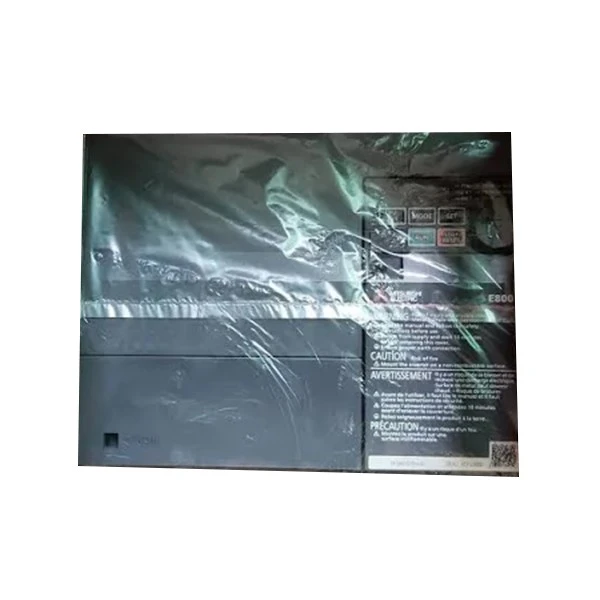
Mitsubishi Electric FR - E840 - 0120 - 4 - 60
The Mitsubishi Electric FR - E840 - 0120 - 4 - 60 is another excellent example. It comes equipped with a powerful PID control function that can handle a wide range of applications. Whether it's controlling the temperature in a heating system or the level in a tank, the PID controller in the FR - E840 can be easily configured to meet the specific requirements of the application. The user - friendly interface allows for quick and easy parameter setting, making it accessible even for users with limited technical expertise.
FR - A840 - 00170 - 2 - 60 Mitsubishi
The FR - A840 - 00170 - 2 - 60 Mitsubishi is also well - known for its advanced features, including a built - in PID controller. This VFD offers enhanced PID control performance, with features such as auto - tuning of PID parameters. Auto - tuning automatically adjusts the PID parameters to optimize the control performance based on the characteristics of the load and the process. This ensures that the system operates at its best, reducing energy consumption and improving product quality.
Benefits of Using Mitsubishi VFDs with Built - in PID Controllers
There are several benefits to using Mitsubishi VFDs with built - in PID controllers:
Simplified System Design
By having a built - in PID controller, there is no need to purchase and install a separate PID controller. This simplifies the overall system design, reduces the number of components, and saves space in the control panel.
Cost - Effective
Eliminating the need for an external PID controller reduces the cost of the control system. Additionally, the energy savings achieved through precise control can lead to long - term cost savings.
Ease of Use
Mitsubishi VFDs are designed with user - friendly interfaces, making it easy to configure and operate the built - in PID controller. Even users with limited programming knowledge can quickly set up the PID control parameters.
Improved Control Performance
The built - in PID controllers in Mitsubishi VFDs offer high - precision control, ensuring stable operation and better product quality. They can quickly respond to changes in the process variable and adjust the output to maintain the desired setpoint.
Applications of Mitsubishi VFDs with PID Controllers
Mitsubishi VFDs with built - in PID controllers are used in a wide range of applications:

HVAC Systems
In heating, ventilation, and air - conditioning (HVAC) systems, PID controllers can be used to control the temperature, humidity, and air flow. For example, the VFD can adjust the speed of the fan based on the temperature sensor feedback to maintain a constant temperature in a room.
Water Treatment Plants
In water treatment plants, PID controllers can be used to control the flow rate, pressure, and level of water in various processes. The VFD can adjust the speed of the pumps to ensure that the water treatment process operates efficiently.
Industrial Manufacturing
In industrial manufacturing, PID controllers are used to control the speed of conveyor belts, the temperature of furnaces, and the pressure in hydraulic systems. This helps to improve the quality of the products and increase the productivity of the manufacturing process.
How to Configure the PID Controller in Mitsubishi VFDs
Configuring the PID controller in Mitsubishi VFDs is a relatively straightforward process. Here are the general steps:
- Set the Setpoint: Determine the desired value of the process variable, such as temperature or pressure, and set it as the setpoint in the VFD's parameter settings.
- Connect the Feedback Signal: Connect the sensor that measures the process variable to the VFD. The VFD will use this feedback signal to calculate the error between the setpoint and the actual value.
- Adjust the PID Parameters: The PID parameters, including the proportional gain, integral time, and derivative time, need to be adjusted to optimize the control performance. Some Mitsubishi VFDs offer auto - tuning functions that can automatically adjust these parameters.
- Test and Fine - Tune: After setting the parameters, test the system to ensure that it operates as expected. Make any necessary fine - tuning adjustments to the PID parameters based on the test results.
Conclusion
In conclusion, many Mitsubishi VFD models do have a built - in PID controller, which provides a convenient and cost - effective solution for implementing closed - loop control systems. The built - in PID controllers offer high - precision control, simplified system design, and ease of use. Whether you are in the HVAC, water treatment, or industrial manufacturing industry, Mitsubishi VFDs with built - in PID controllers can help you achieve better control performance and improve the efficiency of your processes.
If you are interested in purchasing Mitsubishi VFDs or have any questions about their built - in PID controllers, please feel free to contact us for more information and to discuss your specific requirements. We are here to provide you with the best solutions and support.
References
- Mitsubishi Electric Corporation. Variable Frequency Drive Product Manuals.
- Industrial Automation Handbook, various editions.


