


As a supplier of ABB PLC modules, I am often asked about how to use the analog input/output functions of these modules. In this blog post, I will provide a comprehensive guide on this topic, covering everything from the basics of analog signals to the practical steps of configuring and using ABB PLC modules for analog input/output.
Understanding Analog Signals
Before diving into the details of using ABB PLC modules for analog input/output, it's important to understand what analog signals are. Analog signals are continuous signals that can take on any value within a certain range. In the context of industrial automation, analog signals are commonly used to represent physical quantities such as temperature, pressure, flow, and level.
Unlike digital signals, which can only have two states (on or off), analog signals can have an infinite number of values. This makes them more suitable for representing real-world physical quantities that vary continuously. However, it also means that analog signals require more complex processing and conversion to be used effectively in a digital system like a PLC.
Types of ABB PLC Analog Input/Output Modules
ABB offers a wide range of PLC modules for analog input/output, each designed to meet specific application requirements. Some of the most common types of ABB PLC analog input/output modules include:
- AI845 ABB Analog Input Module: This module is designed to measure analog input signals such as voltage, current, and resistance. It has high accuracy and resolution, making it suitable for applications that require precise measurement of physical quantities. AI845 ABB Analog Input Module
- ABB MS116-2.5A: This is an analog output module that can be used to control analog devices such as valves, actuators, and variable speed drives. It can output a current or voltage signal within a specified range, allowing for precise control of the connected device. ABB MS116-2.5A
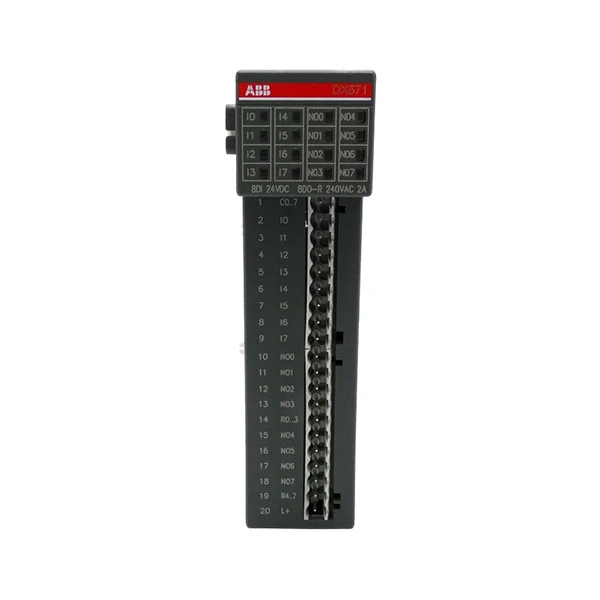
- ABB DX571 1TNE968902R2302: This module combines both analog input and output functions in a single unit. It can measure multiple analog input signals and output analog control signals, making it a versatile solution for many industrial applications. ABB DX571 1TNE968902R2302
Configuring ABB PLC Analog Input Modules
The first step in using ABB PLC analog input modules is to configure them correctly. This involves setting up the module parameters such as the input signal type (voltage or current), the input range, and the sampling rate.
- Determine the Input Signal Type: The first thing you need to do is determine the type of analog input signal you will be measuring. This could be a voltage signal (e.g., 0 - 10V) or a current signal (e.g., 4 - 20mA). Make sure to select the appropriate input signal type in the module configuration.
- Set the Input Range: Once you have determined the input signal type, you need to set the input range. This is the range of values that the module can measure. For example, if you are measuring a 4 - 20mA current signal, you would set the input range to 4 - 20mA.
- Configure the Sampling Rate: The sampling rate determines how often the module will sample the input signal. A higher sampling rate means that the module will capture more data points, but it also requires more processing power. You need to choose a sampling rate that is appropriate for your application.
Most ABB PLC analog input modules can be configured using the ABB PLC programming software. Simply connect the module to the PLC, open the programming software, and navigate to the module configuration settings. Follow the on-screen instructions to set up the module parameters.
Reading Analog Input Values
After configuring the ABB PLC analog input module, you can start reading the analog input values. The analog input values are typically read as digital values in the PLC memory. These digital values need to be converted to real-world physical values using a scaling formula.
The scaling formula depends on the input signal type and range. For example, if you are measuring a 4 - 20mA current signal and the module is configured to output a digital value in the range of 0 - 32767, the scaling formula would be:
[Physical\ Value=\frac{(Digital\ Value - 0)}{32767}\times(20 - 4)+4]
In your PLC program, you can use ladder logic or other programming instructions to read the digital value from the module and apply the scaling formula to convert it to a real-world physical value.

Configuring ABB PLC Analog Output Modules
Configuring ABB PLC analog output modules is similar to configuring analog input modules. You need to set up the module parameters such as the output signal type (voltage or current), the output range, and the resolution.
- Determine the Output Signal Type: The first step is to determine the type of analog output signal you will be using to control the connected device. This could be a voltage signal (e.g., 0 - 10V) or a current signal (e.g., 4 - 20mA).
- Set the Output Range: Once you have determined the output signal type, you need to set the output range. This is the range of values that the module can output. For example, if you are controlling a valve with a 4 - 20mA current signal, you would set the output range to 4 - 20mA.
- Configure the Resolution: The resolution determines the smallest increment by which the output signal can be changed. A higher resolution means that the module can provide more precise control of the connected device.
Again, most ABB PLC analog output modules can be configured using the ABB PLC programming software. Connect the module to the PLC, open the programming software, and navigate to the module configuration settings to set up the module parameters.
Writing Analog Output Values
After configuring the ABB PLC analog output module, you can start writing analog output values to control the connected device. The analog output values are typically written as digital values in the PLC memory. These digital values need to be converted to the appropriate output signal using a scaling formula.
The scaling formula for analog output is similar to the scaling formula for analog input. For example, if you want to output a 4 - 20mA current signal and the module is configured to accept a digital value in the range of 0 - 32767, the scaling formula would be:
[Digital\ Value=\frac{(Physical\ Value - 4)}{(20 - 4)}\times32767]
In your PLC program, you can use ladder logic or other programming instructions to calculate the digital value based on the desired physical value and write it to the module output.
Troubleshooting Analog Input/Output Issues
Sometimes, you may encounter issues when using ABB PLC analog input/output modules. Here are some common issues and their possible solutions:
- Inaccurate Readings: If you are getting inaccurate analog input readings, check the input signal type and range settings. Make sure that the input signal is within the specified range and that the module is configured correctly. Also, check for any electrical interference or noise in the input signal.
- No Output Signal: If the analog output module is not providing an output signal, check the output signal type and range settings. Make sure that the module is powered on and that the connected device is functioning properly. Also, check for any wiring issues or loose connections.
- Communication Errors: If you are experiencing communication errors between the PLC and the analog input/output module, check the communication settings. Make sure that the module is connected correctly to the PLC and that the communication protocol is configured correctly.
Conclusion
Using the analog input/output functions of ABB PLC modules is an important part of industrial automation. By understanding the basics of analog signals, configuring the modules correctly, and using the appropriate scaling formulas, you can effectively measure and control real-world physical quantities using ABB PLCs.
If you have any questions or need further assistance with using ABB PLC analog input/output modules, please feel free to contact us. We are a leading supplier of ABB PLC modules and can provide you with the technical support and products you need for your industrial automation projects. Whether you are looking for AI845 ABB Analog Input Module, ABB MS116-2.5A, or ABB DX571 1TNE968902R2302, we have the expertise and inventory to meet your requirements. Contact us today to start your procurement process and discuss your specific needs.
References
- ABB PLC User Manuals
- Industrial Automation Handbook


