


As a supplier of Omron Variable Frequency Drives (VFDs), I've witnessed firsthand the transformative impact these devices can have on industrial operations. One of the most powerful features of Omron VFDs is their feedback control function, which allows for precise and efficient motor control. In this blog post, I'll share some insights on how to effectively use the feedback control function of Omron VFDs.
Understanding Feedback Control
Before diving into the specifics of using the feedback control function, it's important to understand what feedback control is and why it's important. Feedback control is a system in which the output of a process is measured and compared to a desired setpoint. Based on this comparison, the input to the process is adjusted to bring the output closer to the setpoint. In the context of VFDs, feedback control is used to regulate the speed, torque, or position of a motor.

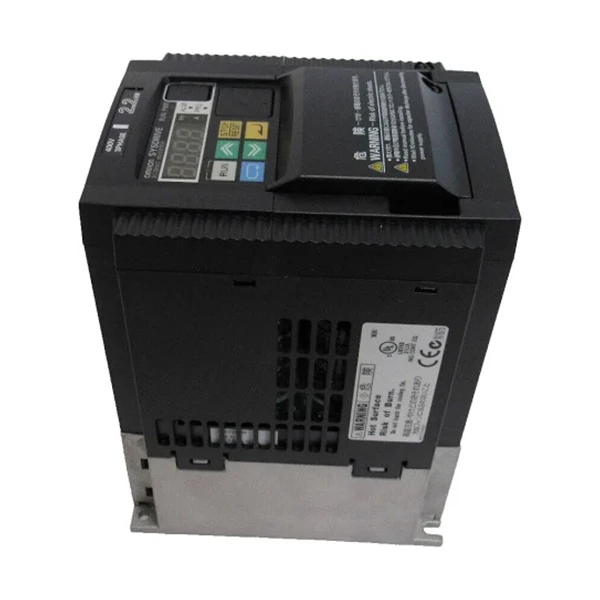
There are two main types of feedback control: open-loop and closed-loop. In an open-loop system, the input to the process is determined without considering the output. This type of control is simple and inexpensive, but it's not very accurate because it doesn't account for changes in the process or external disturbances. In a closed-loop system, the output of the process is continuously monitored and used to adjust the input. This type of control is more complex and expensive, but it's much more accurate because it can compensate for changes in the process or external disturbances.
Types of Feedback Sensors
To implement closed-loop feedback control, you need a feedback sensor to measure the output of the process. Omron VFDs support a variety of feedback sensors, including encoders, resolvers, and tachometers.
- Encoders: Encoders are the most commonly used feedback sensors for VFDs. They provide high-resolution position and speed feedback by generating a series of electrical pulses as the motor rotates. There are two main types of encoders: incremental and absolute. Incremental encoders generate a fixed number of pulses per revolution, while absolute encoders provide a unique digital code for each position of the motor shaft.
- Resolvers: Resolvers are another type of feedback sensor that can be used with Omron VFDs. They provide position and speed feedback by generating a sinusoidal signal that varies with the position of the motor shaft. Resolvers are more rugged and reliable than encoders, but they have lower resolution.
- Tachometers: Tachometers are used to measure the speed of a motor. They generate a voltage signal that is proportional to the speed of the motor shaft. Tachometers are simple and inexpensive, but they have limited accuracy and are not suitable for applications that require high-precision speed control.
Configuring the Feedback Control Function
Once you've selected a feedback sensor, you need to configure the feedback control function of the Omron VFD. The configuration process will vary depending on the model of the VFD and the type of feedback sensor you're using. However, the general steps are as follows:
- Connect the feedback sensor: Connect the feedback sensor to the appropriate terminals on the VFD. Make sure to follow the wiring diagram provided in the VFD's user manual.
- Select the feedback mode: In the VFD's parameter settings, select the feedback mode that corresponds to the type of feedback sensor you're using. For example, if you're using an encoder, select the encoder feedback mode.
- Set the feedback parameters: Set the feedback parameters, such as the number of pulses per revolution for an encoder or the gain for a tachometer. These parameters will depend on the specific characteristics of the feedback sensor and the application requirements.
- Calibrate the feedback sensor: Once the feedback parameters are set, you need to calibrate the feedback sensor to ensure accurate feedback. This may involve running the motor at a known speed or position and adjusting the feedback parameters until the measured value matches the expected value.
- Enable the feedback control function: Finally, enable the feedback control function in the VFD's parameter settings. This will allow the VFD to use the feedback from the sensor to regulate the speed, torque, or position of the motor.
Tuning the Feedback Control System
After configuring the feedback control function, you may need to tune the feedback control system to optimize its performance. Tuning involves adjusting the control parameters, such as the proportional, integral, and derivative (PID) gains, to achieve the desired response.
- Proportional Gain: The proportional gain determines the amount of correction that is applied to the input based on the error between the setpoint and the measured value. A higher proportional gain will result in a faster response, but it may also cause the system to overshoot or oscillate.
- Integral Gain: The integral gain is used to eliminate steady-state errors by accumulating the error over time. A higher integral gain will result in a more accurate response, but it may also cause the system to become unstable.
- Derivative Gain: The derivative gain is used to predict the future error based on the rate of change of the error. A higher derivative gain will result in a more stable response, but it may also cause the system to be more sensitive to noise.
Tuning the feedback control system can be a complex and time-consuming process. It's recommended to use a tuning tool or follow the tuning guidelines provided in the VFD's user manual.
Applications of Feedback Control
The feedback control function of Omron VFDs can be used in a wide range of applications, including:
- Conveyor Systems: In conveyor systems, feedback control can be used to regulate the speed of the conveyor belt to ensure smooth and efficient material handling.
- Pump and Fan Systems: In pump and fan systems, feedback control can be used to adjust the speed of the motor to match the demand, resulting in energy savings and improved system performance.
- Machine Tools: In machine tools, feedback control can be used to control the position and speed of the cutting tool, resulting in higher precision and quality of the machined parts.
- Robotics: In robotics, feedback control can be used to control the movement and position of the robot arm, resulting in more accurate and efficient operation.
Conclusion
The feedback control function of Omron VFDs is a powerful tool that can be used to achieve precise and efficient motor control. By understanding the principles of feedback control, selecting the appropriate feedback sensor, configuring the feedback control function, and tuning the feedback control system, you can optimize the performance of your industrial applications.
If you're interested in learning more about Omron VFDs or have any questions about using the feedback control function, please don't hesitate to contact us for a procurement discussion. We offer a wide range of Omron VFD models, including the Omron 3G3MV-A4022, Omron 3G3MX2-A2007-V1, and Omron 3G3MX2-A4022-E. Our team of experts is here to help you find the right solution for your specific needs.
References
- Omron VFD User Manuals
- Industrial Motor Control Textbooks


