


As a supplier of Allen - Bradley PLCs, I've witnessed firsthand the incredible evolution of these programmable logic controllers. Over the years, Allen - Bradley PLCs have become a cornerstone in industrial automation, offering a wide array of advanced programming features that set them apart from the competition. In this blog, I'll delve into some of these advanced programming features that make Allen - Bradley PLCs a top choice for industries worldwide.
Ladder Logic Programming Enhancements
Ladder logic is the most widely used programming language in the world of PLCs, and Allen - Bradley has taken it to the next level. Traditional ladder logic was simple, with basic contacts and coils representing logical operations. However, modern Allen - Bradley PLCs offer enhanced ladder logic programming capabilities.
One of the significant advancements is the use of function blocks within ladder logic. Function blocks are pre - programmed routines that perform specific tasks. For example, you can use a PID (Proportional - Integral - Derivative) function block to control temperature, pressure, or flow in a process. These function blocks are modular, which means you can easily integrate them into your ladder logic program. They simplify complex control tasks and reduce the amount of code you need to write.
Another enhancement is the ability to create sub - routines. Sub - routines are self - contained blocks of code that can be called from different parts of the main program. This feature improves code organization and reusability. For instance, if you have a set of operations that are repeated in multiple places in your program, you can create a sub - routine for those operations and call it whenever needed. This not only makes the program more concise but also easier to maintain.
Structured Text Programming
In addition to ladder logic, Allen - Bradley PLCs support structured text programming. Structured text is a high - level programming language similar to Pascal or C. It offers a more flexible and powerful way to write complex control programs.
With structured text, you can use variables, loops, conditional statements, and functions just like in traditional programming languages. This allows for more precise control over the PLC's operations. For example, you can use a "for" loop to perform a certain operation a specific number of times or an "if - else" statement to make decisions based on different conditions.
Structured text is particularly useful for implementing algorithms and performing mathematical calculations. If you need to perform complex calculations, such as matrix operations or statistical analysis, structured text provides the necessary tools. It also enables you to interface with external systems more easily, as it can handle data transfer and communication protocols more effectively.
Motion Control Programming
Motion control is a critical aspect of many industrial applications, such as robotics, conveyor systems, and machine tools. Allen - Bradley PLCs offer advanced motion control programming features.
The PLCs can communicate with servo drives and stepper motors to control their speed, position, and torque. You can use the built - in motion control instructions to create smooth and precise motion profiles. For example, you can program a servo motor to move to a specific position at a certain speed and then stop. You can also create more complex motion profiles, such as multi - axis coordinated motion.
The motion control programming in Allen - Bradley PLCs is integrated with the overall control system. This means you can synchronize motion control with other processes in the plant, such as material handling or quality control. For instance, you can coordinate the movement of a robotic arm with the feeding of parts on a conveyor belt to ensure efficient and accurate assembly.
Safety Programming
Safety is a top priority in industrial environments, and Allen - Bradley PLCs have advanced safety programming features. These features allow you to implement safety - critical functions in your control system.
The PLCs support safety - rated communication protocols, which ensure that safety - related data is transmitted reliably. You can use safety - specific function blocks to monitor safety sensors, such as emergency stop buttons, light curtains, and safety mats. If a safety condition is detected, the PLC can quickly execute a safety - related action, such as stopping a machine or activating an alarm.

Safety programming in Allen - Bradley PLCs is designed to meet international safety standards, such as IEC 61508 and ISO 13849. This gives you peace of mind knowing that your control system is compliant with industry - recognized safety requirements.
Data Logging and Analysis
Allen - Bradley PLCs offer powerful data logging and analysis capabilities. You can log data from various sensors and devices connected to the PLC, such as temperature sensors, pressure sensors, and flow meters. This data can be used for process monitoring, troubleshooting, and optimization.
The PLCs can store large amounts of data in their internal memory or external storage devices. You can configure the data logging parameters, such as the sampling rate and the duration of the logging. Once the data is logged, you can analyze it using software tools provided by Allen - Bradley. These tools allow you to create graphs, charts, and reports to visualize the data and identify trends.
For example, if you are monitoring the temperature in a manufacturing process, you can use the data analysis tools to detect any abnormal temperature fluctuations. This can help you identify potential problems before they cause significant damage to the equipment or affect the quality of the products.
Communication Protocols
Allen - Bradley PLCs support a wide range of communication protocols, which makes them highly versatile in industrial networks. Some of the commonly supported protocols include Ethernet/IP, Modbus, Profibus, and DeviceNet.
Ethernet/IP is a popular industrial Ethernet protocol that provides high - speed data transfer and seamless integration with other devices on the network. It allows the PLC to communicate with HMIs (Human - Machine Interfaces), SCADA (Supervisory Control and Data Acquisition) systems, and other PLCs.
Modbus is a simple and widely used protocol for serial communication. It is often used to connect the PLC to legacy devices or devices from different manufacturers. Profibus is another industrial protocol that is commonly used in European industries, and DeviceNet is a network for connecting sensors and actuators.
The ability to support multiple communication protocols means that you can easily integrate Allen - Bradley PLCs into existing industrial networks. This flexibility is crucial for upgrading or expanding your control system without having to replace all the existing devices.
Examples of Allen - Bradley PLCs
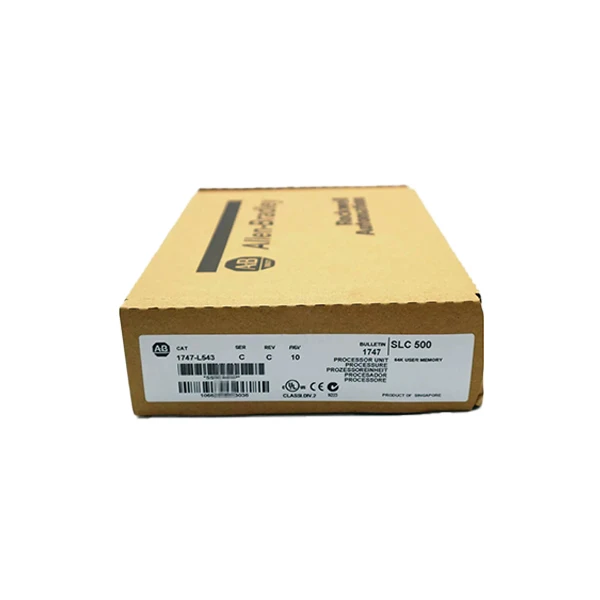
Let's take a look at some specific Allen - Bradley PLC models and their features. The 1747 - L543 Allen Bradley PLC is a powerful mid - range PLC. It offers high - speed processing, large memory capacity, and support for multiple communication protocols. It is suitable for a wide range of applications, from small - scale automation to medium - sized industrial processes.
The Allen Bradley 1763 - L16AWA Controller is a compact and cost - effective PLC. It is ideal for small - scale applications, such as standalone machines or simple automation tasks. Despite its small size, it still offers advanced programming features, including ladder logic and structured text programming.
The 1756 - PA72 Allen Bradley PLC is a high - performance PLC designed for large - scale industrial applications. It has a high - speed processor, extensive memory, and advanced motion control capabilities. It can handle complex control tasks and large - scale automation systems.
Conclusion
The advanced programming features of Allen - Bradley PLCs make them a powerful and versatile choice for industrial automation. Whether you are using ladder logic, structured text, or taking advantage of motion control, safety programming, data logging, and communication protocols, these PLCs offer the tools you need to build efficient and reliable control systems.
If you are in the market for Allen - Bradley PLCs or need more information about their programming features, I encourage you to reach out. I'm here to assist you in selecting the right PLC for your application and to provide you with the support you need during the implementation process. Contact me to start a discussion about your specific requirements and how we can work together to achieve your automation goals.
References
- Allen - Bradley Product Manuals
- Industrial Automation Magazines
- Technical Papers on PLC Programming


