


In the realm of industrial automation, Programmable Logic Controllers (PLCs) play a pivotal role. ABB, a well - known name in the industry, offers a wide range of high - quality PLC modules. As a trusted ABB PLC module supplier, I am often asked about the frequency response of these modules. In this blog, we will delve into what frequency response means in the context of ABB PLC modules, its significance, and how it impacts industrial applications.

Understanding Frequency Response
Frequency response is a measure of how a system responds to input signals of different frequencies. For ABB PLC modules, the frequency response describes how these modules process and react to input signals that vary in frequency. In industrial automation, input signals can come from a variety of sensors, such as temperature sensors, pressure sensors, and flow sensors. These sensors may produce signals with different frequencies depending on the physical phenomena they are measuring.
The frequency response of ABB PLC modules is an important parameter because it determines the module's ability to accurately capture and process these signals. A module with a good frequency response can handle a wide range of frequencies without significant distortion or loss of information, ensuring that the PLC can make accurate decisions based on the input signals.
Factors Affecting Frequency Response in ABB PLC Modules
- Analog Input Filters: ABB PLC analog input modules, like the AI845 ABB Analog Input Module, often have built - in filters. These filters are designed to remove unwanted noise from the input signals. However, they can also affect the frequency response. For example, a low - pass filter will allow low - frequency signals to pass through while attenuating high - frequency signals. The cut - off frequency of the filter is a critical parameter that determines which frequencies will be affected. If the cut - off frequency is set too low, high - frequency components of the input signal may be lost, leading to inaccurate measurements.
- Sampling Rate: The sampling rate of a PLC module is another important factor. It refers to how often the module samples the input signal. According to the Nyquist - Shannon sampling theorem, the sampling rate must be at least twice the highest frequency component of the input signal to accurately reconstruct the signal. In ABB PLC modules, a higher sampling rate allows the module to capture high - frequency signals more accurately. However, increasing the sampling rate also increases the processing load on the module.
- Signal Conditioning Circuits: Inside the ABB PLC modules, signal conditioning circuits are used to adjust the amplitude and impedance of the input signals. These circuits can also affect the frequency response. For example, some signal conditioning circuits may introduce phase shifts or attenuation at certain frequencies, which can distort the input signal.
Importance of Frequency Response in Industrial Applications
- Process Control: In industrial process control applications, accurate measurement and control of variables are crucial. For example, in a chemical process, the temperature and pressure need to be precisely monitored and controlled. If the frequency response of the ABB PLC module used to measure these variables is poor, the module may not be able to accurately capture the rapid fluctuations in temperature or pressure. This can lead to inaccurate control actions and potentially affect the quality and safety of the process.
- Motion Control: In motion control systems, such as those used in robotics and conveyor belts, the frequency response of the PLC module is important for ensuring smooth and precise motion. The module needs to be able to quickly respond to changes in the input signals related to the position, speed, and torque of the motors. A module with a fast frequency response can detect and compensate for changes more rapidly, resulting in improved motion control performance.
- Fault Detection: A good frequency response is also essential for fault detection in industrial systems. By analyzing the frequency components of the input signals, the PLC can detect abnormal behavior in the system. For example, a change in the frequency spectrum of a vibration signal may indicate a mechanical fault in a rotating machine. If the PLC module cannot accurately capture the high - frequency components of the vibration signal, it may miss the early signs of the fault.
Frequency Response Characteristics of Specific ABB PLC Modules
- ABB DX571 1TNE968902R2302: The ABB DX571 1TNE968902R2302 is a digital output module. Although digital modules do not have the same type of frequency response as analog modules, they still have a response time. The response time determines how quickly the module can change its output state in response to an input signal. A fast response time is important in applications where quick on - off control is required, such as in high - speed switching systems.
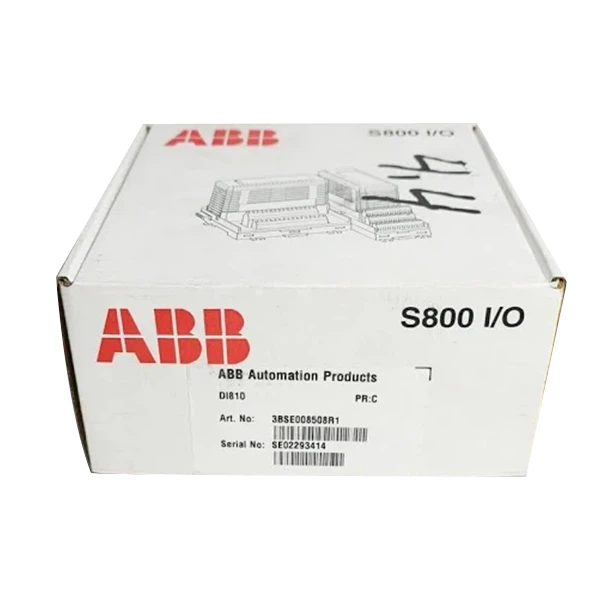
- ABB DI810 3BSE008508R1: The ABB DI810 3BSE008508R1 is a digital input module. It has a certain input filtering and debounce time, which can affect its ability to accurately detect high - frequency input signals. The input filtering is designed to remove electrical noise, but it may also limit the module's ability to detect very short - duration pulses.
Measuring and Testing the Frequency Response of ABB PLC Modules
To ensure that ABB PLC modules meet the required frequency response specifications, various measurement and testing methods can be used.
- Sinusoidal Input Testing: One common method is to apply a sinusoidal input signal with a known frequency and amplitude to the module. The output signal of the module is then measured and compared with the input signal. By varying the frequency of the input signal over a wide range, the frequency response curve of the module can be obtained. This curve shows how the module's gain and phase change with different frequencies.
- Step Response Testing: Another method is step response testing. A step input signal is applied to the module, and the time it takes for the module's output to reach a certain percentage of its final value is measured. The step response can provide information about the module's transient response characteristics, which are related to its frequency response.
Conclusion and Call to Action
In conclusion, the frequency response of ABB PLC modules is a critical factor that affects their performance in industrial applications. Understanding the frequency response characteristics of these modules can help engineers and technicians make informed decisions when selecting the appropriate modules for their systems. As an ABB PLC module supplier, I am committed to providing high - quality products and technical support to ensure that your industrial automation systems operate at their best.
If you are in the process of planning an industrial automation project or need to upgrade your existing PLC system, I encourage you to contact me for more information about our ABB PLC modules. We can discuss your specific requirements and help you choose the modules that best suit your needs. Whether it's a high - speed motion control system or a precision process control application, we have the expertise and products to support you.
References
- "Industrial Automation Handbook", published by a major industrial technology publisher, provides in - depth knowledge about PLCs and their performance parameters, including frequency response.
- ABB's official technical documentation for its PLC modules, which details the specifications and characteristics of different modules.


