


As a supplier of Mitsubishi PLCs, I've had the privilege of delving deep into the intricacies of these remarkable programmable logic controllers. One of the most fundamental aspects that every engineer, technician, or enthusiast should understand is the memory structure of a Mitsubishi PLC. In this blog post, I'll take you on a journey through the memory architecture of Mitsubishi PLCs, exploring its various components and how they work together to make these devices so powerful and versatile.
Overview of Mitsubishi PLC Memory Structure
Mitsubishi PLCs are equipped with different types of memory, each serving a specific purpose. The main types of memory in a Mitsubishi PLC include program memory, data memory, and system memory. These memory areas work in harmony to store the user program, process data, and manage the overall operation of the PLC.
Program Memory
Program memory is where the user's ladder logic program is stored. This program is the set of instructions that tells the PLC what to do in response to input signals and how to control the output devices. Mitsubishi PLCs support different programming languages, with ladder logic being the most commonly used. The program memory capacity varies depending on the model of the PLC. For example, the FX5U-32MR/ES Mitsubishi has a certain amount of program memory that can accommodate a relatively complex ladder logic program.
The program memory is non-volatile, which means that the program is retained even when the power is turned off. This is crucial for industrial applications where the PLC needs to resume operation immediately after a power outage without losing the programmed instructions. When programming a Mitsubishi PLC, the user can use programming software such as GX Works3 to create, edit, and download the ladder logic program to the program memory.
Data Memory
Data memory is used to store various types of data that are processed and manipulated by the PLC during its operation. This includes input and output data, intermediate results, and user-defined variables. Data memory can be further divided into different areas, each with its own characteristics and usage.

- Input Image Memory (X): This area stores the current state of the input devices connected to the PLC. For example, if a limit switch is connected to an input point of the PLC, the state of the switch (open or closed) is stored in the corresponding bit in the input image memory. The input image memory is updated periodically to reflect the actual state of the input devices.
- Output Image Memory (Y): Similar to the input image memory, the output image memory stores the current state of the output devices controlled by the PLC. When the ladder logic program determines that an output device should be turned on or off, the corresponding bit in the output image memory is updated. The state of the output image memory is then transferred to the actual output devices at regular intervals.
- Internal Relay Memory (M): Internal relays are virtual relays that can be used in the ladder logic program for various purposes, such as storing intermediate results, implementing control logic, or coordinating different parts of the program. The internal relay memory provides a large number of internal relays that can be freely used by the programmer.
- Data Register Memory (D): Data registers are used to store numerical data, such as counters, timers, and user-defined variables. The data register memory can store both integer and floating-point numbers, allowing for complex arithmetic operations and data processing in the ladder logic program.
System Memory
System memory is used by the PLC's operating system to manage the overall operation of the device. It stores information such as system parameters, configuration settings, and diagnostic data. The system memory is not directly accessible to the user for programming purposes, but it plays a crucial role in ensuring the proper functioning of the PLC.
Memory Organization in Different Mitsubishi PLC Models
Mitsubishi offers a wide range of PLC models, each with its own unique memory organization. Let's take a look at some popular models and their memory structures.
FX5U Series
The FX5U series is a high-performance PLC series from Mitsubishi. It features a modular design and a large memory capacity. The program memory of the FX5U series can store up to several tens of thousands of steps of ladder logic program, allowing for the implementation of complex control algorithms. The data memory of the FX5U series is also quite extensive, providing a large number of input and output image memory bits, internal relays, and data registers.
The FX5U-32MR/ES Mitsubishi is a specific model in the FX5U series. It has 32 input/output points and is suitable for small to medium-sized control applications. The memory structure of the FX5U-32MR/ES is optimized to provide efficient data processing and reliable operation.
FX5S Series
The FX5S series is a compact and cost-effective PLC series from Mitsubishi. It is designed for simple control applications where space and cost are important considerations. Despite its compact size, the FX5S series still offers a sufficient amount of program and data memory to meet the requirements of many basic control tasks.
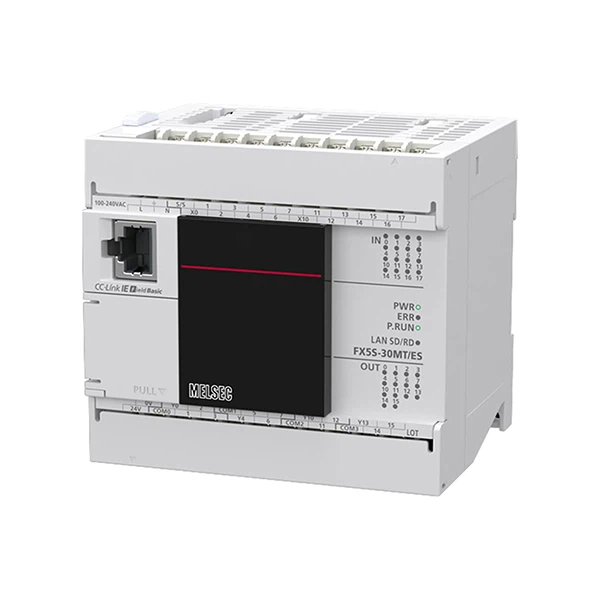
The FX5S 30MT ES is a model in the FX5S series with 30 input/output points. It has a relatively small program memory capacity compared to the FX5U series, but it is still capable of handling simple ladder logic programs. The data memory of the FX5S 30MT ES is also designed to provide basic data processing capabilities.
FX3S Series
The FX3S series is another popular PLC series from Mitsubishi. It offers a good balance between performance and cost, making it suitable for a wide range of industrial applications. The Mitsubishi FX3S 30MR ES is a model in the FX3S series with 30 input/output points. It has a well-organized memory structure that provides efficient data storage and processing.
Importance of Understanding the Memory Structure
Understanding the memory structure of a Mitsubishi PLC is essential for several reasons. Firstly, it allows the programmer to write more efficient and optimized ladder logic programs. By knowing how the different memory areas work and how data is stored and processed, the programmer can make better use of the available memory resources and avoid unnecessary memory usage.
Secondly, understanding the memory structure is crucial for troubleshooting and debugging the PLC system. When a problem occurs in the PLC system, the programmer can use the knowledge of the memory structure to analyze the data stored in the different memory areas and identify the root cause of the problem.
Finally, understanding the memory structure is important for system expansion and upgrading. As the requirements of the control application change, the programmer may need to add more input/output devices, implement more complex control algorithms, or store more data. By understanding the memory structure of the PLC, the programmer can determine whether the existing PLC model can meet the new requirements or whether an upgrade to a different model is necessary.
Conclusion
In conclusion, the memory structure of a Mitsubishi PLC is a complex but essential aspect of its operation. The program memory, data memory, and system memory work together to store the user program, process data, and manage the overall operation of the PLC. Different Mitsubishi PLC models have different memory organizations, which are designed to meet the specific requirements of various industrial applications.
As a supplier of Mitsubishi PLCs, I am committed to providing high-quality products and comprehensive technical support to our customers. If you are interested in purchasing Mitsubishi PLCs or have any questions about their memory structure or other technical aspects, please feel free to contact us for further discussion and procurement negotiation. We look forward to working with you to meet your industrial control needs.
References
- Mitsubishi Electric Corporation. (Year). Mitsubishi PLC User Manuals.
- GX Works3 Programming Software Documentation.


