


Hey there! As an Omron PLC supplier, I've gotten tons of questions about what programming languages can be used for Omron PLCs. It's a hot topic, especially for folks looking to automate their industrial processes. So, let's dive right in and explore the options.
Ladder Diagram (LD)
Ladder Diagram is hands - down the most popular programming language for Omron PLCs. It's super intuitive, and it mimics the look of traditional electrical relay circuits. You know, those old - school diagrams with rungs and contacts? That's what LD is all about.
Think of it like building a circuit. You've got inputs, which are like the switches in a real - world electrical setup. When these inputs are activated, they close contacts in the ladder diagram. And then there are outputs, which are like the lights or motors that turn on when the right conditions are met.
For example, if you're using an OMRON CJ1W - II101 Interface Module, you can use Ladder Diagram to program how it communicates with other devices. You can set up conditions for when it should send or receive data, just like you'd set up a switch to turn on a light.
The great thing about LD is that it's easy to understand, even for people who aren't super tech - savvy. Electricians and technicians who are used to working with electrical schematics can pick it up really quickly. It's also highly visual, so you can easily troubleshoot any issues that come up. If a rung isn't working as expected, you can just look at the diagram and see what's going on.
Structured Text (ST)
Structured Text is a high - level programming language for Omron PLCs. It's more like a traditional programming language, similar to Pascal or C. If you've got a background in coding, you'll feel right at home with ST.
With ST, you can write complex algorithms and functions. You can perform mathematical calculations, manage data structures, and even create loops and conditional statements. It's great for tasks that require a lot of logic and precision.
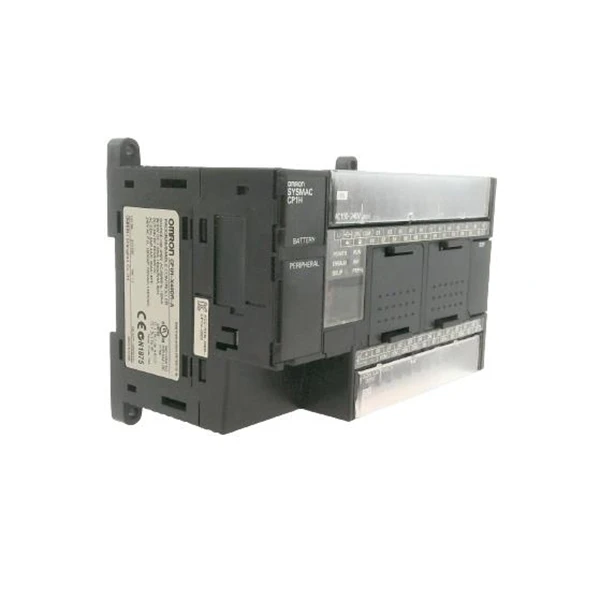
For instance, if you're using a CP1H - X40DR - A Omron to control a manufacturing process, you might use ST to program the exact sequence of operations. You can define variables for things like temperature, pressure, and speed, and then use those variables in your calculations to ensure the process runs smoothly.
One of the advantages of ST is its flexibility. You can write code that's highly customized to your specific needs. You're not limited by the pre - defined structures of other programming languages. However, it does require a bit more programming knowledge than Ladder Diagram. If you're new to programming, you might need to spend some time learning the syntax and concepts.
Function Block Diagram (FBD)
Function Block Diagram is another option for programming Omron PLCs. It uses blocks to represent functions, and these blocks are connected by lines to show the flow of data.
Each block in an FBD represents a specific function, like a mathematical operation, a logical comparison, or a timer. You can combine these blocks to create complex control systems. It's a bit like building with Lego blocks, where each block has a specific purpose, and you can put them together in different ways to create different structures.
Let's say you're using an Omron CP1L - M40DR - A Programmable Controller to control a conveyor belt system. You can use FBD to program the speed control, the start and stop functions, and the safety interlocks. You can create blocks for each of these functions and then connect them in the right order to make the system work as intended.
FBD is great because it's easy to visualize the overall control system. You can see at a glance how the different functions are connected and how the data is flowing. It's also a good option for collaborative projects, as different team members can work on different blocks without interfering with each other.
Instruction List (IL)
Instruction List is a low - level programming language for Omron PLCs. It's a bit like assembly language, where you write instructions in a sequential list. Each instruction tells the PLC what to do, like move data from one location to another, perform a mathematical operation, or jump to a different part of the program.
IL is very efficient in terms of memory usage and execution speed. Since it's a low - level language, it can be used to optimize the performance of the PLC. However, it's also the most difficult to read and write, especially for beginners.
If you're an experienced programmer and you need to squeeze every bit of performance out of your Omron PLC, IL might be the way to go. But for most applications, the other programming languages we've discussed are more user - friendly.
Which Language Should You Choose?
So, which programming language should you use for your Omron PLC? Well, it depends on your specific needs and your level of programming experience.

If you're new to PLC programming or you're working with a team that has a lot of electrical background, Ladder Diagram is a great choice. It's easy to learn and understand, and it's widely used in the industry.
If you need to write complex algorithms and you have a programming background, Structured Text might be the way to go. It gives you a lot of flexibility and power.
Function Block Diagram is a good option if you want a visual way to design your control system and if you're working on a collaborative project.
And Instruction List is best for advanced users who need to optimize the performance of the PLC.
As an Omron PLC supplier, I'm here to help you make the right choice. Whether you're just starting out or you're looking to upgrade your existing system, I can provide you with the support and resources you need.
If you're interested in purchasing Omron PLCs or have any questions about programming languages, feel free to reach out. We can have a chat about your specific requirements and figure out the best solution for you. Let's work together to take your industrial automation to the next level!
References
- Omron Corporation, "Programming Manuals for PLCs".
- Industrial Automation Handbook, various editions.
- Online forums and communities dedicated to Omron PLC programming.


