


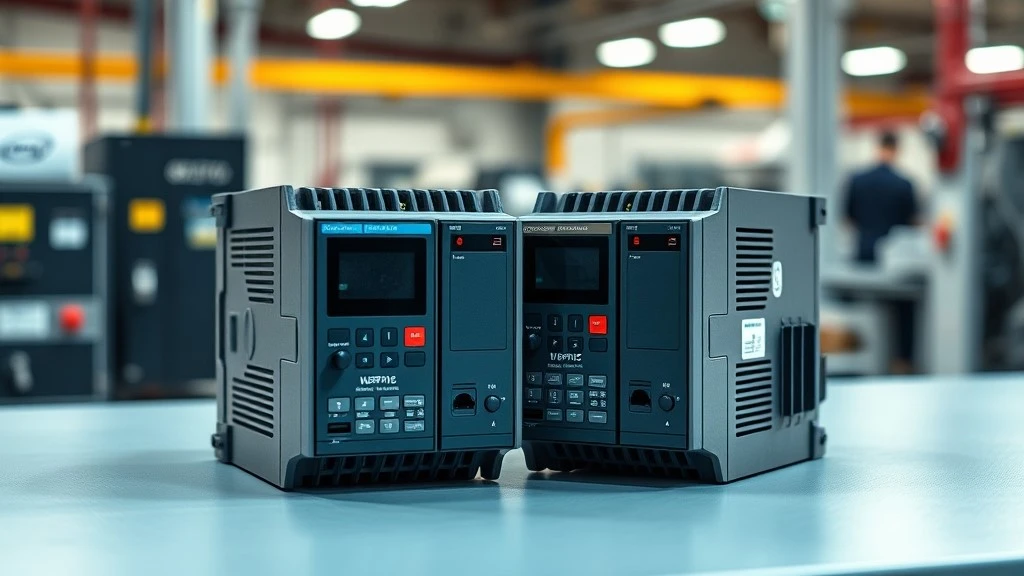
If you have narrowed your controller choice to Omron and Allen-Bradley, the short answer is this. Omron Sysmac fits compact, high-speed machine automation, while Allen-Bradley Logix fits large, plantwide control where everything runs on one network. Both are excellent platforms. The part most guides skip is that picking the right brand is only half the job. The other half is buying it right, with genuine stock, honest lead times, and long-term spare-part support. As a multi-brand supplier that stocks both, CHENTUO has no reason to push one over the other, so this guide is built to help you choose correctly and then source safely.
The 60-Second Verdict and a 5-Question Selector
Choose Omron NJ/NX if you are building a single machine or compact cell that needs tight motion, vision, and safety in one controller, especially in packaging, electronics, semiconductor, or medical work. Choose Allen-Bradley CompactLogix or ControlLogix if you run a large North American plant, need many remote I/O racks on one network, or your maintenance team already works in Studio 5000. Cost and sourcing, not raw performance, are usually what decide the close calls.
Answer these five questions to find your lean:
- A single machine or line, or a whole plant with many lines tied to one SCADA?
- Is your existing installed base already Omron or Allen-Bradley?
- How many synchronized motion axes and vision systems do you need?
- Where are your main market and your local integrators located?
- How price-sensitive is the build, and do you need built-in OPC UA or MES connectivity?
|
Your situation |
Leans toward |
|
Compact machine, heavy motion plus vision |
Omron NJ/NX |
|
Large plant, many remote I/O, one SCADA |
Allen-Bradley ControlLogix |
|
Existing Allen-Bradley site, adding one line |
Allen-Bradley |
|
Budget-sensitive build with motion control |
Omron |
|
Mixed or uncertain |
Ask for a spec review |
Not sure how your specs map to a model? Send us your machine spec, and our engineers will give a neutral recommendation. To make every judgment below stand up, start with the one idea that explains everything else.
1. The Real Difference: Machine-Centric Omron vs Plant-Centric Allen-Bradley
The cleanest way to understand these two platforms is to see what each assumes about your system.
Allen-Bradley assumes the PLC sits at the center of a large system. One ControlLogix CPU can manage thousands of I/O points across remote racks, talk to Kinetix servo drives and PowerFlex drives over EtherNet/IP, and feed live data to FactoryTalk SCADA. The controller is the plant hub. That brings scale and a clean single-vendor story, but also a larger footprint and deeper dependence on the Rockwell ecosystem.
Omron's Sysmac platform starts from the machine. An NJ or NX CPU packs logic, motion, safety, and machine vision into one controller and one project file, with no separate motion or safety PLC. For a 12-axis packaging line with camera inspection, that means one environment to program and debug. The trade-off is that Sysmac is tuned for the machine, so tying many Omron machines into one factory-wide SCADA takes more integration work.
On the network layer, EtherCAT (Omron) uses distributed clocks for very tight, deterministic motion, while EtherNet/IP (Allen-Bradley) trades a little timing precision for a broad device ecosystem and easy plant integration. Hold that single idea, machine-first versus plant-first, and the cost, software, and system differences below all follow.
2. Model-to-Model Cheat Sheet (Entry, Mid, High, Safety)
Use this map to locate your machine's tier, then match it to the equivalent family on each side. Pick the row that matches your I/O count and motion needs, not the biggest CPU you can afford.
|
Tier |
Allen-Bradley |
Omron |
I/O and motion (indicative) |
Software |
|
Entry |
Micro800, MicroLogix |
CP1, CP2E |
Compact I/O, basic motion |
Connected Components, CX-One |
|
Mid |
CompactLogix 5370/5380 |
CJ2M, NJ301, NX102 |
Hundreds of I/O, multi-axis |
Studio 5000, Sysmac Studio |
|
High |
ControlLogix 5570/5580 |
NX502, NX701, NJ501 |
Thousands of I/O, many axes |
Studio 5000, Sysmac Studio |
|
Safety |
GuardLogix |
NX-SL plus NJ/NX CPU |
Integrated safety |
Same environment |
Each family scales differently, so a like-for-like swap is rarely one to one. Browse current stock on our Allen-Bradley PLC and Omron PLC pages, and if you are unsure which tier fits your load and axis count, send us your I/O list and we will map it. Datasheet tiers are a starting point, but they are not what decides the build on a real machine.
3. The Specs That Actually Decide It on a Real Machine
Datasheets compare raw scan time and I/O count, but on a real machine the spec that runs out first is usually memory under combined motion and communication load. Here is what that means in practice. The figures below are manufacturer-stated or indicative for 2026, not an independent test.
Memory gets eaten before you write a rung. Every servo axis consumes configuration and variable memory before any control logic exists. On a small Allen-Bradley CompactLogix controller with limited user memory, a mid-axis-count machine plus a modest HMI tag table can climb toward high memory utilization quickly. A comparable Omron NX controller, which ships with more program and variable memory, sits much lower at the same axis count. Plain takeaway: if your machine has many servo axes, check memory headroom, not just scan time, because a smaller-memory CPU with the same axis count tends to choke first. When does this reverse? On a pure I/O replacement job with no motion and few tags, the smaller controller is perfectly comfortable, and the extra memory is unused capacity.
Node count is a hard ceiling on one side and a soft limit on the other. Omron's EtherCAT line has a fixed node ceiling, so a very high device count forces you up to a bigger CPU. Allen-Bradley's EtherNet/IP scales to many more nodes, but the requested packet interval per node rises as you add devices. Plain takeaway: EtherCAT fails at an architectural wall, while EtherNet/IP degrades gradually, so size the network for your real device count rather than the headline number.
Built-in OPC UA versus an external gateway. Some Omron controllers embed an OPC UA server, which is convenient for MES connectivity but consumes onboard memory when active. Allen-Bradley typically uses an external gateway, which keeps controller memory free but adds hardware cost and one more point of failure. Plain takeaway: if you need MES data, decide where you want to pay, in controller memory or in extra hardware. The next cost is one you cannot see on a single datasheet either.
4. True 5-Year Total Cost of Ownership (Not Just Sticker Price)
Sticker price is the smallest part of the bill. The real number is what the platform costs over five years, and that is where the popular claim that Omron is ten times cheaper falls apart.
|
Cost area |
Allen-Bradley |
Omron |
|
CPU hardware (indicative) |
$1,500 to $10,000+ |
$800 to $6,000 |
|
Programming software |
Higher (Studio 5000 Professional) |
Lower (Sysmac Studio) |
|
Annual software support |
Required, significant |
Lower |
|
Motion licensing |
Separate (Kinetix) |
Often built in |
|
Training and talent pool |
Very wide in North America |
Smaller, growing |
|
Switching cost from another brand |
High |
High |
Hardware is only the start. Studio 5000 Professional licensing sits well above a Sysmac Studio license, and Allen-Bradley software typically requires the version to match controller firmware exactly, so a mismatch can stop work until you update. Omron tends to bundle motion without separate licensing. But the savings story flips the moment your plant already runs one brand. Switching one machine to the other adds training time, spare-part complexity, and re-validation that can erase the upfront difference.
A simple worked example shows the point. Take a machine with roughly sixteen servo axes and a couple of hundred HMI tags. On paper, the Omron build can look cheaper on hardware and software. If your team and your stockroom are already standardized on Allen-Bradley, the true five-year cost of the Omron build rises once you add training, separate spares, and integration into existing systems. If you are building new from scratch with no installed base, the Omron cost advantage on motion-heavy machines is real. All figures here are indicative ranges for 2026, so ask for a current quote on your exact models before you set a budget.
5. Software and Engineering Reality: What Your Team Lives In Daily
Your team will spend more hours in the software than anywhere else, so the daily experience matters.
|
Feature |
Studio 5000 (Allen-Bradley) |
Sysmac Studio (Omron NJ/NX) |
|
Variable model |
Tag-based |
Auto-allocated variables |
|
Motion |
Separate (Kinetix) |
Native in the same project |
|
Safety |
GuardLogix (separate) |
Integrated safety task |
|
HMI and vision |
Separate tools |
Integrated |
|
Online editing |
Strong |
Good |
|
Standard motion |
Proprietary |
PLCopen (open standard) |
Two field notes that a spec sheet will not tell you. First, Studio 5000 online editing lets engineers change logic while the machine runs, which is valued in 24/7 plants, but the strict firmware-to-software version match is a recurring friction point. A v33 controller will not accept a v32 laptop without an update, and that costs time on the floor. Second, if you evaluate Omron, make sure you are looking at Sysmac Studio with NJ/NX hardware, not the legacy CX-Programmer with CP/CJ controllers. The legacy environment uses manual memory addressing such as D0001 and adds real setup time, so buying into it today is a step backward.
6. Best Fit by Industry, Region, and Existing Infrastructure
By industry, the patterns are clear. Large North American plants, automotive assembly, pharmaceutical batch, and oil and gas tend to standardize on Allen-Bradley because the single-vendor ecosystem and local talent make commissioning and support clean. High-speed packaging, electronics, semiconductor handling, and medical devices lean on Omron, where one controller synchronizes many axes plus vision in a small panel.
By region, weigh local reality over brand prestige. Allen-Bradley support, integrators, and overnight spares are strongest across North America. Omron has the closest installed base and talent across Japan, much of Europe, and Southeast Asia. For buyers in emerging markets, the deciding factor is often which platform your local integrators actually know and how fast you can get spares, which can matter more than the badge.
By existing infrastructure, the rule is simple. If you already run Allen-Bradley, mixing in one Omron machine usually adds more cost and complexity than it saves, so stay consistent unless there is a clear technical reason. For a brand-new machine with no installed base, either works, so let needs and budget decide. Want a recommendation for your specific industry and region? Tell us your application and we will send a model shortlist.
7. It Is a System, Not Just a CPU: Pairing PLC with HMI, VFD, Servo, and Sensors
The brand decision rarely stops at the controller. It ripples through the HMI, the drives, the servos, and the sensors, so it pays to think in terms of the whole panel.
A single-brand system buys consistency. Allen-Bradley pairs ControlLogix with PanelView HMIs, PowerFlex drives, and Kinetix servos over EtherNet/IP, so commissioning and diagnostics share one language. Omron pairs NJ/NX with NA-series HMIs and 1S servos over EtherCAT, with the tight motion integration the Sysmac platform is built for. In both cases, one ecosystem means simpler wiring, one set of spares, and one software environment.
Mixing brands is common and often fine, but know what travels and what does not. Field devices and standard sensors usually cross easily. Drives and remote I/O are simplest when they match the controller's native protocol. The friction shows up at the edges. Getting a third-party HMI to talk cleanly to an Allen-Bradley controller often needs FactoryTalk or an OPC bridge, and importing tags across brands is rarely automatic. Plan those bridges in advance rather than discovering them at commissioning.
Because we stock the full stack, we can quote a matched panel of PLC, HMI, VFD, servos, and modules in one place, or a mixed build if that is what your project needs.
8. Lifecycle, Obsolescence, and Cross-Reference: Do Not Get Stranded
A controller you buy today will eventually reach end of life, and the buyers who get stranded are the ones who never checked. Treat the lifecycle as part of the selection.
First, check the lifecycle status before you commit. Both manufacturers publish product lifecycle stages, from active to mature to end of life, with announced last-order and last-support dates. A model that is already in a mature phase is a poor choice for a machine you expect to run for a decade.
Second, know the migration paths. Older Omron CP and CJ controllers move forward to the NJ and NX Sysmac platforms, and legacy Allen-Bradley families migrate into the Logix platform. Finding the right replacement, often called a cross-reference, means matching I/O type, motion capability, and communication protocol, not just picking the nearest catalog number.
Third, build a spare-part strategy early. For long-life machines, consider a last-time buy of critical parts before end of life and keep one or two key spares on the shelf, especially CPUs and communication modules that carry long lead times.
If you are holding an older model and are not sure of its status, send us the part number and we will confirm whether it is still in production and what current replacement fits.
9. Sourcing Safely as an International Buyer
Once you have chosen a brand and model, the harder question for an overseas buyer is how to get a genuine product, with a warranty, at a sane lead time. This is where most comparison guides go quiet, and it is where money is actually won or lost.
Confirm the product is genuine, not grey-market or refurbished. Ask any supplier for batch and date codes, traceability to an authorized channel, and clear documentation. Refurbished or relabeled units may carry old firmware or no manufacturer warranty, which becomes your problem at startup. A credible supplier answers these questions without hesitation.
Treat real stock and a realistic lead time as more important than the lowest quote. A price means little if the part is not actually on the shelf. Ask for confirmation of physical stock and a written lead time before you commit, and be skeptical of quotes that look too good with vague delivery promises.
Get warranty, MOQ, bulk pricing, and export terms in writing. Clarify the warranty period and who honors it, minimum order quantities, volume pricing, and who handles export documents, customs, and logistics. For OEM buyers, lock these into the purchase agreement rather than a chat thread.
Vet the supplier itself. Look for verifiable company registration, traceable inventory, responsive technical support, and a willingness to send a single unit or sample before a large order. A supplier who meets neutral standards like these is one you can trust.
A quick checklist before you pay: genuine documentation, confirmed physical stock, written warranty and lead time, clear export terms, and responsive support. If you want a genuine Omron or Allen-Bradley product with confirmed availability and warranty, send your model list or BOM, and we will respond with a quote and stock confirmation.
10. Final Recommendation and Scorecard
To turn all of this into a decision, score your own project. Give each row the brand it favors, weight the rows that matter most to you, and see which side wins.
|
Decision factor |
Favors Omron |
Favors Allen-Bradley |
Your weight |
|
Machine vs plant scope |
Single machine or cell |
Plant-wide control |
|
|
Motion and vision density |
High |
Moderate |
|
|
Existing installed base |
Omron or none |
Allen-Bradley |
|
|
Region and local integrators |
Europe, Asia |
North America |
|
|
Upfront budget pressure |
High |
Lower |
|
|
MES or SCADA integration |
Machine level |
Plant level |
If your project leans toward integrated motion, vision, compact panels, and lower upfront cost, Omron is likely your platform. If it leans toward large-scale plant control, deep EtherNet/IP integration, a North American talent pool, and an existing Rockwell base, Allen-Bradley is the lower-risk path. Most close calls come down to your installed base and your sourcing, not the spec sheet.
We stock both brands as genuine products, so our only goal is to help you choose correctly and buy safely. The fastest next step is to send us your model list or BOM for a quote and stock confirmation.
FAQ

Is Omron cheaper than Allen-Bradley?
Can an Omron PLC directly replace an Allen-Bradley PLC?
EtherNet/IP vs EtherCAT, which matters for my machine?
My Omron or Allen-Bradley model is obsolete. How do I find a cross-reference?
How do I make sure I am buying a genuine, not grey-market, PLC?
Is Allen-Bradley owned by Siemens?


