


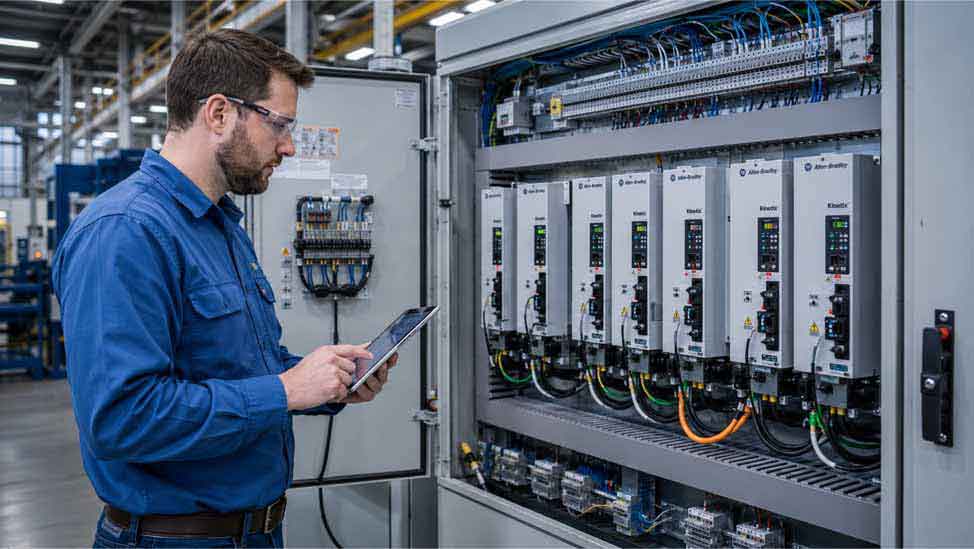
Searching for a PowerFlex 7 Series drive is not as simple as comparing a few model numbers.
The term can lead you to current PowerFlex 750-Series platforms such as the 753, 755, and 755T family, but it also appears in discussions about legacy architecture-class drives such as the PowerFlex 70 and 700. For a new project, the question is usually which platform fits the application. For an existing machine, the more important question may be whether the installed drive should be replaced with the same model or migrated to a newer platform.
That means a useful PowerFlex drive selection process must consider the application, motor current, duty rating, control performance, safety, network architecture and lifecycle status.
This guide focuses specifically on those decisions.
If you need a broader overview covering compact PowerFlex models, sourcing, startup parameters, and other PowerFlex families, see our Allen-Bradley PowerFlex VFD Selection, Replacement and Sourcing Guide (2026).
Quick PowerFlex Selection Summary
|
If You Need |
Consider |
Main Reason |
|
General industrial motor control |
PowerFlex 753 |
Flexible architecture with standard industrial control capability |
|
Deeper Logix integration or demanding control |
PowerFlex 755 |
Integrated Motion, more option capacity and advanced integration |
|
TotalFORCE control |
PowerFlex 755TS |
High performance control in a traditional six-pulse drive |
|
Regeneration or harmonic mitigation |
PowerFlex 755TR / 755TL |
Application requires energy return or power quality functions |
|
Common DC bus architecture |
PowerFlex 755TM |
Multi-drive or common bus system requirement |
|
Replacement of PowerFlex 70 or 700 |
Evaluate 750-Series migration |
Lifecycle and compatibility must be checked before ordering |
This table is only a starting point. The final catalog number still depends on voltage, current, enclosure, duty, options and the existing control system.
What Does "PowerFlex 7 Series" Actually Mean?
Architecture-Class vs Compact PowerFlex Drives
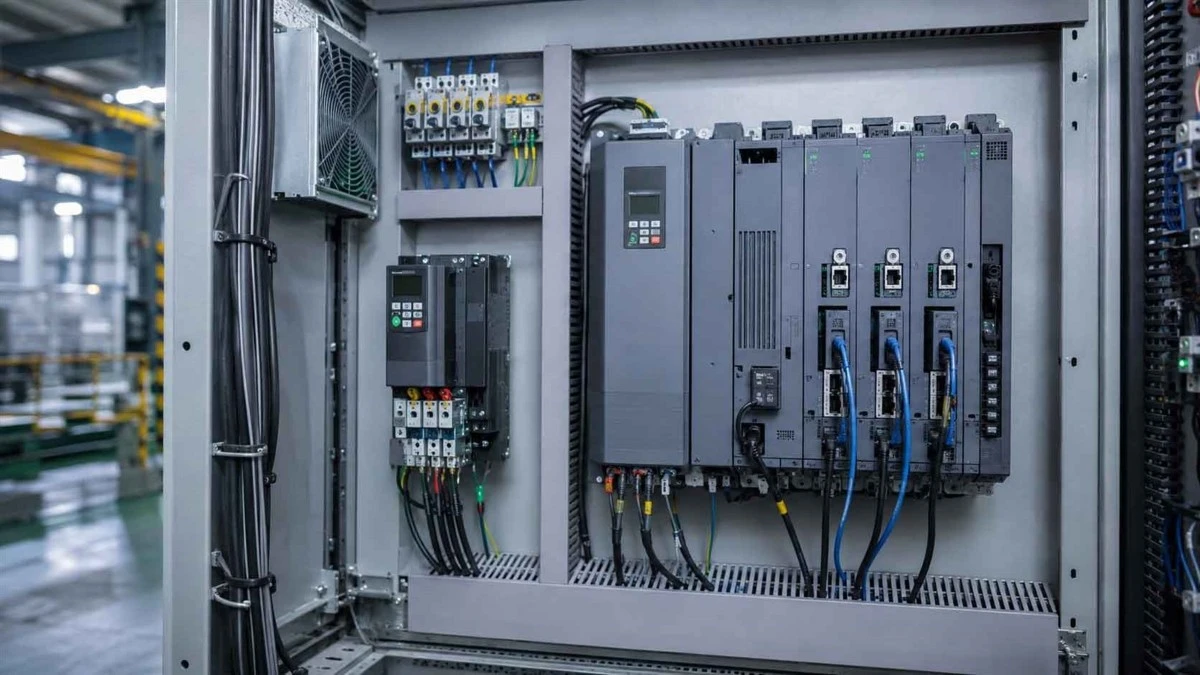
A useful first step is separating compact PowerFlex drives from architecture-class platforms.
Compact products are generally intended for simpler machine and motor control requirements where size, cost and straightforward commissioning are priorities. Architecture-class drives provide a more modular platform for applications that may need advanced motor control, feedback, safety options, additional communications or deeper system integration.
This is why choosing by model number alone can be misleading. A PowerFlex 525 and a PowerFlex 755 may both control an induction motor, but they solve different system-level problems.
If your real question is whether an application needs a VFD at all or should use a servo platform, our Kinetix vs PowerFlex guide goes deeper into the boundary between speed control, positioning and coordinated motion.
PowerFlex 7 vs. PowerFlex 750 Series
"PowerFlex 7 Series" is commonly used as a search term, but it should not automatically be treated as another name for the PowerFlex 750-Series.
A practical way to understand the relationship is to separate older architecture-class platforms, such as PowerFlex 70 and PowerFlex 700, from the newer PowerFlex 750-Series architecture represented by PowerFlex 753, 755, and related TotalFORCE platforms.
For current projects, the PowerFlex 750 family is normally the more relevant starting point. For maintenance and MRO purchasing, however, older PowerFlex 70 and 700 catalog numbers still matter because many installed machines continue to use them.
Do Not Confuse PowerFlex 7 with PowerFlex 7000
PowerFlex 7000 is a different category. It is a medium-voltage drive platform, so the low-voltage selection logic in this article should not be applied to it.
Rockwell Automation announced on June 9, 2026 that PowerFlex 7000 medium-voltage drives will no longer be available for sale after March 31, 2027, with modernization directed toward the PowerFlex 6000 family.
The important lesson is simple: similar product numbers do not necessarily indicate the same platform or migration path.
PowerFlex Models at a Glance
The goal of a comparison table should be to narrow the research list, not reproduce a technical datasheet.
|
Platform |
Typical Role |
Important Selection Point |
Lifecycle View |
|
PowerFlex 70 |
Installed legacy systems |
Exact configuration and enclosure matter |
Lifecycle sensitive |
|
PowerFlex 700 |
Legacy architecture-class applications |
Migration normally requires engineering review |
Discontinued |
|
PowerFlex 700S / 700H / 700L |
Specialized legacy applications |
Control and power architecture can complicate migration |
Legacy |
|
PowerFlex 753 |
General purpose architecture-class control |
Good starting point when advanced 755 functions are unnecessary |
Current platform |
|
PowerFlex 755 |
More demanding integration and control |
Consider for Integrated Motion, additional options and advanced safety |
Current platform |
|
PowerFlex 755TS |
TotalFORCE six-pulse platform |
Consider when higher performance control is required |
Current platform |
|
PowerFlex 755TL |
Low harmonic applications |
Power quality requirement drives the selection |
Current platform |
|
PowerFlex 755TR |
Regenerative applications |
Energy must be returned to the supply |
Current platform |
|
PowerFlex 755TM |
Common bus systems |
System architecture matters more than a single motor rating |
Current platform |
Rockwell describes the PowerFlex 753 as a general purpose architecture-class drive with built-in I/O, multiple control modes and three option slots. The PowerFlex 755 adds features such as Integrated Motion on EtherNet/IP and five option slots.
For buyers who already know the required family, our Allen-Bradley VFD category can be used to browse available PowerFlex products.
How to Choose a PowerFlex Drive: Start With the Application
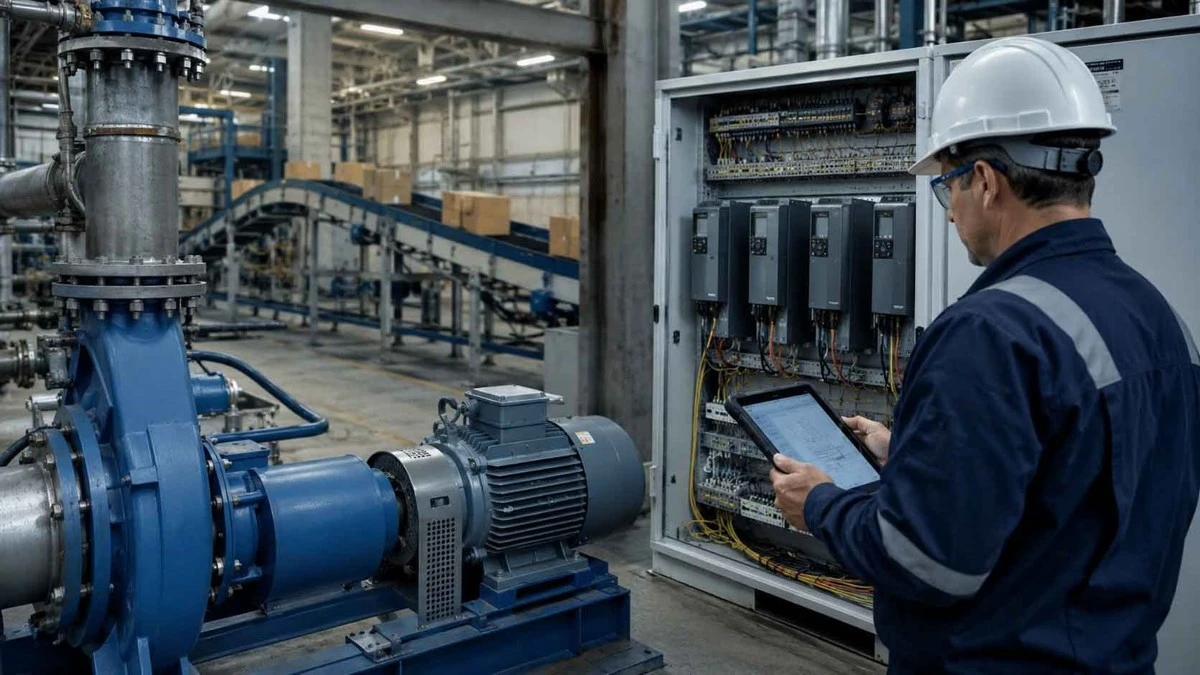
Do not begin with the question, "Should I buy a 753 or 755?"
Begin with what the machine requires from the drive.
Step 1: Identify the Load Type
A centrifugal pump or fan usually presents a very different drive requirement from a loaded conveyor, extruder, crane or winder.
- Identify whether the load is:
- Variable torque
- Constant torque
- High inertia
- Regenerative
- Suspended
- Coordinated with another axis
This first decision influences overload, braking, feedback, regeneration, and safety requirements.
A simple fan may only need stable speed control. A hoist may require controlled torque, feedback, braking coordination, and safety functions. A winder may add tension and synchronization requirements.
Step 2: Check the Motor Nameplate
Record the actual motor data before choosing a drive:
- Supply and motor voltage
- Motor full-load current
- kW or HP
- Frequency
- RPM
Horsepower is useful for initial screening, but it should not be the only sizing value. Motor current and the required duty rating can change the suitable drive even when two motors have the same nominal power.
Step 3: Determine Normal Duty or Heavy Duty
Normal Duty and Heavy Duty ratings exist because applications place different overload demands on a drive.
A fan operating close to steady state does not behave like a conveyor that starts under load. Review continuous current, acceleration requirements, overload demand and the operating cycle.
The selection question is therefore not simply:
"Does the drive match the motor HP?"
It is:
"Does the drive deliver enough continuous current and overload capability for this load profile?"
Step 4: Determine the Required Control Performance
Use the process requirement to define the control level.
|
Application Need |
Control Direction |
|
Basic pump or fan |
V/Hz or sensorless vector |
|
Accurate speed regulation |
Vector control |
|
Torque-sensitive process |
Advanced or closed-loop vector |
|
Position or coordinated motion |
Motion-capable architecture |
Do not pay for control capability the process cannot use. At the same time, do not force a simple control architecture into an application that requires feedback, precise low-speed torque, or motion coordination.
Step 5: Define Safety Requirements
Safety should be considered before the catalog number is finalized.
Ask:
- Is Safe Torque Off sufficient?
- Is safe speed monitoring required?
- Is the load suspended?
- Does the machine risk assessment require integrated safety?
- Does the application need brake and torque coordination?
PowerFlex 753 and 755 platforms support safety options, while the 755 can also support more advanced integrated safety architectures depending on configuration.
The correct choice must follow the machine risk assessment rather than a generic feature list.
Step 6: Define Network and Controller Integration
For a new Logix-based machine, EtherNet/IP and Studio 5000 integration may be part of the intended architecture.
For an older machine, the problem can be the opposite. The installed drive may depend on DeviceNet, ControlNet, legacy option cards or a control structure that cannot simply be transferred to the new drive.
Before replacing a unit, identify:
- PLC or controller family
- Communication protocol
- Existing option card
- Hardwired versus network control
- Feedback interface
- Existing drive profile and firmware environment
This step often determines whether a project is a simple drive replacement or a control-system migration.
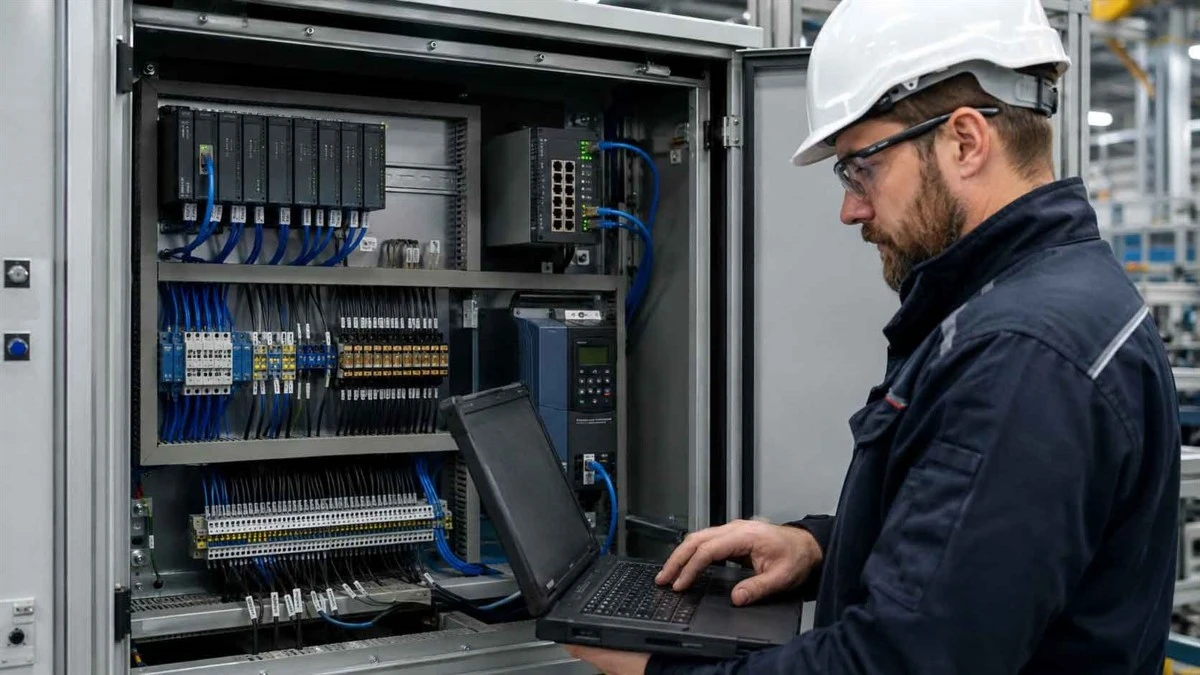
Step 7: Check Environment and Enclosure
A correct electrical rating does not guarantee a correct installation.
Check enclosure type, ambient temperature, dust, moisture, corrosive atmosphere, ventilation and available cabinet space. Also review any required derating.
This becomes especially important in retrofit work because a newer drive may have a different frame size, depth or cooling requirement.
Step 8: Decide Whether Regeneration or Harmonic Mitigation Is Required
A standard six-pulse architecture is sufficient for many applications.
The discussion changes when the process frequently returns energy, operates an overhauling load, has strict harmonic requirements or uses a common DC bus.
Rockwell positions the PowerFlex 755T family around TotalFORCE control and includes configurations for harmonic mitigation, regeneration and common bus systems. The 755TL focuses on low harmonic operation, the 755TR on regenerative operation and the 755TM on common bus architectures.
The important point is not that these options are "more advanced." They solve a different electrical and process requirement.
Which PowerFlex Platform Fits Common Applications?
Application names are useful only when connected to the real load requirement.
|
Application |
Main Requirement |
Main Selection Risk |
|
Pumps and fans |
Speed control, efficiency, integration |
Over-specifying the drive |
|
Conveyors |
Starting torque, overload, braking |
Choosing only by HP |
|
Compressors |
Current, acceleration, high inertia |
Underestimating overload |
|
Cranes and hoists |
Torque, brake coordination, safety |
Treating a suspended load as a normal conveyor |
|
Winders |
Torque, feedback, synchronization |
Insufficient control performance |
|
Regenerative processes |
Energy flow and power quality |
Using a standard braking solution where regeneration is required |
A simple pump may not need an architecture-class drive at all. A synchronized conveyor or winder can require a very different control platform even at a similar motor power.
This is why application-first selection is more reliable than starting from the model catalog.
PowerFlex 753 vs 755 vs 755T: Where Is the Real Decision Boundary?
When PowerFlex 753 Is Enough
The PowerFlex 753 is a strong starting point for general industrial applications that need architecture-class flexibility, safety options, feedback or communication expansion without the full feature set of a 755.
Do not think of it as simply a "smaller 755." The more useful question is whether the application actually needs the additional integration or control capability of the higher platform.
When PowerFlex 755 Becomes Relevant
Move the discussion toward PowerFlex 755 when requirements include deeper Logix integration, Integrated Motion on EtherNet/IP, more option capacity or advanced application control.
Rockwell lists Integrated Motion, embedded EtherNet/IP, multiple control modes, predictive diagnostics and five option slots among the 755 capabilities.
For a detailed model-to-model comparison, read our PowerFlex 753 vs 755: Which One Should You Choose? article rather than duplicating the full comparison here.
When 755TS, 755TL, 755TR or 755TM Enter the Discussion
These platforms should enter the shortlist because of a requirement, not because their model number is newer.
Consider them when the application requires TotalFORCE control, low harmonic performance, regenerative operation or a common DC bus architecture.
That is the real boundary between a conventional 753/755 discussion and a 755T system discussion.
Current vs Legacy PowerFlex Drives
Lifecycle changes the purchasing decision.
A current platform selected for a new machine and a legacy drive needed to restore production are two different buying situations.
PowerFlex 700 Migration
Rockwell states that the PowerFlex 700 AC Drive was discontinued and became unavailable for sale as of November 30, 2023. Rockwell recommends modernization to the PowerFlex 750 family and provides migration resources for PowerFlex 700 applications.
That does not mean every PowerFlex 700 can be replaced by ordering a PowerFlex 755 with the same horsepower.
A migration review should include:
- Full existing catalog number
- Motor current and duty
- Control mode
- Encoder or feedback
- Communication hardware
- Safety functions
- Option cards
- Panel dimensions
- Existing wiring
- Parameter and controller configuration
If you are working specifically with the older family, see our PowerFlex 700 vs 700S vs 700H comparison for a deeper explanation of the legacy platforms.
PowerFlex 70 Lifecycle Requires More Care
PowerFlex 70 is a good example of why lifecycle should be checked at the catalog-number level.
Rockwell's current family page states that IP20/Type 1, IP54/Type 12, and flange versions are scheduled to become unavailable for sale on September 30, 2026, while NEMA 4X versions remain Active Mature. Individual catalog-number pages can show their own lifecycle dates.
So avoid statements such as:
"PowerFlex 70 is discontinued."
The safer purchasing question is:
"What is the lifecycle status of this complete PowerFlex 70 catalog number?"
Before Replacing a Legacy PowerFlex Drive, Check These 10 Items
Before asking whether a 753, 755 or another platform can replace an existing unit, collect:
Full existing catalog number
- Input voltage
- Motor full-load current
- Motor kW or HP
- Normal Duty or Heavy Duty requirement
- Enclosure and physical dimensions
- Installed option modules
- Encoder or feedback configuration
- Communication protocol
- Safety, braking and regeneration requirements
Also preserve the existing parameter set, record firmware information and take clear photographs of the drive nameplate, option cards and control wiring.
This information helps separate three very different situations:
Same-model replacement: The objective is to restore the machine with minimal engineering change.
Engineering replacement: A newer drive is selected, but wiring, dimensions, parameters or communication may change.
Modernization: The drive replacement is part of a larger change involving controls, network architecture, safety or machine performance.
Do not assume that "recommended migration" means "drop-in replacement."
Technical Features That Actually Change Your Selection
Feature lists are only useful when a feature changes the purchasing decision.
V/Hz, sensorless vector and vector control: The important question is how much speed accuracy, low-speed torque and feedback performance the application requires.
TotalFORCE: Relevant when application performance, adaptive control or the newer 755T architecture justifies moving beyond a conventional drive configuration.
EtherNet/IP and Integrated Motion: Important when the drive must participate closely in a Logix architecture rather than operate mainly through hardwired commands or basic communication.
STO, Safe Speed and integrated safety: Relevant when the machine risk assessment requires more than a simple stop function.
Regeneration and harmonic mitigation: Important when energy flow or power quality becomes part of the electrical design.
Predictive diagnostics: Most valuable on critical assets where avoiding unplanned downtime has measurable production value.
The right question for every feature is:
Will this capability change my application, integration, safety or lifecycle decision?
If the answer is no, it should not dominate the model selection.
Common PowerFlex Selection Mistakes
Choosing by Horsepower Alone
Motor HP is not enough. Confirm motor current, drive continuous current, duty rating and overload requirement.
Assuming Similar Model Numbers Are Interchangeable
PowerFlex 700, 753, 755 and 755TS are not interchangeable simply because the numbers look related.
Ignoring Option Card Compatibility
A replacement drive body may be electrically suitable while the existing communication, feedback or safety option is incompatible.
Ignoring Lifecycle Status
Available inventory does not necessarily mean the product is current or appropriate for a new design.
Buying More Capability Than the Application Needs
A simple pump does not become a better application because the drive has more option slots, motion functions or advanced diagnostics.
The best drive is the one that satisfies the real engineering requirement with an appropriate lifecycle strategy.
PowerFlex Buying Checklist Before Requesting a Quote
A useful RFQ should contain both technical and commercial information.
Send:
- Exact catalog number, if available
- Quantity
- Existing drive nameplate photo
- Motor nameplate photo
- Input voltage
- Motor current and kW or HP
- Application
- Required communication
- Required safety functions
- Whether this is a new project or replacement
- Destination country
- Required delivery date
Shenzhen Chentuo Technology supplies Allen-Bradley VFDs and other industrial automation products for international customers, including buyers working with both current and legacy equipment.
If you already have the existing part number, the most useful first step is to send the complete catalog number and nameplate photo so configuration, lifecycle and availability can be checked before ordering.
FAQ

What is the PowerFlex 7 Series?
Is PowerFlex 7 the same as PowerFlex 750 Series?
Is PowerFlex 700 discontinued?
Yes. Rockwell Automation states that PowerFlex 700 became unavailable for sale on November 30, 2023 and recommends modernization toward the PowerFlex 750 family.
A migration still requires engineering review because the new drive may differ in dimensions, communication, options, wiring and parameters.
What replaces a PowerFlex 700 drive?
There is no universal one-to-one answer based only on horsepower. Rockwell's modernization direction is the PowerFlex 750 family, and its current migration resources also include PowerFlex 700 vector-control migrations toward PowerFlex 755TS.
The final choice depends on the existing catalog number and application.
Is PowerFlex 70 discontinued?
What is the difference between PowerFlex 753 and 755?
The 753 is positioned for general purpose architecture-class applications, while the 755 adds capabilities such as Integrated Motion on EtherNet/IP and greater option capacity.
For a detailed application-by-application comparison, use our dedicated PowerFlex 753 vs 755 comparison guide.
Final PowerFlex Selection Checklist
Before committing to a PowerFlex catalog number, confirm the decision in this order:
- Identify the application and load behavior.
- Confirm motor voltage, current and power.
- Check Normal Duty or Heavy Duty requirements.
- Define the required control performance.
- Confirm machine safety requirements.
- Identify the controller and communication architecture.
- Check the enclosure and installation environment.
- Decide whether regeneration or harmonic mitigation is required.
- Verify lifecycle status.
- Confirm the complete configuration and catalog number.
For a new machine, this process helps avoid paying for unnecessary capability.
For a legacy machine, it helps prevent a different problem: ordering a technically similar drive that does not actually fit the existing electrical, mechanical or control architecture.
If you need a current PowerFlex drive or a replacement for an existing PowerFlex 70, 700, 753 or 755, send Shenzhen Chentuo Technology the complete catalog number, motor data, application information and required quantity. We can use that information to check the configuration and availability before you place an order.


