


As a Siemens HMI supplier, I've had the privilege of witnessing firsthand the robust security features that Siemens HMI (Human - Machine Interface) products offer. In today's digital age, where cyber threats are becoming increasingly sophisticated, the security of industrial control systems is of utmost importance. Siemens has recognized this and has integrated a wide range of security features into its HMI devices to protect critical infrastructure and ensure the smooth operation of industrial processes.
Authentication and Authorization
One of the fundamental aspects of security in Siemens HMI is authentication and authorization. Siemens HMIs support various authentication methods to ensure that only authorized personnel can access the system. For example, user accounts can be created with unique usernames and passwords. These passwords can be set to meet specific complexity requirements, such as a minimum length, a combination of letters, numbers, and special characters.

In addition to password - based authentication, Siemens HMIs also support more advanced authentication methods like smart cards and biometric authentication. Smart cards can store digital certificates that are used to verify the identity of the user. Biometric authentication, such as fingerprint or facial recognition, provides an even higher level of security by relying on unique physical characteristics of the user.
Once a user is authenticated, the system uses authorization mechanisms to determine what actions the user can perform. Role - based access control (RBAC) is a common approach used in Siemens HMIs. Different roles, such as operators, supervisors, and maintenance personnel, are assigned specific permissions. For instance, an operator may only be allowed to view process data and start/stop certain processes, while a supervisor can configure parameters and access historical data. This fine - grained control over access helps prevent unauthorized changes to the system and reduces the risk of security breaches.
Secure Communication
Siemens HMIs are designed to communicate securely with other devices in the industrial network. They support secure communication protocols such as SSL/TLS (Secure Sockets Layer/Transport Layer Security). SSL/TLS encrypts the data transmitted between the HMI and other devices, preventing eavesdropping and man - in - the - middle attacks.
When an HMI communicates with a server or a PLC (Programmable Logic Controller), the SSL/TLS protocol ensures that the data is protected from interception. The encryption keys used in SSL/TLS are generated and managed in a secure manner. The HMI and the communicating device exchange keys during the handshake process, and these keys are used to encrypt and decrypt the data throughout the communication session.
Another important aspect of secure communication is the use of virtual private networks (VPNs). VPNs create a secure tunnel between the HMI and a remote network. This is particularly useful when the HMI needs to be accessed from outside the local industrial network, such as during remote maintenance or monitoring. By using a VPN, the communication between the HMI and the remote network is encrypted, and the connection is authenticated, ensuring that only authorized users can access the HMI over the public network.
Data Integrity and Protection
Data integrity is crucial in industrial applications. Siemens HMIs use various techniques to ensure that the data stored and transmitted is accurate and has not been tampered with. One such technique is the use of checksums. A checksum is a value calculated from the data, and it is used to verify the integrity of the data. When the data is transmitted or stored, the checksum is also sent or stored along with it. When the data is received or retrieved, the checksum is recalculated, and if it matches the original checksum, it indicates that the data has not been modified.
Siemens HMIs also support data encryption for sensitive data. For example, configuration data, user credentials, and historical process data can be encrypted using strong encryption algorithms. This ensures that even if the data is accessed by an unauthorized party, it cannot be read without the proper decryption key.
Software Updates and Patch Management
To keep up with the latest security threats, Siemens regularly releases software updates and patches for its HMI products. These updates often include security fixes that address newly discovered vulnerabilities. As a supplier, I always recommend my customers to keep their Siemens HMIs up - to - date with the latest software versions.
Siemens provides a reliable mechanism for software updates. The updates can be downloaded from the official Siemens website and installed on the HMI devices. The update process is designed to be as seamless as possible, minimizing the impact on the normal operation of the industrial process.
Patch management is also an important part of maintaining the security of Siemens HMIs. Siemens notifies customers about security patches in a timely manner, and it provides detailed instructions on how to apply these patches. By promptly applying security patches, customers can protect their HMIs from known security vulnerabilities.
Physical Security
Physical security is an often - overlooked aspect of HMI security. Siemens HMIs are designed with physical security features to prevent unauthorized access to the device itself. For example, the HMIs have tamper - resistant enclosures that make it difficult for an attacker to open the device and access its internal components.
The HMIs also support features like lockable USB ports and Ethernet ports. This prevents unauthorized devices from being connected to the HMI, which could potentially introduce malware or other security threats. Additionally, some Siemens HMIs are equipped with sensors that can detect physical tampering, such as opening the enclosure or removing a cover. When tampering is detected, the HMI can trigger an alarm and take appropriate actions, such as locking down the system.
Examples of Secure Siemens HMI Products
Let's take a look at some specific Siemens HMI products and their security features. The SIMATIC HMI KTP1200 is a popular HMI device that offers a high - level of security. It supports user authentication with passwords and can be integrated with smart card readers for more secure access. The KTP1200 also uses SSL/TLS for secure communication with other devices in the network, ensuring that the data transmitted is protected.
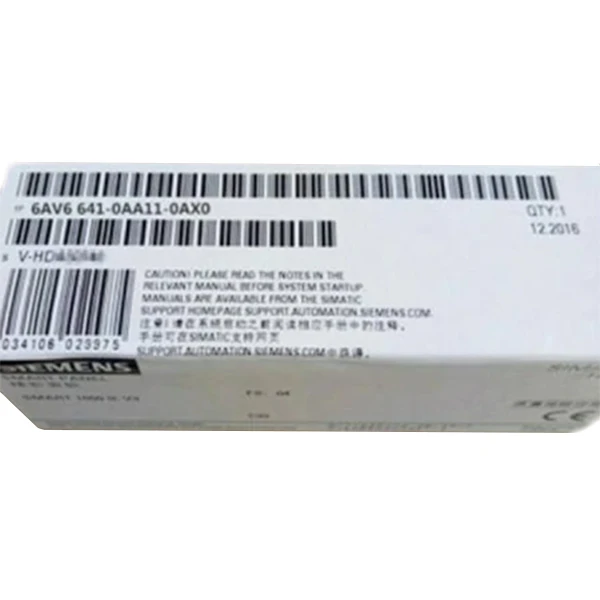
The Siemens 6AV6641 - 0AA11 - 0AX0 SIMATIC HMI is another example. It has advanced role - based access control, allowing different users to have different levels of access to the system. The device also supports data encryption for stored data, protecting sensitive information from unauthorized access.
The Siemens 6av6644 - 0ab01 - 2ax0 Simatic Mp 377 is a powerful HMI with a large display and extensive security features. It supports biometric authentication options, such as fingerprint recognition, providing an extra layer of security. The Simatic Mp 377 also has a built - in firewall that can be configured to block unauthorized network traffic, protecting the HMI from external attacks.
Conclusion
In conclusion, Siemens HMIs offer a comprehensive set of security features that are essential for protecting industrial control systems from cyber threats. From authentication and authorization to secure communication, data integrity, software updates, and physical security, Siemens has taken a holistic approach to ensure the security of its HMI products.
If you are in the market for a secure and reliable HMI solution, consider Siemens HMIs. As a supplier, I am well - versed in the security features of these products and can help you choose the right HMI for your specific application. Whether you are looking for a small - scale HMI for a simple process or a large - scale HMI for a complex industrial plant, Siemens has a solution for you. I encourage you to reach out to me to discuss your requirements and start the procurement process. Together, we can ensure that your industrial processes are protected by state - of - the - art security technology.
References
- Siemens official product documentation
- Industry reports on industrial cyber security
- Technical papers on HMI security features


